Security

Defence, would Italy be able to defend itself against drones? Here's what we know

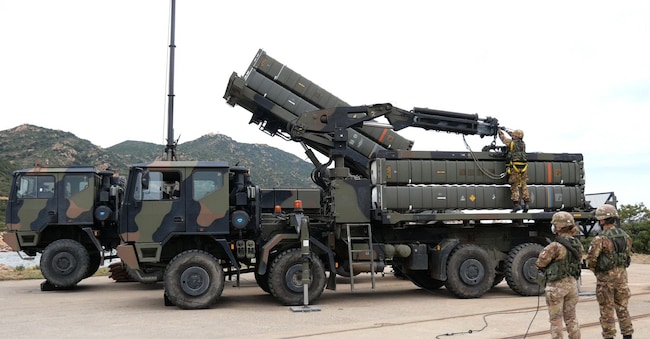
The Samp/T NG is scheduled to enter into service in 2026

by Andrea Carli

5' min read

5' min read

The latest episode is very recent. "This morning, some Russian jets violated Estonian airspace. Nato responded immediately and intercepted the Russian plane. This is yet another example of Russia's reckless behaviour and Nato's ability to respond,' Nato spokeswoman Allison Hart wrote on X. In this context, two Italian F35s took off from the Amari base, after the Atlantic Alliance radar systems detected the presence of the Russian planes, for a 'scramble', the order to take off on alert. With the overflight of the Italian F35s, which took off in 'Qra' (quick reaction alert) mode, the Russian aircraft then took off. The Italian detachment, made up of the F35s of the 13th group of the 32nd Amendola Wing and constantly on a state of rapid alert, is deployed in Estonia to ensure the surveillance of Baltic airspace as part of NATO air policing activities on the eastern flank.

The previous one

.

The umpteenth case of trespassing, which remotely follows that of a dozen Russian drones in the Polish skies, and thus in the airspace of a NATO country, places the need to deploy solutions to prevent, intercept and destroy threats from the air increasingly in the foreground. A G-550 CAEW of the Italian Air Force, which took off from the Amari airbase (Estonia), also took part in the air defence operation triggered after that episode, interpreted by the Allies as a dangerous escalation on the part of Moscow, although for others it was more of a provocation.

Loading...

A SAMP-T battery of the Italian Army, operational within the framework of the NATO Baltic Air Policing mission, was also used on that occasion. "We are neither ready for a Russian attack nor for an attack by another nation, I have been saying this for a long time. I think we have the task of putting this country in a position to defend itself if some madman decides to attack us: I'm not saying Putin, I'm saying anyone,' confided the defence minister Guido Crosetto just a few hours after the incident.

Crosetto: Italy will be able to defend itself independently in 2031 .

Interviewed by Repubblica, Crosetto went on to explain: 'How long does it take to put Italy in a position to defend itself against a possible foreign attack? My prediction is this: if, as we are doing, we take action now, I predict it will take six years. So I imagine 2031'. Crosetto referred to the country's autonomous defence, not to the NATO system. 'This is obviously,' he clarified, referring to the date of 2031, 'if we do not consider Nato and assume, which we do not, that Italy must defend itself'.

Portolano: development and acquisition of new radars capable of detecting ballistic and hypersonic threats

The game is played above all (but not only) in the skies. Where do we start from? How are we moving? At the hearing before the Defence Commission of the Chamber of Deputies on 21 May, the Chief of Defence Staff, General Luciano Portolano, said that "with regard to the air domain we will continue to support the Eurofighter 2000 and Joint Strike Fighter programmes through the acquisition of a further 24 Eurofighters to replace the first aircraft that came on line, whose operational life will end in 2029, and with the increase of a further 25 F35s, bringing the total number of Italian assets from 90 to 115, of which 75 Alfa and 40 Bravo. At the same time,' he added on that occasion, 'the development of the Global Combat Air Programme (GCAP), together with the United Kingdom and Japan, will continue, as well as the delicate sector of integrated missile air defence through the adaptation of the radar network dedicated to it, including the development and acquisition of new radars capable of detecting ballistic and hypersonic threats. Finally, we will continue with the JAMMS (Joint Airborne Multi-mission, Multi-sensor System) programme for the realisation of a multi-mission, multi-sensor airborne platform, which is necessary to significantly enhance the control, analysis, and support of operations in the electromagnetic spectrum.

Conserve: crucial to develop a robust and autonomous national defence

"The ability to defend our airspace and to project our deterrence is no longer a tactical issue but an irreplaceable strategic pillar of our freedom and our country's prosperity," emphasised Air Force Chief of Staff Antonio Conserva most recently, speaking on Thursday 11 September at a hearing before the House Defence Committee. "Today, the Air Force's direct area of responsibility extends from the lower atmosphere, where aircraft and drones operate, to outer space, where satellites orbit and hypersonic and intercontinental ballistic missiles transit," he added.

"While benefiting from the guaranteed support of the US shield," warned the Air Force Chief of Staff, "it is essential to develop a robust and autonomous national defence to effectively protect our territory, flanking and complementing that support," the Air Force Chief of Staff emphasised.

The Communication Infrastructure

.

Hence the importance of surveillance and air defence. "With ground-based radars, advanced sensors, radar aircraft and satellites," explained the general, "we constantly monitor what is happening in the sky: continuous tracking, which allows us to identify any potential threat, which is accompanied by the capacity for immediate response, through interception, missile defence and early warning systems. The enabling element of this fundamental activity is the command and control system, or more precisely, the C4ISR system, which stands for 'Command, control, communications, computers, intelligence, surveillance and reconnaissance', i.e., a communication and information infrastructure that connects the decision-making centres in real time with those operating in the field or in the sky". "This system," Conserva continued, "is what allows us to turn data into action and action into superiority.

"The Italian radar network must be modernised"

.

Among the priorities are 'long- and short-range radar sensors, which are necessary for a comprehensive situational awareness of the aerospace environment. In this area, it is therefore essential to modernise the Italian radar network, integrating long-range systems and strengthening the fleet of radar aircraft such as the Caew. At the European level, there are plans to develop joint programmes for anti-missile defence with orbital sensors and long-range radar. While at the national level, Italy is to enhance strategic and tactical surveillance over vast areas and critical sites. The integration of these systems into a common network increases the effectiveness of air defence'.

Nato, Crosetto: "Disposti a lasciare più tempo Samp/T e Caew su Fronte Est"

The Samp/T system

.

When we talk about air defence, we talk (also) about the Samp/T system, which is capable of engaging and neutralising a multitude of air and missile threats at 360 degrees. The Samp/T system, already operational in the Italian Army, Italian Air Force and French Air Force, provides a medium-range surface-to-air defence capability against aircraft and theatre ballistic missiles (TBMs). The Samp/T NG modernisation programme, launched in 2021, is designed to respond to a scenario characterised by increasingly rapid, elusive and complex threats. The new configuration includes a radically revamped engagement system and the integration of a latest-generation radar, designed to fully exploit the potential of the future ASTER 30 B1 NT Extended Capability missile. The Samp/T NG is scheduled to enter into service in 2026.


Copyright reserved ©
Loading...

Brand connect

Loading...

Newsletter

Notizie e approfondimenti sugli avvenimenti politici, economici e finanziari.

Iscriviti