Online food delivery

EU antitrust, Delivery Hero and Glovo to receive 329 million cartel fine

Record fine on Delivery Hero and Glovo for cartel in online food delivery market: the two online food delivery giants were fined a total of €329 million

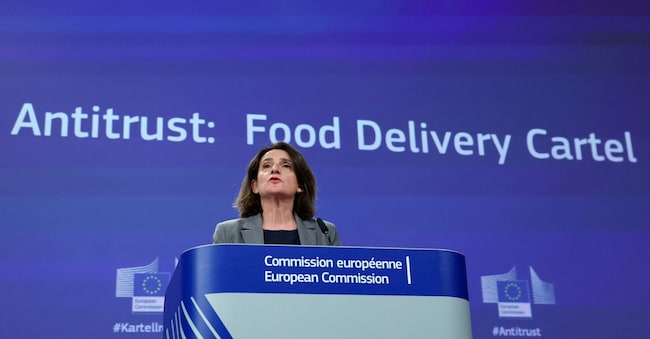
La vicepresidente esecutiva della Commissione europea per una Transizione pulita, giusta e competitiva, Teresa Ribera, parla in una conferenza stampa a Bruxelles, Belgio il 2 giugno 2025. Reuters/Yves Herman

3' min read

3' min read

The European Commission has fined Delivery Hero and Glovo, the two online food delivery giants, a total of EUR 329 million for participating in a cartel in the online food delivery industry.

In particular, the two companies have:
1 - agreed not to steal each other's employees;
2 - exchanged commercially sensitive information;
3- allocated geographic markets.

Loading...

The infringement concerned the European Economic Area (EEA) and lasted four years;

Both companies admitted their involvement in the cartel and agreed to settle the case.

This is the first decision in which the Commission has identified a cartel in the labour market and the first time it has sanctioned the anti-competitive use of a minority share in a competing company.

Delivery Hero and Glovo are two of the largest home food delivery companies in Europe. They deliver food (prepared by a restaurant or professional kitchen), groceries and other retail (non-food) products to customers who order from an app or website.

Delivery Hero brands

.

"Delivery Hero is less well known because that is actually the name of the company. But the platform names are different. They have different platforms all over the world. In Europe, they basically have a brand called Foodora, which is the name they have in Austria, for example, or in Finland or Sweden. But they also have other names in other markets, such as in Greece with E-Food, or in Cyprus with Foodie,' explains an EU official.

Corporate Transitions

.

In July 2018, Delivery Hero acquired a non-controlling minority stake in Glovo and gradually increased this stake through subsequent investments.

In July 2022, Delivery Hero acquired sole control of Glovo.

The Commission found that, from July 2018 to July 2022, Delivery Hero and Glovo progressively removed the competitive constraints between the two companies and replaced competition with multi-level anticompetitive coordination.

In particular, the two companies agreed to:

1 - do not steal from each other

.

The shareholders' agreement signed at the time Delivery Hero acquired a non-controlling minority interest in Glovo included limited reciprocal non-employment clauses for certain employees.
Little later, this agreement was extended to a general agreement not to actively contact each other's employees.

2 - exchanging commercially sensitive information

.

The exchange of commercially sensitive information (e.g. on business strategies, prices, capacities, costs and product characteristics) enabled companies to align and influence each other's market behaviour.

3 -subdivide geographic markets

.

Specifically, the two companies agreed to divide up their national markets for online food delivery in the See, eliminating all existing geographical overlaps, avoiding entering each other's national markets, and coordinating which of them would enter markets where neither was yet present.

All the above-mentioned practices were facilitated by Delivery Hero's minority shareholding in Glovo.

Details of competition law

Owning a stake in a competitor is not illegal per se, but in this specific case it allowed anti-competitive contacts between the two rival companies at different levels.

It also allowed Delivery Hero to gain access to commercially sensitive information and influence Glovo's decision-making processes, ultimately aligning the two companies' respective business strategies. This demonstrates that horizontal cross-ownership between competitors can pose antitrust risks and should be handled with caution.

The extent of penalties

.

The penalties imposed on both companies were established on the basis of the Commission's 2006 Guidelines on Penalties.

In determining the fines, the Commission took into account several elements, including:
- the multifaceted nature of the cartel;
- the fact that it covered the entire See;
- its overall duration;
- the evolution of the cartel over time, with periods of lesser intensity.
- In addition, the Commission applied a standard reduction of 10% to the fines, in line with the Commission's 2008 Settlement Notice, as both companies acknowledged their participation in the cartel and their liability.

The breakdown of the fines imposed on each party is as follows: aDelivery Hero 223,285,000 euros, aGlovo 105,732,000 euros. 

Delivery Hero is based in Germany.

It is currently present in over 70 countries worldwide, 16 of which are located in See. It cooperates with hundreds of thousands of restaurants. Delivery Hero is listed on the Frankfurt Stock Exchange.

Also Glovo, based in Spain, is a company active in home food delivery.

It is currently present in more than 20 countries worldwide, eight of which are located in the See.

In June 2022 and November 2023, the Commission carried out surprise inspections at the premises of Delivery Hero and Glovo. The investigation, initiated on the Commission's own initiative into possible collusion in the home food delivery sector, was triggered by a market monitoring exercise, which in turn was prompted by information received from a national competition authority and through the anonymous reporting tool. The investigation was formally launched in July 2024.

Any person or company harmed by the anti-competitive conduct described in this case may bring the matter before the courts of the Member States and seek damages.

Copyright reserved ©
Loading...

Brand connect

Loading...

Newsletter

Notizie e approfondimenti sugli avvenimenti politici, economici e finanziari.

Iscriviti