
'Democracy at risk, curb the power of big tech'
Entrepreneur Caltagirone and Ambassador Massolo discuss the dangers of modern elites controlling data and economic power

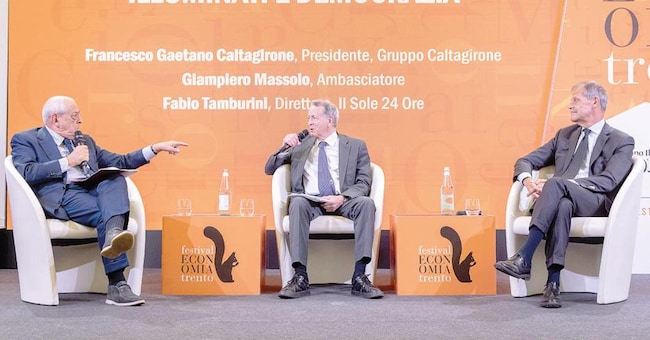
There is a red thread that starts in Ancient Mesopotamia, where a small elite led by the lugal (the ruler) held absolute power, and winds its way through the centuries to the present day. Where other minorities, with access to cutting-edge technologies and availability of economic resources, are able to condition the normal democratic process, influencing governments and overall balances. And it was around this game of historical ebb and flow that Francesco Gaetano Caltagirone, entrepreneur and president of the Caltagirone Group, and Ambassador Giampiero Massolo, vice-president of Mundys and long-time diplomat, discussed yesterday on the stage of the Trento Festival. Because, began the opening speech by the director of Il Sole 24 Ore, Fabio Tamburini, the title chosen for the panel "Illuminati and democracy" is highly topical, as the "extraordinary power" in the hands of the "so-called new illuminati today is that guaranteed by technology", with often obscure and dangerous implications.
How, then, can democracy be defended against this new threat? The countermeasures were different going back in history, Caltagirone explained. His reflection thus started from the USA where, in 1911, in order to stem the outsized growth of tycoons, the first antitrust law was enacted (the so-called Sherman law), which forced industrialist John D. Rockfeller, at the apex of a real monopoly between railways and oil, to split up his company. "He divided it into 48 companies, one for each state in the US: he chose one, Esso (then Standard Oil of New Jersey) and sold the others because it had become too big. And, in that case, democracy defended itself with a law that limited the capacity for expansion'. A very precise move, therefore, but different, stressed the number one of the Roman holding company, from the one put in place 2,200 years ago in ancient Rome. Where, in order to stem the power conquered by Scipio the Asiatic through conquests and then put on trial by the Roman Senate, it was decided to send him into exile. Because, Caltagirone recalls, as his great accuser Cato pointed out, 'with that victory you became too big and Rome too small for you'.
No one, therefore, can be too big in a society to impose himself on the collective interest. And it is an alert that, observed director Tamburini, seems to be valid also against the five big tech companies, 'whose economic weight has reached more or less that of the 27 European countries, but with a substantial difference: presidents and CEOs answer only to themselves, while the 27 are subject to a system of democratic checks and controls that is totally lacking for the big tech companies'. Ergo, it is necessary to find, Caltagirone went on to observe, 'systems to limit them but without curbing their growth'.
But how can such seemingly distant needs be reconciled? According to Massolo, the only way to avoid a very risky drift "is to find ways of managing businesses", but this must be done without hesitation since, warned the ambassador, "today those who deal with data are in a position to exert enormous influence", to the point that "the monopoly of data risks being more dangerous than that linked, for example, to oil or communications". And this is all the more true if one looks at the United States where, the vice-president of Mundys further emphasised, 'these big companies have gone from being mere platforms to service providers'. With the result 'that a handful of companies have a monopoly on key assets, from telecoms to critical infrastructure' and there is no shortage of tension between these giants and governments. But in this tight confrontation, is the reasoning put forward by the ambassador, there is a great absentee, Europe, 'which does not possess the necessary ecosystem and we watch in astonishment at what is happening in the US and China where big tech has grown to the point of seizing power, just think of Musk who has become head of the Doge (the American department for government efficiency)', while governments, overseas and elsewhere, have tried to regain control with not always positive results.
Democracy, therefore, 'is already at risk and in great pain. And if we continue like this, we are taking a big risk,' Caltagirone insisted. While director Tamburini emphasised, citing a recent Morgan Stanley study, another front of challenge linked to the multiplication of humanoid robots, with over a billion units in circulation by 2050, and then launched a final question: 'Is there a risk that new technologies could get out of our control? For Massolo, 'it is the problem of problems' and 'maintaining a dose of control is fundamental, but for this to happen, we need a dose of consensus', as well as a combination of factors that also passes through a prudent management of technological progress. Caltagirone, on the other hand, shifted his gaze again to the weakness of democracy 'which has become too slow and uncertain in decision-making'. Whereas, to achieve results, 'delegation must be broader but brief and without the possibility of immediate re-election'. Because, he concluded, a functioning democracy 'must give a lot of power to those who govern but for a short time'.


