Elections

Denmark, bitter victory for the Social Democrats, down and without a majority

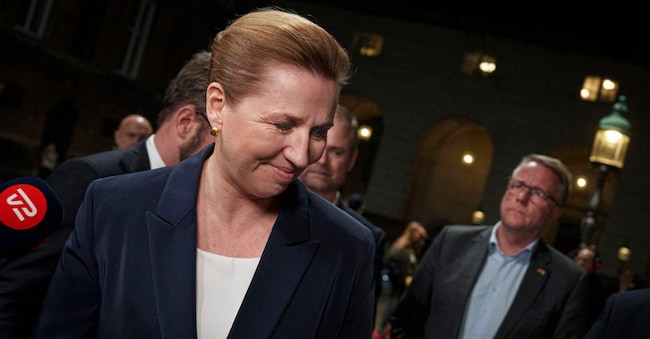
Prime Minister Frederiksen is running for a third term ('Disappointed by the votes but ready to take on the responsibility of prime minister') but her party scores its worst result in over a century. The next coalition is a puzzle, with former premier Rasmussen's Moderates the needle in the balance.

from our correspondent Michele Pignatelli

Aggiornato il 25 marzo 2026, ore 10:00

3' min read

Translated by AI
Versione italiana

3' min read

Translated by AI
Versione italiana

COPENHAGEN - The eve's polls were not wrong. The Social Democrats of outgoing Prime Minister Mette Frederiksen have won the Danish general election, albeit with their worst result since 1903: 21.9% of the vote. And forming a government coalition in Denmark's highly fragmented unicameral parliament will be very complex, as neither of the two opposing blocs, centre-left and centre-right, has a majority, with the centre-left leading by seven seats, 84 to 77 out of 179.

However, it is difficult, at least for now, to imagine the next government without Frederiksen, who would thus obtain a third term in office. Not least because his main opponent, the leader of the Venstre Liberals and current Defence Minister, Troels Lund Poulsen, has in turn obtained the worst result in his party's history (10.1%). The third government party, the Moderates of Foreign Minister and former prime minister Lars Løkke Rasmussen (,7.7%), also fell, but since they are not openly aligned with either of the two blocs, with their 14 seats they will be the needle of the scales.

Loading...

Among the other parties, on the left is the exploit of the Ecologist Left, which with 11.4% of the vote is second, on the right the overbearing return of the populists of the Danish People's Party, which rose to 9.1% from 2.6 in 2022.

The reactions

'I am ready to take on the responsibilities of prime minister,' the outgoing premier commented warmly. Of course I am sorry that I did not get more votes, but we expected it: we had to face the war, we were threatened by the American president and in these almost seven years (since 2019, the year of the start of his first term in office, ndr) we have lost four percentage points: I think it is OK.

As for Rasmussen, he called on his political opponents, both left and right, to take a step back from some of the positions they took during the election campaign and 'join us'. Denmark, said the former prime minister, "is a small country of six million people in a world of eight billion, which is in turmoil: there is war in Iran and there is war in Ukraine. We are one tribe. We must unite. We must not be divided".

The scenarios

The appeal does not seem to be making inroads for the time being, as Christoffer Hentzer Dausgaard, political scientist at the University of Coepnhagen, notes: 'It is not at all clear what will happen,' he explains, 'as the parties of the blue bloc (the centre-right) are hardening their negotiating positions: the Danish People's Party insists on not wanting to cooperate with the Moderates and Venstre insists on not wanting to cooperate with the left-wing parties (including the Social Democrats). This makes any coalition with the blue bloc parties very difficult. At the moment there is no clear path to any majority, but I would say that centre-left coalitions seem somewhat more likely.

Apart from the Moderates, the four seats (two each) allocated to the two Danish semi-autonomous territories, Greenland and the Faroe Islands, could also weigh on the final balance. So Greenland - a trigger point for the elections, since the popularity regained during the confrontation with Trump prompted Prime Minister Frederiksen to call for elections as early as March, but then proved to be of little significance in the campaign - could once again become somewhat decisive in such a tight race. To the advantage, probably, of the centre-left bloc, since the Greenlandic MPs would hardly support a government with the populists of the Danish People's Party, whose leader, Morten Messerschmidt, has dismissed the hypothesis of an independent Greenland as 'absurd'.

La premier danese in Groenlandia incontra il capo del governo locale

Campaign themes

Economic issues, especially the cost of living, dominated the campaign, which perhaps explains the overall negative performance of the government formations. As for the ecologist Left's exploit, it was probably also driven by the weight that certain environmental issues had during the campaign, from the quality of drinking water, threatened by pesticides, to intensive pig farming. As for the populists, they most likely managed to re-appropriate the migration theme, also present in the campaign, which Frederiksen's hard line had in the past years depreciated. "

"In a parliament that shows the greatest fragmentation ever," concludes Hentzer Dausgaard, "the big winner is the Danish People's Party, which has tripled its share of the vote.

Negotiations to form a government are therefore inevitably going to be lengthy. Analysts speak of weeks, if not months.

Copyright reserved ©
Loading...

Brand connect

Loading...

Newsletter

Notizie e approfondimenti sugli avvenimenti politici, economici e finanziari.

Iscriviti