Disputed island

Greenland, Denmark: 'We could not convince the US'. Trump: 'We will find solution'. European countries send military

Today 50 minutes of face-to-face talks between US Vice President Vance and Secretary of State Rubio and Danish and Greenlandic diplomacy aiming to convince Trump to give up annexation in exchange for concessions

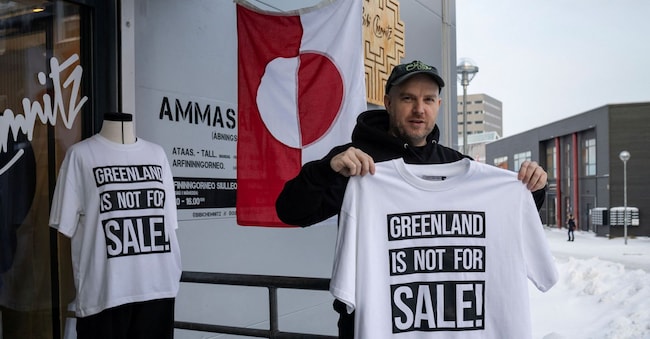
Il proprietario di un negozio, David Rogilds, mostra una maglietta che vende a Nuuk, in Groenlandia, il 14 gennaio 2026. REUTERS/Marko Djurica

4' min read

Translated by AI
Versione italiana

4' min read

Translated by AI
Versione italiana

"We are ready and willing to do more" for security in the Arctic. The United States already has 'extensive military access' to Greenland and can ask to increase its presence, and any request from Washington will be 'examined' constructively. So said Danish Foreign Minister Lars Lokke Rasmussen after his meeting in Washington with Vice President JD Vance and Secretary of State Marco Rubio. Following the summit, Rasmussen admitted that 'so far we have not succeeded in getting the US to change its position', adding that 'it is clear that the president has this desire to take over Greenland, and we have made it unequivocally clear that this is not in our interest'.

On the issue, US President Trump stated: 'I think a solution will be found'. The tycoon also assured that he had 'a very good relationship' with Denmark and repeated that Greenland 'we need it for national security'.

Loading...

Trump had previously refused to rule out the use of military force to obtain the world's largest island, claiming that the US needs it for defence. Rubio retracted these statements, claiming that the goal is to acquire Greenland. The Danes have stated that it is not their right to sell it, and the Greenlanders that there is no amount of money that can buy their land. At a press conference in Washington, Greenlandic Foreign Minister Motzfeldt said: 'We do not want the United States to control us'. The Danes argue that a comprehensive defence agreement dating back to 1951 already allows the United States to use the territory at will for defensive purposes, making any acquisition unnecessary.

On Wednesday Trump, in a post on Truth, had declared the necessity of Greenland for US national security, adding: 'Nato becomes much more formidable and effective with Greenland in the hands of the US. Anything below this is unacceptable'. The Arctic island 'is crucial for the Golden Dome we are building. NATO should pave the way for us to get it. If we don't do it, Russia or China will, and that cannot happen! Militarily speaking, without the vast power of the United States, NATO would not be an effective force or deterrent, not even close!"

"Which side, Greenland man?" the White House then asked in a provocative image posted on its institutional profile. Indeed, the official White House profile posts an image showing what it believes to be the choice facing Greenland (represented by two dog sleds): it can either side with the United States and enjoy a bright future or face a storm represented by the joint forces of Russia and China.
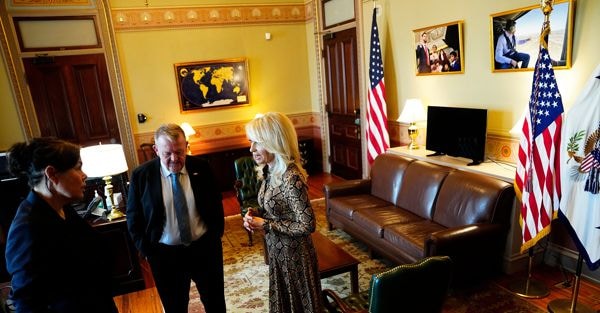
Il ministro degli Esteri danese Lars Loekke Rasmussen, al centro, e il ministro degli Esteri groenlandese Vivian Motzfeldt, a sinistra, si accingono ad incontrare il vicepresidente J.D. Vance e il segretario di Stato Marco Rubio alla Casa Bianca a Washington D.C. mercoledì 14 gennaio 2026. (Mads Claus Rasmussen/Ritzau Scanpix via AP)

Different European countries send soldiers to Greenland

Meanwhile, the Danish government is sending military equipment and vanguard units to Greenland, so that the island will be ready to receive larger forces from the Danish army. This was reported by the Danish broadcaster DR. Initially, DR explains, a so-called forward command has been sent to Greenland, whose task is to ensure that the logistics and environment are ready to receive any reinforcements at a later date.

In addition to the Danish forces, a detachment of Swedish army officers arrived on the island. "A number of officers from the Swedish Armed Forces are arriving in Greenland today. They are part of a group from several allied countries," pSwedish Prime Minister Ulf Kristersson announced in a post on X. "Together they will prepare the next phases of the Danish exercise Operation Arctic Endurance," he added, pointing out that the sending of troops is "at Denmark's request". Norway will also send two military officers, according to a Defence Ministry spokesman in Oslo.

In the evening of 14 January came the news, leaked by Bild citing German and Scandinavian sources, that Germany will send the first soldiers to Greenland as early as this week. A Defence Ministry spokesman replied that he could neither confirm nor deny the news. France will also participate in the military mission to Greenland coordinated by Denmark, according to the army.

Brussels aligned with Greenland's will

The EU leadership is also on the move. The Greenlanders 'can count on us', said EU Commission President Ursula von der Leyen, after President Trump's threats to take over the Arctic island and while an important summit on the future of the semi-autonomous territory under the Kingdom of Denmark is expected at the White House.

"We respect the will of the Greenlanders and their interests," von der Leyen added at a press conference in Brussels, explaining that Greenland is part of NATO and, when we talk about security in the Arctic, this is one of the Alliance's central themes.

Against this backdrop, the Conference of Presidents (CoP) of the European Parliament also approved by a large majority a declaration of full support for Greenland and Denmark. "Any attempt to undermine the sovereignty and territorial integrity" of Copenhagen and Nuuk "violates international law," reads the text, adopted on the initiative of the Socialists and Democrats. The group leaders "unequivocally condemn the Trump administration's statements" which "constitute a blatant defiance of international law, the principles of the UN Charter and the sovereignty and territorial integrity of a NATO ally. Such statements are unacceptable and have no place in relations between democratic partners'.

The position of major European countries

Also from France, which will open an embassy in Greenland on 6 February, come concerned statements. US President Trump's intentions on Greenland "must be taken very seriously", said French Prime Minister Sebastien Lecornu speaking at the National Assembly. France is 'in full solidarity with Denmark and the legitimate authorities of Greenland,' Lecornu added.

From Berlin come even darker comments. "The transatlantic relationship we have known so far is dissolving, we are experiencing a phase of historical change in which all the certainties we could rely on in Europe are being put under pressure," said Federal Vice-Chancellor and Finance Minister Lars Klingbeil speaking at an initiative of the German Institute for Economic Research (Diw).

Klingbeil referred to the recent US statements on Greenland and the new national security strategy: 'the transatlantic alliance is facing a much deeper change than we may have wanted to admit'. The vice-chancellor added: 'anyone who reads the Trump administration's new national security strategy realises that the US administration continues to move away politically and culturally from Europe. The strategy and actions could almost be interpreted as a challenge to the European Union and our liberal democratic order'.

Copyright reserved ©
Loading...

Brand connect

Loading...

Newsletter

Notizie e approfondimenti sugli avvenimenti politici, economici e finanziari.

Iscriviti