Design, despite the bombs: Ukraine holds out even so
Young people's tales at the Salone del Mobile stands. Open factories, amid mourning, devastation and blackouts

4' min read
4' min read
"How many dead? Perhaps you mean how many killed'. Michayl's face hardens, even his tone becomes harsher. And with good reason, in the light of the ill-posed question about his company's casualties.
Talking to the factory manager of Dniprovud, part of the Veneto group, is a stark reminder of reality and the recovery of a correct perspective. With the theme of duties, so pervasive and all-encompassing in the dialogue with Italian companies, fading into the distance and becoming a faint background noise in the face of the suffering and pain experienced every day, for the past three years, by the Ukrainian people and the many companies that continue to produce in spite of the framework of continuous emergency.
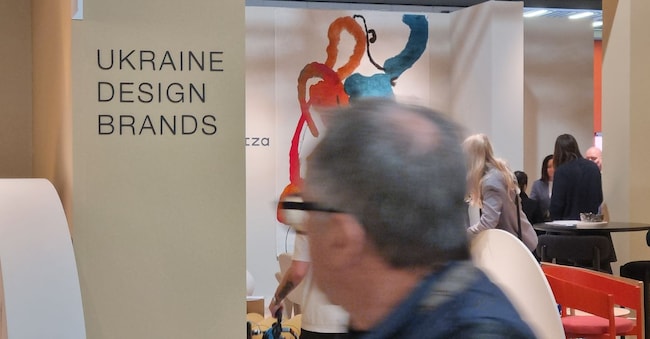
The joint stand gathering 13 Kiev companies at the Salone del Mobile is a sample of pride but also of optimism, despite everything. A simple, sparse stand, with linear productions and objects, perhaps somewhat removed from our taste. And yet capable of conveying more emotion than the large neighbouring stands costing hundreds of thousands of euro. Consistent with a world, ours, richer but above all luckier, geographically far from Putin's Russia.
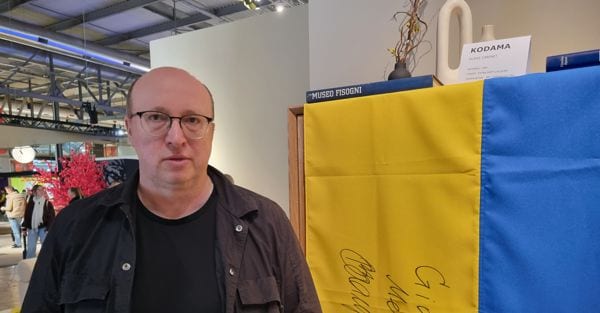
To be here, with products made amidst mourning and bombs, is something of a minor miracle. For it is first and foremost factory life that has to adapt. 'With shifts disrupted,' Mikhayl explains, 'to produce at night and take advantage of the possibilities offered by the battered electricity grid. Even if quality,' he observes, 'is jeopardised by the difficulties of night work, the higher error rate, the tiredness of the people'. But what is necessarily changing in the companies is also the workforce, which has changed in a few years by inverting the 60-40 ratio between men and women, taking into account the forced absences of the male population, which often turn into permanent vacancies.
"Eight people from our factory were killed in the war," Mikhayl explains, "but all of us in Ukraine know someone who has lost a relative or an acquaintance. People killed, not dead. Because it is different. And the words we use define reality'.