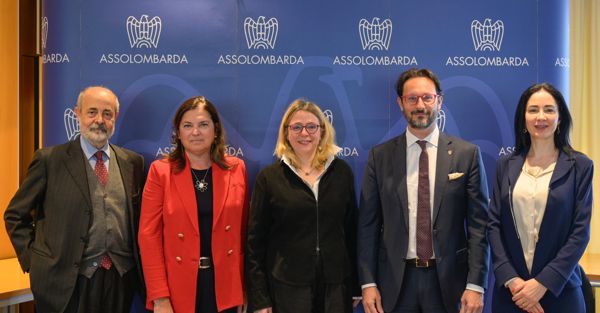
'Legality and Enterprise,' explains Alvise Biffi, President of Assolombarda, 'is a strategic project because it focuses on a decisive factor for the future of Milan: the quality of rules as a lever for development. Today the city is at a turning point: after years of growth, it is facing a more complex phase. This is why we have to look at Milan as a 'Greater Milan', an ecosystem that integrates industry, services, finance, research and education, overcoming administrative boundaries. In this scenario, legality becomes an enabling condition for attracting and retaining talent, accompanying the great urban and productive transformations, and, above all, supporting the competitiveness of businesses, which represent the heart of the city: I recall that we are the first Lombardy province in terms of GDP with 245 billion euro of value out of the regional total of almost 517 billion euro. Only by strengthening the relationship between institutions and the economic system can we build effective solutions and consolidate Milan's role as a laboratory of innovation and growth for the country'.
'An initiative that expresses a just commitment,' comments Deputy Mayor and Councillor for Urban Regeneration, Anna Scavuzzo, 'in line with the Ambrosian spirit that has allowed the development and growth that characterises our great Milan. An economic system grows in a healthy way if rules are respected, if legality and justice underpin trust between operators and allow fair competition. The correlation between economic development and social development is clear and allows us to be a community that promotes sustainable economic growth. Doing business in an ethical and transparent manner is a strategic choice, it is not limited to being the response to a regulatory obligation, but is a commitment to generate value in a healthy way so as to contribute to the development, including the social and environmental development of our territories; a choice that the public administration promotes with conviction and for which it shares the responsibility'.
"Milan," added the Rector of the Università Statale di Milano, Marina Brambilla, "can today be considered a polycentric ecosystem, in which the ability to compete globally will increasingly depend on the quality of the dialogue between universities, industry, institutions and the third sector. In this context, the University of Milan accepts the invitation of Assolombarda, which with the 'Legality and Enterprise' project invites us to contribute to the construction of a new stable space for dialogue between the players in the area. In the wake of our civic mandate, we will continue to work to promote balanced and sustainable development, capable of holding together economic growth, social innovation and legality. If Milan wants to strengthen its role as a laboratory of the future, the universities are called upon to play their part to the full: the Statale will not fail to make its contribution and its deep connection with the city'.
"Justice,' said the President of the Gip-Gup section of the Court of Milan, Vincenza Maccora, 'does not represent an abstract system, living in an 'ivory tower' separate from the other institutions of the country, but is an integral part of a broader and more complex system of rights, duties, powers and responsibilities that permeates the entire social and economic life of the country, contributing to its development On the occasion of the recent referendum on Justice, we noted the lively interest of citizens in understanding both general and particular issues involving the administration of jurisdiction together with the demand for an efficient, timely and transparent jurisdiction. The contribution of the Court of Milan to the Project goes precisely in this direction'.
The project will be divided into four working tables dedicated to the city's economic development, language and information, public administration and quality of services, and clarity and quality of the regulatory framework. The tables will have the task of developing in-depth analyses, identifying critical issues and areas for improvement and drafting policy proposals and recommendations, contributing to the construction of a shared framework on the relationship between legality and development.