
Digital advertising: Rai and Mediaset call on the web’s major players to ensure transparency
The Ce.R.T.A. at the Catholic University is scrutinising the promises of online advertising. Cardani (Mfe Advertising): ‘The market needs the certainty of third-party, independent metrics’. Poggi (Rai Pubblicità): “We have something that others will never have: our audiences.”

A market heading towards one trillion euros, and one question: is digital advertising really as precise, measurable and efficient as it’s made out to be?
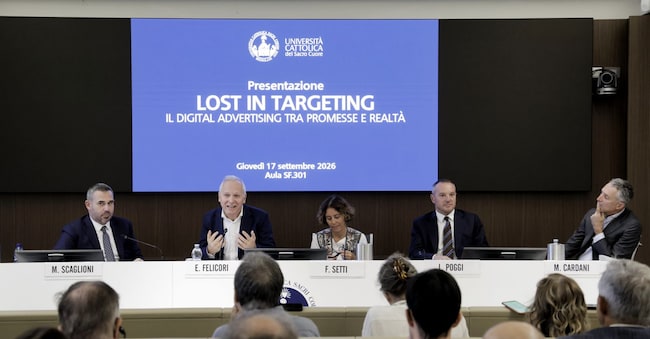
This is the starting point for *Lost in Targeting*, a publication by Ce.R.T.A. (the Centre for Research on Television and Audiovisual Media at the Catholic University of the Sacred Heart), published by Link/RTI. The launch took place at Cattolina and, following opening remarks by Scaglioni and Fabio Guarnaccia (Director of Link, Strategic Marketing at RTI), a panel discussion was held featuring Edoardo Felicori (Region Media Manager for Italia at Ferrero), Federica Setti (Chief Data Technology Analytics Officer at WPP Media), Luca Poggi (Managing Director of Rai Pubblicità) and Matteo Cardani (Chief Marketing Officer at Mfe Adv), with closing remarks by Federico di Chio (Senior Vice President of International Strategic Marketing at Mfe).
In essence, the key message of *Lost in Targeting* lies in the belief that the question of the accuracy, measurability and efficiency of digital advertising is less theoretical than it seems. This is also evident from the figures it highlights: Alphabet, Meta and Amazon control almost 70 per cent of the digital advertising market; more than half of internet traffic is generated by bots; and 60 per cent of every euro invested in programmatic advertising is retained by intermediaries in the supply chain before reaching the consumer.
The research centre at the Catholic University is thus seeking to understand what remains, when put to the test of the market, of the promises that accompanied its rise. The research draws on scientific literature, documents from the major platforms and interviews with leading figures in the Italian advertising industry. It scrutinises three key pillars: brand, audience and medium.
The first short circuit, according to the study’s findings, concerns targeting itself. Targeting consumers with ever-greater precision means tapping into existing demand. Building a brand, on the other hand, also means creating it, by working over time to build brand awareness, reputation and the collective imagination. And when the audience is broken down into a multitude of micro-targets, something is likely to get lost along the way.


