The Memory of Objects/Quinta Puntata

Digitisation and physical architecture: the archive is living matter

A journey into the heart of two companies that have written the history of Italian design and invest in the collection and organisation of materials, sketches, prototypes, objects.
by Antonella Galli

4' min read

4' min read

Luca Fuso: 'Being radical in today's homes'.

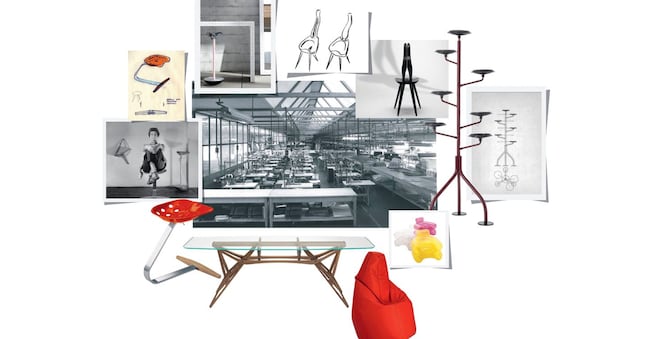
"The archive is always an asset, it is never a burden," begins Luca Fuso, managing director of Cassina and Zanotta. The emblematic company of radical Italian design, acquired by Cassina just two years ago, still has pieces in production such as the Sacco armchair (Gatti, Paolini, Teodoro, 1968), the Sciangai coat stand (De Pas, D'Urbino, Lomazzi, 1973), the Mezzadro stool (Achille and Pier Giacomo Castiglioni, 1957), the Quaderna series (Superstudio, 1972), the Tonietta chair (Enzo Mari, 1985). The list is long - practically the history of Italian design. But it's a legacy that doesn't frighten, on the contrary: "It's lucky to have it," confirms Fuso. "The company's DNA is generated from there and it is a source of continuous inspiration. You just have to go back to see what has been done and find great benefit from it, either by reissuing pieces made in the past or taking inspiration for new models". Zanotta's archive is tidy, but not a physical place: "It includes over 650 products, of which we have all the drawings and photos. Even if we don't have all the pieces, we can trace them back to those who own them, because Zanotta is part of the history of Brianza and as such is experienced by those who bought and still own the products". The company started making designer furniture from 1964 onwards, and since then it has been possible to trace back almost all the pieces put into production. "After the acquisition by Cassina, as a first step we studied Zanotta's record well to define which pieces best identified the brand and which we could reissue," he continues. In 2024, it was the turn of the Dealbata vases and the Cuculia bowl by Alessandro Mendini (designed between 1985 and 1986); at the same time, the Blow inflatable armchair by De Pas, D'Urbino, Lomazzi was exhibited as a prototype. "This year we are proposing it as a real product, in a limited series," reveals Fuso.

Loading...

Luca Fuso: «Essere radicali nelle case di oggi»

Photogallery12 foto

But Zanotta's is not a pure revival of the golden age of Italian design, quite the contrary. "We do not rely on the archive, although it is important as a source. There is always the combination with new projects. Zanotta represented radical design, but to remain faithful to this identity, we have to adapt to the spirit of today. Houses are no longer what they used to be, we no longer produce objects that are only beautiful'. In this sense, the choice fell on Fien Muller and Hannes Van Severen, two Belgian creatives: "They are radical as people and as thinking, applied to the present moment. They have a creative and functional approach'.

Giulia Molteni: 'A living entity traversed by many red threads'.

The value of the archive for a group like Molteni, with over ninety years of history, is plastically expressed in a physical place, an identification pole open not only to insiders, but to all those who wish to visit it: this is the Molteni Museum, located in the Giussano Compound (Monza and Brianza), next to the company headquarters and showrooms. After ten years of existence, the museum presented, last March, a new installation curated by Ron Gilad, also designer of the building, an ethereal glass cube. The title of the new exhibition is Museum 2D and is dedicated to the history of graphic design and communication of the Molteni Group (Molteni&C, UniFor and Citterio). A journey through the history of design, but without objects: rather, it is about photographic campaigns, graphic design, advertising, catalogues, even gadgets and invitation cards. There are also photographic series by authors such as Gabriele Basilico, Mario Carrieri, Luigi Ghirri, Leo Torri and Miro Zagnoli. An excursus that shows the all-round value of communication, the language a company chooses to address the world. And which reveals so much about its own identity. "The archive sees in the Molteni Museum its primary expression," says Giulia Molteni, the third generation marketing and communication director of the Group. "Many red threads unravel in our ninety years of history, and with the synergy between museum and archive we have the opportunity to communicate a part of us each time". The work done on the archive front is truly impressive: 'It is housed in the Compound. We have divided it into two sections: the one dedicated to Molteni&C and the one concerning the historical Dada material (kitchens).

Giulia Molteni: «Un’entità viva percorsa da tanti fili rossi»

Photogallery11 foto

The UniFor archive is located in Turate while Citterio's historical materials are in Sirone'. The entire corpus has been divided into different sections, then into thematic groups in order to be able to easily use the preserved material. "Since 2013, digitisation work has also been underway to enable targeted and in-depth research. The materials are all connected through a three-dimensional architecture, made up of connections between products, events, designers, historical periods. To this research architecture corresponds a physical architecture. This is proof that the material acquires value thanks, above all, to the way it is organised. The archive is open to collaborators, but also to researchers and universities. "For us it is a living entity," Giulia Molteni concludes. "It is an ongoing project, which is also tackling the problem of preserving the present. You don't think about it, but in the digital age, in which everyone is connected and the flow of information is continuous, preserving the memory of things is the real challenge.

Copyright reserved ©
Loading...
Loading...

Newsletter

Notizie e approfondimenti sugli avvenimenti politici, economici e finanziari.

Iscriviti