Hospitality industry

Dimora Camille, the former farmhouse turned into a hotel and spa in unspoilt Sicily

Situated just a stone’s throw from Scicli’s monumental Baroque architecture, the property opened its doors this June on the initiative of Sammi Coubeche and the architect Viviana Haddad

by Laura Dominici

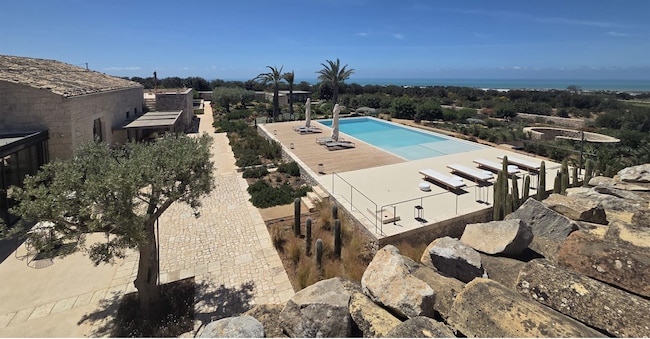
Dimora Camille vista dalla terrazza

5' min read

Translated by AI
Versione italiana

5' min read

Translated by AI
Versione italiana

There is a distinctive light that bathes the countryside around Scicli, a warm hue that reflects the golden glow of the local blonde stone. It is here, in this UNESCO-protected corner of eastern Sicily, in the Spinazza district, that Dimora Camille stands – a hospitality venture that is not merely a restoration, but a layering of stories, journeys and moments of tranquillity.

The project

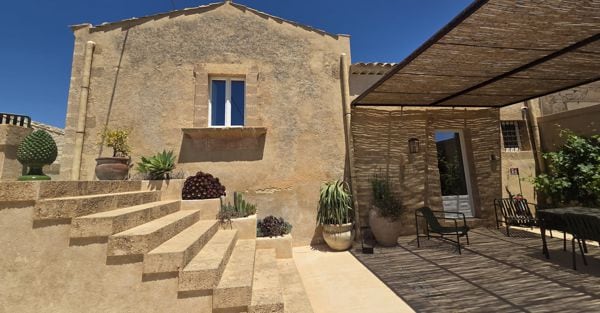
Situated just a stone’s throw from the monumental Baroque architecture of Scicli and the cerulean waters of Donnalucata and Sampieri, the property – which opened its doors to guests this June – has risen from the ashes of a mid-19th-century farm. The dates carved into the stone provide a precise chronology: 1851 for Villa Spinazza, a country residence used by the owners during the harvests. Following the unification of Italia, further buildings were added, including the Palmento, built in 1875 and dedicated to the traditional production of olive oil. The feeding troughs set into the ancient dry-stone walls bear witness to the farm’s livestock-rearing activities. Then came a period of silence that lasted almost a century.
Loading...

The meeting: an eight-year dream

The revival began in 2015, when Sammi Coubeche – a cosmopolitan spirit with African roots and a European upbringing – discovered these ruins. Despite the collapsed roofs and the wild nature that had reclaimed the site, Coubeche sensed its soul. To bring this vision to life, she turned to the expertise of architect Viviana Haddad, who has a deep understanding of Sicily, where she has lived for 25 years.

“I ended up in Modica by chance, having come from Milan,” says architect Viviana Haddad, “where I was working at the Polytechnic and conducting research into materials. I was struck by the beauty of this area and decided that this was where I belonged: I had to look after this land by restoring existing buildings and preserving the Sicilian way of life.” In the case of Dimora Camille, the partnership between the owner and the architect resulted in a complex conservation project that lasted a full eight years. The challenge was a bold one: to preserve the rural identity of the farmhouse whilst enriching it with a natural cultural fusion. The building site was transformed into a permanent artisan workshop, where local craftsmen worked closely with the clients to source materials, furnishings and details that spoke a universal and timeless language. An undertaking that required, as the owners emphasise, ‘stubbornness, vision and perseverance. A huge labour of love for a land that demands incredible resilience, where everything you plan is constantly thrown into disarray and you need a great ability to create synergy between people to achieve the goal’.

Architecture and Interiors: the poetics of emptiness and matter

Dimora Camille is characterised by an interplay of volumes that respect the topography of the rocky terrain. The property, comprising three rooms, one suite and four apartments, welcomes guests into an atmosphere of understated luxury,
Inside, texture takes centre stage: the floors range from the austere simplicity of local stone to the opulence of Venetian terrazzo, whilst ceramics and natural fabrics add a tactile dimension to the spaces.
“Almost all the furniture, from the bedside tables to the benches, right through to the writing desk and wardrobes, has been specially designed,” explains Haddad. They were crafted by DiSé mobilieri di pregio, a company based in Grammichele led by Giampiero Corallo, a cabinetmaker who has successfully transformed Sicilian craftsmanship into a bespoke added value, capable of perfecting every minute detail. Here, every detail, from a door lock to a small hinge, has been designed to make each piece unique.” Every room is a tribute to tradition reimagined: the ‘Camera Canne’ is a stylistic exploration of rural heritage.
‘The thatched roof is a traditional technique of the area,’ the architect explains, ‘as olive trees were not felled for timber. We gathered the reeds along the River Irminio under a full moon, leaving them to season for a year, before tying them with twine dyed with natural essences such as tea and finished with linseed oil, evoking a sense of natural seclusion and a weave that almost recalls the atmosphere of Bali.” The first-floor suite opens out onto the landscape like a privileged vantage point over the countryside and the sea. The apartments, christened with evocative names such as ‘Mare’ and ‘Patio’, offer an experience of time standing still, ideal for those seeking a homely and private retreat.
The use of materials is a tribute to ‘zero-kilometre’ sourcing and the philosophy of wabi-sabi: “We’ve used reclaimed stone that still bears the marks of the hand-saws of yesteryear, alongside local natural lime, cocciopesto and cement tiles featuring extremely rare oriental motifs,” continues Haddad. ‘Here, imperfection is beauty: the materials age over time just like our skin, becoming part of the place’s history.’

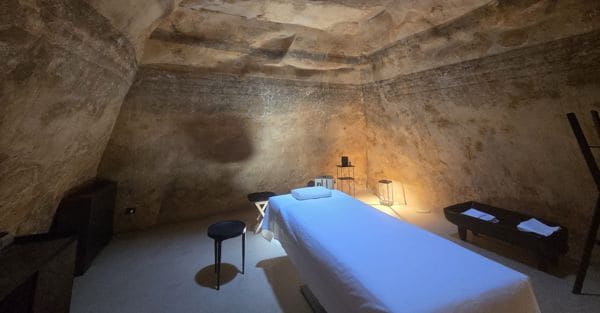
La sala dei trattamenti Spa

Well-being as an extension of the landscape

The sensory heart of the Dimora is the wellness area. Here, the architecture takes on an underground character: the massage room has been created within a spectacular ancient irrigation cistern, hewn directly out of the rock. ‘The inspiration came from St Patrick’s Wells,’ reveals Viviana Haddad, ‘the aim was to create an underground spa that would nevertheless enjoy natural light and a constant flow of fresh air. It was almost an archaeological undertaking to clear the cistern of earth; today, thanks to an invisible dehumidification system, the air is perfectly fresh, as if there were a window always open onto the rock.’ The hammam, decorated with exquisite zellige (small polished tiles), complements the sauna and the modern Technogym-equipped fitness centre, whose large windows blur the boundary between indoors and outdoors. The infinity pool, surrounded by a minimalist solarium, acts as a mirror of water reflecting the Sicilian sky, becoming the link between the built environment and the surrounding nature.

The garden: an open-air room

The landscaping, an integral part of the sensory experience, is not merely a backdrop. The Mediterranean gardens at Dimora Camille offer an olfactory and meditative journey: visitors stroll through the citrus grove, the vegetable garden and the orchard, surrounded by the scent of aromatic plants. ‘We have worked to maintain continuity with the landscape of the local quarries,’ comments the architect. ‘The rock garden, previously buried beneath the earth, has been brought back to light, revealing feeding troughs that run along the dry-stone walls like a graphic motif. We have planted grasses that sway in the wind, creating a sea of greenery, alternating them with sculptural species such as cacti or rare plants sourced from historic nurseries such as Vivai Cuba in Syracuse. It is an ongoing dialogue, where the human hand and nature know no boundaries.” A particularly charming corner is the rock and succulent garden, a Zen-like retreat where the mineral composition of Scicli’s soil takes centre stage.

La Dimora is designed as a laboratory of experiences: from cooking classes dedicated to local flavours, to yoga sessions overlooking the sea, right through to private dinners prepared by local chefs. The stay includes breakfast. A personal trainer, beauty treatments and local experiences and tours are also available on request. A project where ‘the ultimate connection is the human being: whether you’re in Africa or Sicily, the gesture of the hand shaping the material to create beauty is the same. Dimora Camille tells the story of this union’.

Copyright reserved ©
Loading...

Brand connect

Loading...

Newsletter RealEstate+

La newsletter premium dedicata al mondo del mercato immobiliare con inchieste esclusive, notizie, analisi ed approfondimenti

Abbonati