
Diplomacy as the art of speaking to one’s enemies and understanding the world

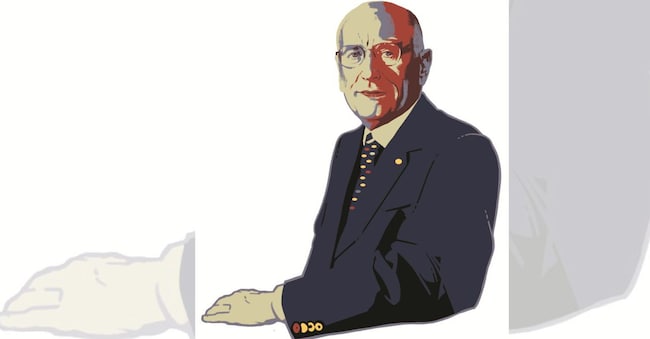
‘The international landscape has changed. The conflict between the United States, Israel and Iran is reshaping it according to new balances and with new points of friction. The Russian war in Ukraine is a source of instability. China has assumed a central role that it did not have as recently as fifteen years ago. One principle remains valid in the traditional lexicon of diplomacy: channels of communication with enemies must always remain open. I have fulfilled this role twice: to break the silence. Once with China. Once with Iran. I did so with the discreet autonomy of someone who knows their counterparts, whilst coordinating with and remaining subordinate to the political authorities.”
Umberto Vattani epitomises the tradition and culture of the 20th-century Italian diplomatic corps, one of the country’s invisible pillars and a silent bulwark against political instability and institutional fragility. We are at the Circolo degli Esteri, on the left bank of the Tiber: a lush green space and a setting frequented by the upper ministerial middle classes, a world away from the ostentation of luxury watches and the less-than-fluent Italian that characterise the aesthetic and language of Rome’s other, better-known ‘clubs’. At the restaurant, several colleagues approach him to greet him: ‘Ambassador, I’ve just returned from the Balkans,’ says one of them, little more than a lad. And another, of a more mature age: ‘Umberto, it’s a pleasure to see you. As you know, I’m off to Africa in September.’
Vattani has twice held the post of Secretary-General for Foreign Affairs. He has, in fact, shaped at least two generations of diplomats and has had such a profound influence on the Farnesina that he has filled its offices and corridors with works of modern and contemporary art, in a blend of private passion and public life that, for once, was functional and positive rather than voracious and a prelude to strange instances of misappropriation. His father, Mario, was consul in Skopje, the third consulate opened by Galeazzo Ciano in the Balkans, alongside those in Zagreb and Ljubljana. He himself was born in Skopje. His mother, Angela, had the Venerable Gizzi De Santis in her family tree. ‘I started out in the research department of Guido Carli’s Bank of Italia. I’ve always had a keen interest in mathematics. At the age of nine, whilst at a Jesuit boarding school in Paris, my classmates and teachers treated my brother Alessandro and me like outcasts because we didn’t know French and so, in every subject, we were given marks of zero. I weathered the hostility thanks to maths, in which I excelled, benefiting from my aptitude and the subject’s status as a lingua franca. But the lure of diplomacy was too strong. At home, we talked of nothing but geopolitics,’ he says.
The tables are spaced apart. All the diners are speaking in a normal tone of voice. The windows look out onto the garden. The waiter in livery brings us both a plate of culatello and buffalo mozzarella. On his recommendation, we order a Verdicchio to drink. Italia was the first Western country to break the isolation of China imposed by the Western bloc following the crackdown on 3 June 1989 in Tiananmen Square. Vattani adds: ‘The same thing happened with Iran. On 17 September 1992, a commando unit in Berlin entered a bar, the Mykonos, and killed four members of the Iranian Kurdish Democratic Party, including its leader Sadegh Sharafkandi. The Germans arrested the perpetrators. In 1997, judges in Berlin convicted them, ruling that the order had come from Tehran. The European Union, at Germany’s instigation, isolated Iran. We Italians resumed dialogue. If you don’t talk to your enemies, who do you talk to?’”
The heat of last summer makes one drink more mineral water than wine. Vattani clarifies a concept and picks up the thread of his argument: ‘We are a people of Christian culture. Dialogue with everyone is an element of Catholic cultural universalism. It is so from a doctrinal point of view. And it is so in the tension between universality and everyday life, absolute values and relative interests, the international order and the policies of individual countries. I was a diplomatic adviser to Prime Minister Giulio Andreotti, who, with his down-to-earth sophistication, often said, ‘In this world, there are no angels and there are no devils.’"


