Biennial

Diriyah, art as geography in motion

Third edition interweaves migration, memory and technology to rewrite the cultural maps of the Gulf between political ambition and global visions
by Maria Adelaide Marchesoni

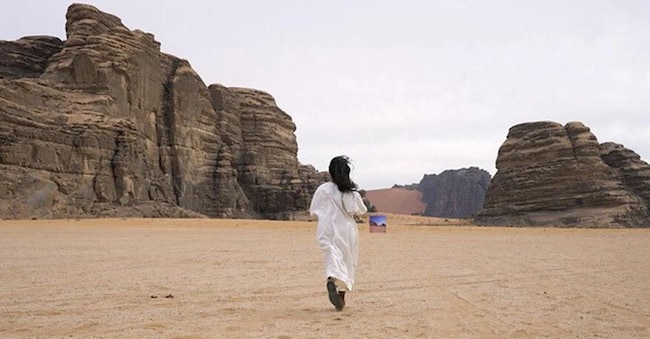
Ahaad Alamoudi, «The Run», 2025, fotogramma dal film. Per gentile concessione dell'artista

5' min read

Translated by AI
Versione italiana

5' min read

Translated by AI
Versione italiana

In the ongoing reshaping of global cultural geographies, Saudi Arabia is increasingly emerging as one of the strategic areas in the Gulf. In this scenario, the Diriyah Contemporary Art Biennale - now in its third edition - is a cultural device capable of catalysing international attention, transnational artistic practices and long-term political ambitions. From 30 January to 2 May 2026, in the spaces of the JAX District in Diriyah, a historical site on the outskirts of Riyadh, the Biennial thus becomes a privileged observatory to read the Kingdom's cultural ambitions to become a full part of contemporary symbolic geographies.
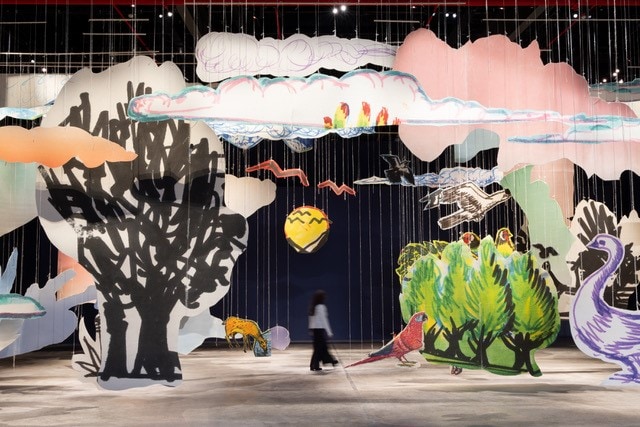
Petrit Halilaj, «Very volcanic over this green feather», 2021, veduta dell'installazione. Per gentile concessione dell'artista e della Fondazione Biennale di Diriyah; fotografia: Alessandro Brasile

Entitled 'In Interludes and Transitions' - a phrase from colloquial Arabic evoking the ebb and flow of nomadic life in the Arabian Peninsula - the exhibition explores themes of migration, cultural exchange and interconnectedness. The two artistic directors Nora Razian and Sabih Ahmed presented a wide-ranging and international selection with over 65 artists from more than 37 countries, including historical names and emerging contemporary voices, as well as 25 new commissions.

Loading...

There are no Italian artists at the Diriyah Biennial, but the set design for the entire exhibition was created by the Formafantasma design studio, which reinterpreted the industrial architecture of the JAX creative district as a composition light in colour and fluid in its flat shapes and curved passages, accompanying visitors through the 12,900 square metres of exhibition halls, courtyards and terraces.
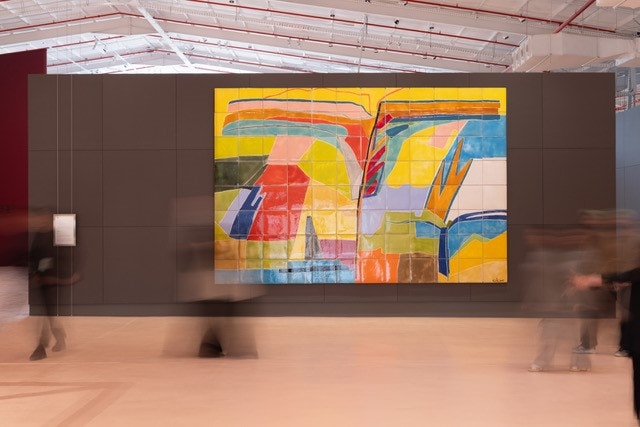
Etel Adnan, «Untitled» (2020_2024). Photo by Alessandro Brasile, courtesy of the Diriyah Biennale Foundation

The curatorial theme: movement, migration

The Biennial conceives of the world not as a fixed place, but as a set of "processions", interpreting life as a continuous passage and transformation: political conditions before aesthetic ones, inspired by the nomadic traditions of encampments and travels in the Arabian Peninsula.

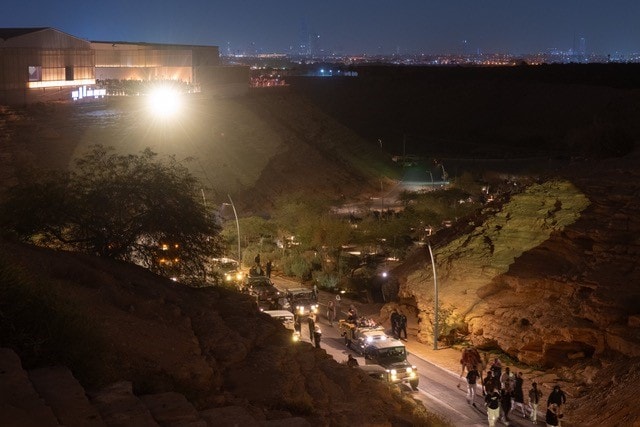
The event started with a performance: a number of pick-up trucks with jubilant Saudi men, women and musicians on board drove through the Wadi Hanifah river valley. Inspired by the historical Bedouin caravans, the parade by Saudi Arabian artist Mohammed Alhamdan, entitled 'Folding the Tents' (2026), juxtaposed contemporary vehicles and camels, creating an evocative image of old and new forms of transport in the desert. The action culminated in the Biennale's main courtyard with a performance by Palestinian rapper Shabjdeed, an influential figure in Ramallah's underground hip hop scene.
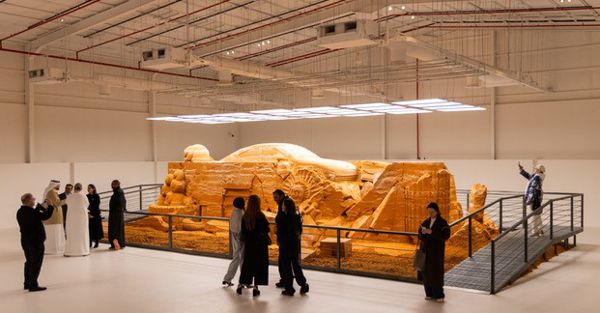
Théo Mercier, «House of Eternity» (2026). Photo by Alessandro Brasile, courtesy of the Diriyah Biennale Foundation

The artists

The exhibition presents a plurality of practices from Nigeria, the Emirates, Saudi Arabia, India and Europe: paintings and works on paper that operate as visual archives of individual and collective memory; textiles, tapestries and embroideries that recall diasporic genealogies and artisanal knowledge; site-specific installations that activate the visitor's body; films, videos, sound works and archival materials that tension historical memory and the construction of the present.

Welcoming visitors to the first of the five pavilions, the installation 'Very volcanic over this green feather' (2021) by Petrit Halilaj recreates a series of drawings made by the artist when he was 13 years old in a refugee camp during the Kosovo war (1998-99): colourful, suspended images, portraits of animals and rural landscapes together with military vehicles. The tension is echoed on the upper floor in the work 'Gauze' (2023-24) by Palestinian artist Hazem Harb, where white gauze bandages on cardboard evoke mutilated or fallen bodies.

There is no shortage of historical figures such as Etel Adnan and Pacita Abad, who share an intense use of colour and a plurality of techniques and materials. Their work dialogues with a younger generation of artists, including several Saudis. The young Ahaad Alamoudi (class of 1991) focuses on one of Saudi Arabia's most publicised projects: NEOM, the futuristic mega-initiative that includes The Line, which was recently downsized. In the video "The Run" (2025), the artist traverses the Tabuk desert towards a canvas depicting the same landscape behind, physically penetrating the image in a hypnotic loop that undermines the promise of linear progress (from ATHR Gallery, Jeddah, Riyadh, his works range in price from EUR 4,000 to 22,000).

Another Saudi Arabian artist, Abdelkarim Qassem presents "The Final Scene" (2017), a short film shot on a mobile phone during his time in the armed forces: a journey along a deserted road, rendered in white and grey, where a sense of uncertainty and suspended trauma dominates. Another video is the one commissioned from Aziz Hazara, "Shab Nama I (Night Chronicles)" (2026), which evokes the shabnama, political leaflets distributed clandestinely in Afghanistan to circumvent censorship, in line with his practice of constructing "counter-forensic" archives in conflict contexts. The artist worked in Italia with Fondazione In Between Art Film for the exhibition "Penumbra" at the Complesso dell'Ospedaletto, Venice (at Experimenter, Kolkata, his photographs in sets start from 4 thousand to 36 thousand dollars).

In Interludi e transizioni, Biennale d'arte contemporanea di Diriyah 2026, Mohammed Alhamdan (7amdan), «Folding the Tents» (2026), foto di Alessandro Brasile, per gentile concessione della Fondazione Biennale di Diriyah

In the centre is the environment

Among the works that extend ecological and political reflection, Daniel Otero Torres's Echoes of the Earth (2026) pays tribute to environmental defenders from around the world, including Berta Cáceres and Ken Saro-Wiwa, through totemic wooden sculptures placed within a large frame, alongside embroidered hammocks and water containers that reflect the sounds of the rainforest. The work imagines a symbolic meeting space for 'silent heroes', a place of rest and exchange for ideal travellers.

The series "Lines in Nature" (2025) by Elias Sime presents intricate geometric networks assembled from electronic waste - printed circuit boards, cables, keyboards - transforming discarded technology into meditations on the balance between progress and environmental cost. If Sime works on the material side of innovation, the editorial initiative Kayfa ta, housed in a modular structure designed by AAU ANASTAS, traces an alternative genealogy, reconstructing the history of Kuwaiti Sakhr Computers and Saudi Arabian Internet forums in the 1990s: a reminder that the history of technology does not belong exclusively to Silicon Valley, but is articulated in parallel trajectories.

Among the thematic movements, the monumental 'House of Eternity' (2026) by Théo Mercier occupies an entire room. Four compact sculptures emerge from a ground of loose sand, evoking termite mounds, desert monoliths and wind-sculpted architecture. An elevated metal catwalk offers an aerial perspective that reconfigures the relationship with the work: from above, the installation reveals itself to be both fragile and immersive, a speculative archaeology of the present in which the saline sediments of the sand accumulate like digital residues, suggesting what images might emerge if our data servers were to dissolve.

Art, politics and global ambition: the Saudi bet

In this interweaving of real and symbolic deserts, counter-forensic archives, speculative ruins and futuristic visions, the Diriyah Contemporary Art Biennale is configured as a platform for geopolitical as well as aesthetic narrative. The movement evoked by the title is not only that of bodies, caravans or data, but that of images and ideas that cross borders, redefining the maps of contemporaneity.

Between memory and projection, trauma and utopia, the Biennial stages a landscape in transition that reflects the Kingdom's ambitions: to build a new cultural centre capable of dialogue with the global South, with diasporas and with alternative technological genealogies. If the desert has historically been a place of crossing and exchange, Diriyah now attempts to transform it into a space of symbolic sedimentation, where art and politics overlap. It remains to be seen whether this constellation of voices will manage to consolidate over time; in the meantime, the third edition marks a clear passage: Saudi Arabia no longer limits itself to hosting international art, but aspires to redefine its trajectories.

Copyright reserved ©
Loading...

Brand connect

Loading...

Newsletter

Notizie e approfondimenti sugli avvenimenti politici, economici e finanziari.

Iscriviti