

"Disability? It is life from another perspective, no less rich'
Paris 2024. Rossana Pasquino, fencing champion and professor of Engineering at the Federico II University, explains how sport has given her a new identity
3' min read
3' min read
From our correspondent
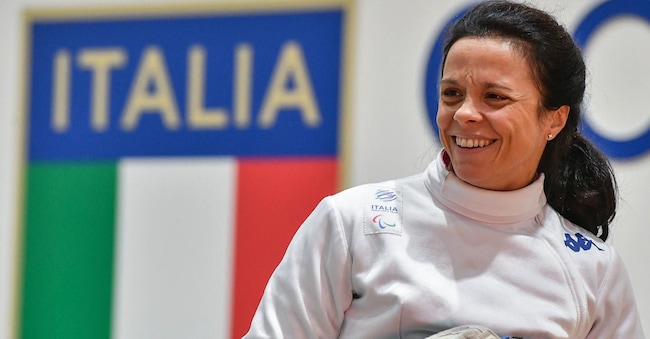
PDad Vincenzo, an engineer, and mum Vincenza, a maths teacher, will take a plane after 15 years for her. Destination Paris because Rossana Pasquino, 40, their third daughter, a multiple fencing champion, will be on the piste from tomorrow in the sabre and epee competitions at the Games. "It is a great joy, a circle that is closing," the athlete began, "to know that the people who love me, friends and colleagues from all over Europe will come to cheer me on.
The Grand Palais is sumptuous: 'What a thrill already to be there. Never in my life would I have imagined such an experience,' she confesses on this September morning in the spaces of the Village. Rossana, with her serene smile and soft voice, is a woman of science, who since childhood has seen herself among experiments and test tubes, dreaming of Rita Levi Montalcini. Then came a degree with honours in Chemical Engineering in Naples, a doctorate and post-doctorate, a Marie Curie scholarship around the world, from Belgium to Greece, to Canada: 'I deal with rheology, with everything that flows,' she explains with the simplicity of people of value, 'and on my way back from one of these doctorates, in a somewhat complicated phase for me, my friend Francesca Boscarelli, a former national epee team member, invited me to the gym: a platform for the disabled had just arrived', which was perfect for Rossana, who has been a paraplegic since she was 9 years old, due to a spinal cord stroke that forced her into a wheelchair within hours. "Dad and mum have been fantastic, they have always urged me to do everything, not to set myself any limits," so she, already an artistic gymnastics champion, embraced fencing in 2013, "a mix of physique (you should see how sculpted Rossana's torso is, ndr), technique and a lot of head, like a tight chess match". The first results arrived, World Cups, European Championships (just won in both sabre and epee) and World Championships, and the Tokyo Games: 'Already the ceremony on Wednesday, so empathetic and bright, was pure adrenalin.
Now it's time to compete, starting with the sabre competition, and then the epee and team competition (Paralympic fencing in Italy has 400 members and 95 clubs for Paralympic activity), where they put in the long training sessions at the Antonio Furno Olympic Fencing Academy in Benevento and the Neapolitan Fencing Centre in Naples. The opponents are mainly Chinese and Ukrainian, but masters Dino Meglio (for sabre) and Antonio Iannacone (for epee) have given Rossana the keys to go further. She has also acquired a certain familiarity in her everyday life to move between her many lives: lecturer in Principles of Chemical Engineering at the Federico II University, athlete, sister, aunt, for the past four years federal councillor in the Italian Fencing Federation's athlete quota (it is the first time that a Paralympian represents both Olympians and Paralympians): "Life is a passage in which to try to be happy and live everything, I have a great need for filling, an infinite desire to know, to meet, to eat moments, to travel, life is a breath, it belongs to us down to the last grain and should not be wasted. And sport, in this thirst for life, has been fundamental, it has given Rossana another identity, in addition to the academic one: 'Fencing has been therapeutic, it has made me recover my body and has given me completeness' so much so that she has defined disability in this way: 'It is life seen from another perspective, no less rich or involving: I do what I wanted, only in another form'.
The barriers were not lacking, right from my first day at university: staircase access and zero accessible services: 'I raised my voice, I made myself heard. Our country still has serious gaps in terms of accessibility, I am obliged to travel by car in Naples because I cannot use public transport, but Naples itself relies on the valuable work of the Sinapsi association which supports disabled students with digital, medical and psychological support'. So many sides of the same country, of the same life: 'At home I was always taught not to complain and to find solutions to deal with problems,' perhaps taking a cue from Frida Kahlo's life. "For me she was always a great source of inspiration. An accident made her bedridden but she painted using a mirror, she did politics, she welcomed friends, she loved'. In a word, she lived.


