
Discovering layering: crafting your own fragrance like a portrait
Layer by layer, gradually moving closer to what we like and, above all, to what reflects who we are. To create a bespoke fragrance, you need a playful, unhurried approach that fosters highly experimental connections.

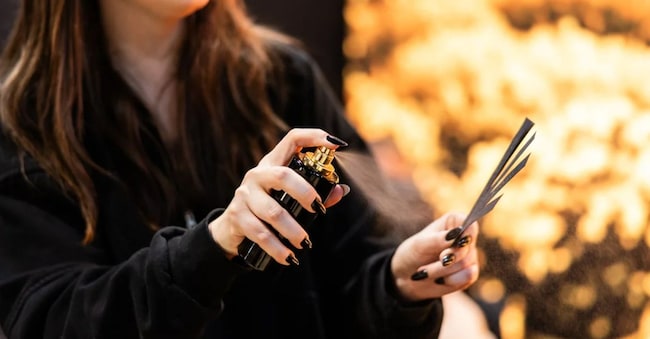
Since ancient times, the use of incense, balms and aromatic oils has been commonplace. And not just amongst the nobility or in religious practices, but also in everyday life. Even today, we use different products for skincare, hair styling or make-up, and each has its own more or less perceptible scent. But whilst the olfactory result here is random, layering is a deliberate and conscious process: you apply the first, more intense and long-lasting fragrance, let it dry for a few minutes, and then layer it with the second, fresher and brighter fragrance. With a specific aim: to personalise the scent we wear. “The trend stems from a rejection of standardisation, which in the 1980s was, on the contrary, a status symbol, a sign of belonging: the same clothes, make-up, hairstyles, accessories and perfumes,” emphasises Claudia Scattolini, fragrance designer and olfactory educator. “Today we have completely moved beyond the concept of standardisation: everything that speaks of the self must use a subjective language, and perfume, in particular, has become an expression of identity. After all, the act of applying perfume is personal: we do it for ourselves, because we like those notes, they make us feel good. And they represent us. Artistic perfumery, with its originality, limited production and use of precious ingredients, is the star of olfactory layering, but there’s nothing to stop you using mainstream perfumes, including scented creams, oils and balms in the mix.” Some simplify the ‘how-to’ of layering as simply ‘layer upon layer’, but there is much more to it than that. “You need to have a good understanding of the olfactory composition of what you’re using, so as not to create a sort of cacophony. Furthermore, when applying perfume to the skin, it’s always best to use a nourishing cream as a base: it ensures better absorption and prolongs the fragrance’s longevity. The order of the classic olfactory pyramid must then be subverted. We start, yes, with base notes such as vanilla, amber, resins and woods that provide support. But, immediately above, there are illuminating top notes, such as citrus ones. The proof of perfect success is when the perfume as a whole reveals itself over time, just as a classic fragrance does, note by note’. So, in this pyramid that does not follow the classic top-heart-base structure, the middle notes have stepped out of the limelight. ‘Exactly, but they can serve as an alternative base. Those who love the floral and fruity scents typical of a fragrance’s heart can apply them as the first step and then let them shine through. This can be done on the décolleté, but if you want a more subtle result, one that only becomes apparent when we move or get close to someone, the best spots are the warm, pulsating areas: the neck, wrists, crooks of the arms and even behind the knees. In this case, it is best to limit yourself to one or two notes, avoiding fragrances with overly complex compositions. Given that artistic perfumes are the first choice for those who layer scents, olfactory layering seems like an experiment for the few. “Not necessarily. Today, luxury is not about owning, but about choosing. Creating one’s own olfactory identity is a choice, and therefore a luxury in itself. Just as taking the time to conceive it and bring it to life is. There is also an aspect to consider that links layering to sustainability and repurposing: just as in tailoring we can modernise a garment, in the same way it is possible to make a fragrance we own—or have been given—but which perhaps does not suit our taste, look cool’. Refinement therefore depends above all on the type of olfactory combination. ‘Today, elegance is represented by notes that embrace, soft and enveloping like cashmere wood (achieved through a combination of hints of amber, cedar, vanilla and musk), luminous resins, soft musks and teas: a second-skin effect that conveys sophisticated comfort. A loud olfactory statement is never elegant, whereas a whispered one is.”
Similarly, in the business world, layering has emerged as a natural evolution and extension of two key strategic tools: scent marketing, where the use of fragrance in spaces is designed to enhance the customer experience, increasing dwell time and the likelihood of purchase, and scent branding, which translates a brand’s identity and values into a sort of scented logo. “These are extremely effective and widely used tools because the sense of smell is directly connected to the brain’s limbic system, which governs memory and emotions,” says Maurizio Cavezzali, co-founder of Esxence and CEO of Equipe International, author of Olfatti non parole. A Guide to Olfactory Communication in Marketing and Personal Branding (Ideazioni, €18 on amazon.com). In both marketing and olfactory branding, layering is not merely a theoretical exercise, but an important, tangible lever for shaping the sensory experience. The most classic example concerns high-end hotels, where layered profiles are used, modulating different fragrances in different areas (lobby, reception, lifts, rooms). This is also done by linking them to furnishings and works of art. A simple example: where there is a painting with a floral subject, a light fragrance of petals and blossoms is diffused.
In olfactory branding, however, layering takes the form of reproducing the brand’s signature scent across a whole range of products such as candles, reed diffusers, room sprays and home textiles, bringing the brand’s olfactory narrative into the home. A powerful tool, provided it is well-structured and calibrated. ‘Just as with personal layering, the challenge in the business world is to control intensity, longevity and consistency: the experience must blend with the space and its atmosphere; it must be noticeable without ever being intrusive. The frequency with which the scent is refreshed must also be carefully calculated.” A further evolution of layering is the layering of laundry fragrances. “We’re still talking about niche products: a range of detergents, fragrances to add to fabric softener, scenting for wardrobes and drawers, right through to pillow sprays to be used in sequence. Here too, without ever overdoing it.”
SU MISURA CLAUDIA SCATTOLINI runs basic and advanced perfumery courses, €330, and the Olfactory Portrait, a one-day workshop where you can create your own bespoke eau de parfum, €950, claudiascattolini.it. ESXENCE is organising The Art Perfumery Event, from 3 to 6 June, at MiCo in Milan, €23, esxence.com.

