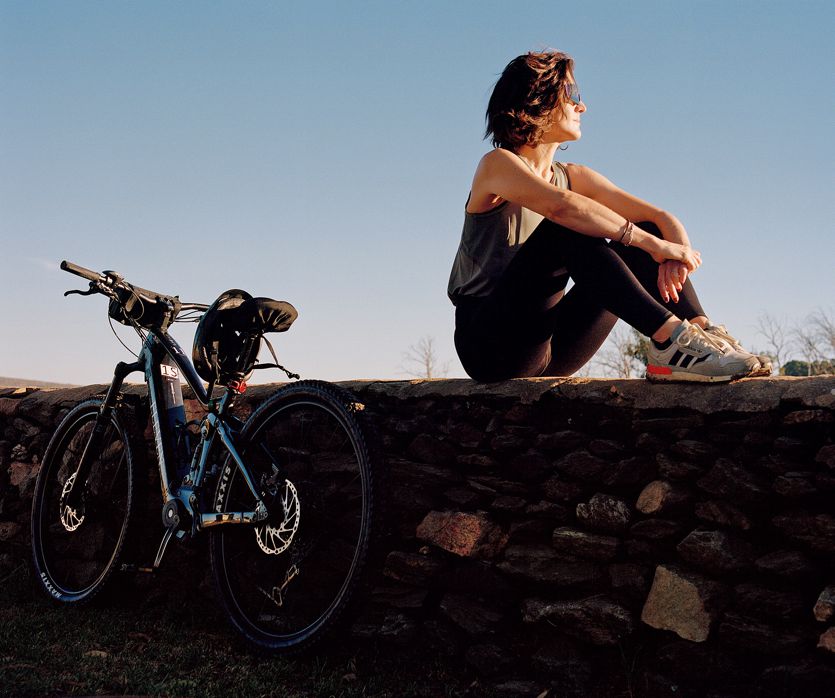
Sports tourism

Discover South Africa by bike, from the vast valleys of the Klein Karoo to the rainforests of Tsitsikamma

Travelling 330 kilometres off-road on an e-bike. A feat of low physical effort and high emotional impact, with unpredictable panoramas and a group of travellers who have become friends.
by Charlotte Sinclair

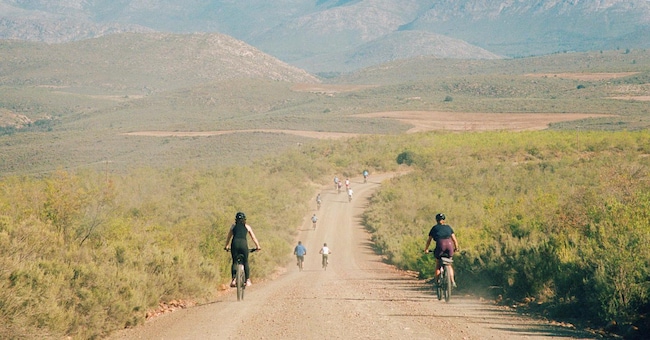
Il gruppo pedala lungo la strada Kammanassie. ©Kent Andreasen

7' min read

7' min read

In the inland area of the Garden Route, the road that winds along the coast of South Africa, away from cars and whale watching tours, one has the feeling that time dilates. A backdrop of low hills and cultivated fields as far as the eye can see stretches from the Outeniqua Mountains towards the vast valleys of the Klein Karoo. Each layer of the landscape reveals a piece of history: from the rock paintings of the San people that decorate the overhanging rocks, hidden from view, to the Victorian-era engineering that made the Swartberg Pass possible, to the towns founded by European settlers, whose ghosts - it is said - still haunt the Boer cemeteries.

It is an area particularly well suited to being explored on two wheels, which is why The Slow Cyclist - a niche tour operator founded by Oli Broom in 2014 and specialising in responsible tourism - has decided to start working here too. Its philosophy is inspired by a journey that took Broom from London to Brisbane in 2010 to watch The Ashes (Australia's oldest international cricket competition): a decidedly slow tour that lasted 412 days through 23 countries, totalling 28 thousand kilometres. From Rwanda to Transylvania, from Turkey to the Peloponnese, the agency offers adventures with electric bikes, characterised by a good dose of fascination and unusual experiences, with little effort and a reduced risk of injury.

Loading...

Broom describes The Slow Cyclist as 'a way of travelling responsibly and with low impact, getting in touch with people and places in an authentic way. Our customers are curious travellers with energy in their legs: they are not cyclists, but they love to pedal. Seeing the world from the saddle of a bike means removing the barrier - in this case the car windscreen - between yourself and the people and places you pass through'.

There is no doubt that cycling offers the opportunity to interact with the context in a deeper way. Feeling under your wheels the transition from uneven rock track to red clay, whizzing through glittering pockets of hot air that sprout on the road like wildfires... In the car, it would be easy to miss the croak of an ibis hadada soaring from the top of a eucalyptus tree, or the rustle of a herd of ostriches, graceful as dancers, as they descend along the curve of a field.
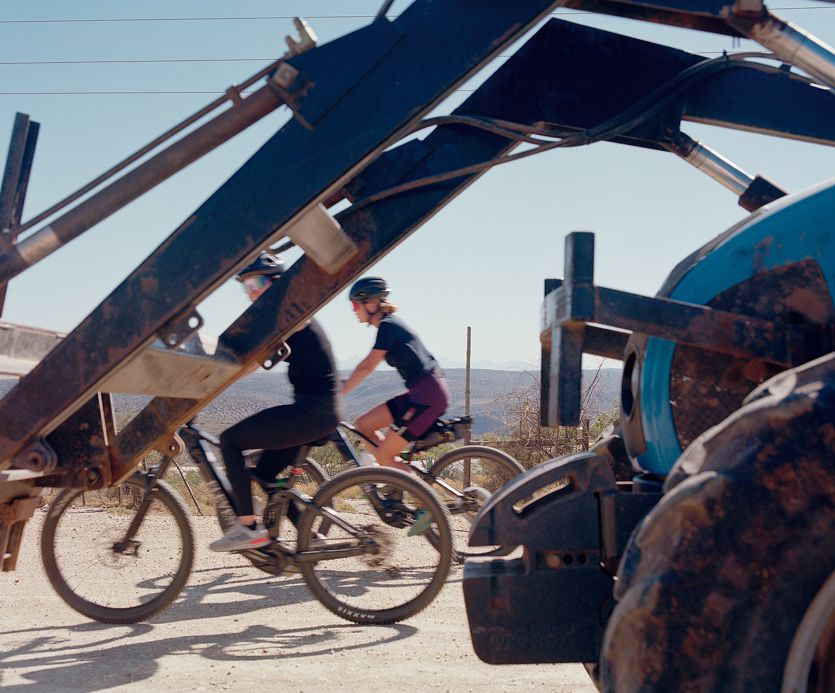
L’autrice dell’articolo, Charlotte Sinclair, e Hannah Basson, guida di The Slow Cyclist, sorpassano i mezzi agricoli incontrati sulle strade della regione sudafricana del Karoo. ©Kent Andreasen

On a route that winds its way towards the Indian Ocean, this first journey of The Slow Cyclist in the Western Cape province encompasses three different ecosystems: the vast Great Karoo desert, the semi-desert zone of the Klein Karoo and the temperate rainforests of Tsitsikamma National Park. A total of about 330 kilometres with an elevation gain of 4,500 metres, which, however, is barely noticeable, because the bike's engine allows you to quickly overcome even the steepest gradient.
The itinerary is carefully designed to avoid confusion and traffic, and rather include a series of surprises: few details are shared with participants, so one enjoys the rare pleasure of not knowing everything in advance. Each stop is organised with the aim of fostering a deeper understanding of the context: whether it is a pizza in a biker pub with the ceiling covered in motor racing flags, a tea in a sculptor's studio or a stop in the fields of the Klein Karoo where a lunch of chicken salad, mango and chilled white wine is set out on a veranda.

The overnight accommodations are interesting and full of charm: from the small vineyard where the crack of a whip chases away the starlings attacking the Chardonnay grapes, to the secluded cottage where horses roam freely around the clearing, drink from a puddle of rainwater and wander curiously around the breakfast table. We are nine participants, plus the indefatigable South African hosts, Jaco van der Westhuizen and Katja Ratcliffe, and guide Hannah Basson (who takes it upon herself, after riding all day at the back of the group, to clean and recharge the bikes). We are a cheerful bunch, almost all English, with an average age of between fifty and sixty. There is a couple from London in their seventies who are on their third trip with The Slow Cyclist; a couple of farmers from Yorkshire; the president of a racecourse; a Swiss couple who work in finance in Singapore. The diversity of ages is proof of how democratic the electric bike is, with an easy barrier to entry: a minimum of training may come in handy, but it is not essential, not least because luggage travels separately, saving effort.

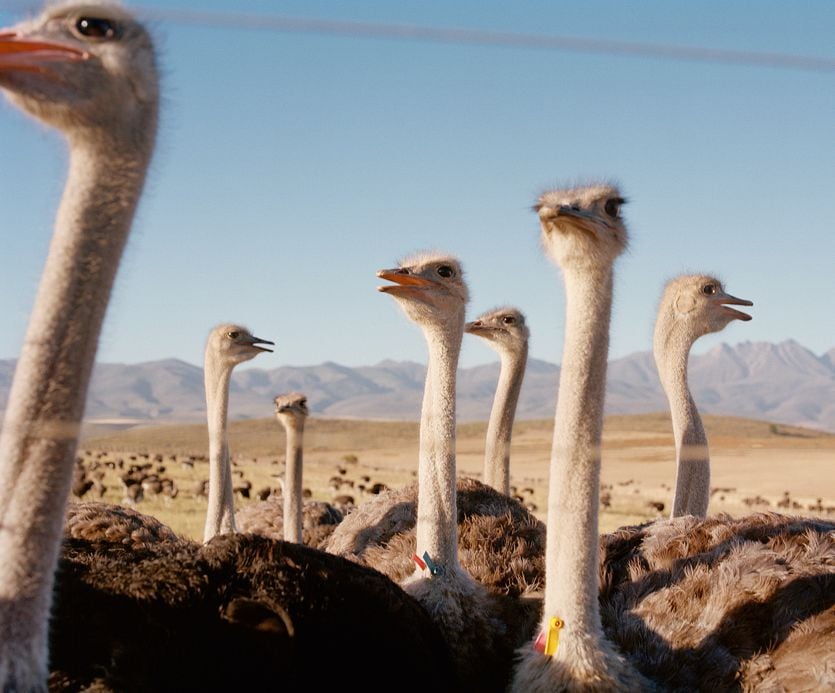
Gli struzzi della fattoria Louvain, nella valle del Langkloof. ©Kent Andreasen

Honestly, it is a great relief not to hear once about apps for monitoring one's performance when doing sports, such as Strava. The customers of The Slow Cyclist share a passion for adventure and a laid-back approach: over lunch they swap tales of trips to Patagonia and Antarctica. Sara Foyle, a vivacious 72-year-old, says: "This is an experience for people who are not interested in taking a cruise to Antigua or sitting on the beach all day sunbathing. We want adventure. A few afternoons later, Sara won the title of speed queen, whizzing downhill and fearlessly reaching 54 kilometres per hour.

On our first day, we set off from Prince Albert - a colonial outpost of the Karoo that boasts a beautiful Cape Dutch colonial-style church and a jazz festival - climbing towards the rolling hills of the Swartberg Pass. The road, which passes through a Unesco World Heritage site, is the work of an engineer, Thomas Bain, who in 1888 created a passage through a hitherto impassable mountainous area. The landscape is impressive: a jagged line of hills against the backdrop of the desert plateau stretching to the horizon. It is quite an intense start: a steep thousand-metre climb that I foolishly decide to tackle in energy-saving mode. The bike weighs almost 30 kilos; as I slow down to a walking pace, my legs spinning madly due to the low gear, a companion overtakes me shouting "Turbo!" - which is the name of the highest setting.

We cycle in the light of crystal-clear mornings, down green valleys, past bougainvilleas that seem to burst out of cottage gardens and rows of willows dotting a riverbank. We become enchanted as we watch a water mongoose swim across a dam. As we pass, children direct cries of encouragement at us: "Hang on, legs, hang on!". From the fields where some blue cranes chase the loose earth, the distant sound of a tractor rises. When I ask what can be extracted from that notoriously impenetrable terrain, our guide Katja replies impassively: 'Rocks'.

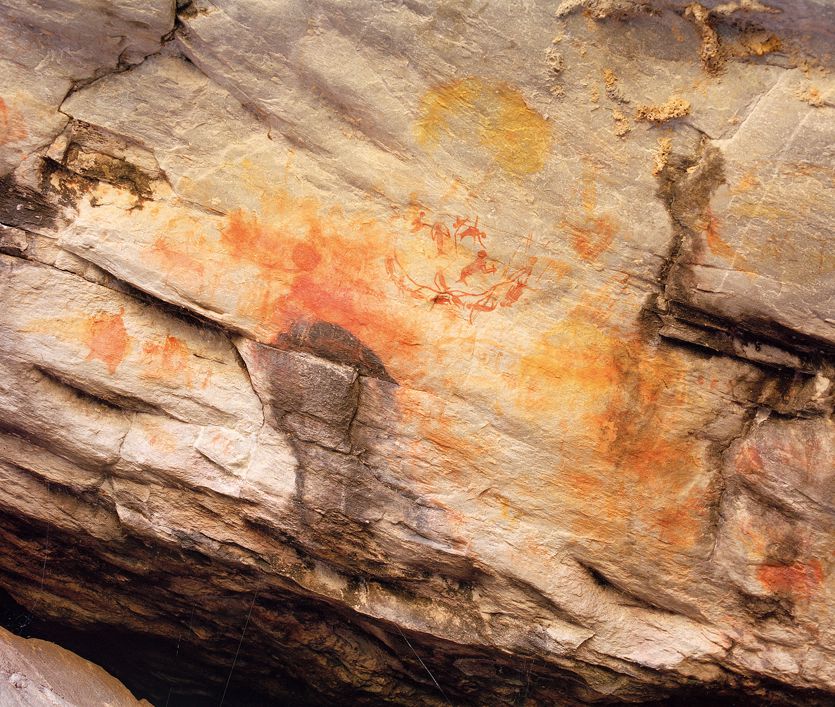
Pittura parietale ttribuita ai San, vicinoalla fattoria Louvain. ©Kent Andreasen

"The drought has lasted for seven years. Half of the farms have gone bankrupt," explains Laura Schoeman, owner of the Berluda ostrich farm. The feather trade predates the arrival in the town of Oudtshoorn at the end of the 19th century of some enterprising Lithuanians, called 'feather barons', who became rich by selling them to the hatmakers of Europe. At the beginning of the 20th century, a kilo of white feathers yielded more than a kilo of gold. Today, Berluda's main customers are Brazilians who use them for carnival costumes. Ostrich skin has also become a source of income: 'The processing is extremely specialised,' says Schoeman. "Customers like Hermès or Louis Vuitton only want flawless skins, without imperfections. We do everything here."

We ascend along undulating tracks, crossing green hills covered with fynbos, shrubby vegetation typical of the coastal strip of the Western Cape. The sun begins to set, leaving a series of shimmering streaks hanging over the Langkloof valley. We descend to Louvain, a 50-hectare farm whose first settlement - by settlers who followed the San into the mountains - dates back to 1780. The owner, Morne Jonker, grills ostrich steaks for dinner on the braai. The leather produced in Louvain, he confides, is sold to Prada. 'South Africans are used to hard work,' he says, referring to the challenges farmers face in an environment characterised by drought and fires.

The next morning Morne's son Douglas, despite the heat, leads us to a cave, located near a spring where he used to swim as a child. "But I didn't know there were these at the time," he says pointing to a wall decorated with giraffes and antelopes, painted hundreds of years ago by the San. We are particularly struck by the drawing of some mermaids that seem to swim in the depths of the nearby spring.

L’autrice nella riserva naturale del Rolbaken. ©Kent Andreasen

As we grind kilometres, we accumulate stories: about who lives here, where, how. We leave the farmland behind to immerse ourselves in the temperate rainforest; over dinner we discuss politics - the long shadow of apartheid and colonisation, agricultural property and the thorny issue of expropriation. The conversations reflect the unique perspective that comes from observing a place unhurriedly, meeting people in their environment, looking into their eyes.

Through thin rain we reach the forests of Knysna, where in a tea room with a tin roof, Hardy Loubser, a guide with an extraordinary beard, tells us more stories of lives that the wilderness has made difficult, such as those of the 19th century loggers, who were born and died without ever leaving the forest. Somewhere in this large park still hides a lone elephant, the last specimen of the large herds that roamed free through the Klein Karoo before human settlement. "The only condition he knows is loneliness," Hardy comments. "He is alone, but he doesn't know he is."

On the Sedgefield coast, where the Indian Ocean, beyond the dunes, appears as a long, silky expanse, we separate ourselves from the bikes. It is a bittersweet feeling: the idea of getting into a car has an almost alienating effect. 'Travelling like this affects the body and mind,' says Broom - it is as much a mental as a physical experience - 'an antidote to unconsciousness'. Not least, it is also a lot of fun, an adventure where the group dynamics are key: the banter, the team spirit, the meeting as strangers and parting as friends, the many glasses of delicious local wine. An experience that confirms the theory that the truly unforgettable trips are the ones you share.


IN SADDLE The Slow Cyclist offers a seven-night tour of the Western Cape starting from EUR 4,000, including luggage transport, English-speaking guides, overnight stays, meals, drinks, all activities, bike and helmet hire.

Copyright reserved ©
Loading...
Loading...

Newsletter

Notizie e approfondimenti sugli avvenimenti politici, economici e finanziari.

Iscriviti