
Discovering the most beautiful art pools: swimming in contemporary art
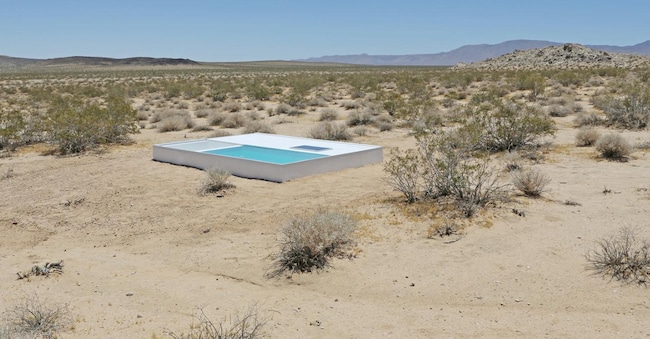
A Land Art installation in the California desert or a sculpture on Fifth Avenue. Nicolas Party's mosaic in Le Sirenuse and Picasso's dancer in Marbella. Opportunities to immerse oneself in water and another dimension.
6' min read
6' min read
It was 1964 when David Hockney, then aged 27, moved to Los Angeles. He came from grey, conservative England, where he had come out, although homosexuality was still a crime. Flying over the American city on the West Coast he was struck by the many swimming pools: a luxury in his homeland, a necessity in the Californian climate. He did not yet know that it would become one of the most characteristic themes of his creative production and, above all, that the market would recognise it as his expressive signature: in 2018, at Christie's, the painting Portrait of an Artist (Pool with Two Figures) from 1972 fetched $90.3 million, at the time the highest price ever paid at auction for a work by a living artist (a record later broken by Jeff Koons). The pool, for Hockney, represented a space in which to explore the male figure, the surface of the water, the sparkle of light. His fascination with the theme went so far that he painted the floor of his swimming pool with the blue waves he used to represent in his paintings, and he did the same for the swimming pool of the Roosevelt Hotel in Hollywood. The story goes that one day in 1988 he showed up at the hotel with a paint can and a paintbrush attached to a broom handle: within four hours he painted the bottom of the pool, which was empty at the time, creating an immersive work of art in the true sense of the word.
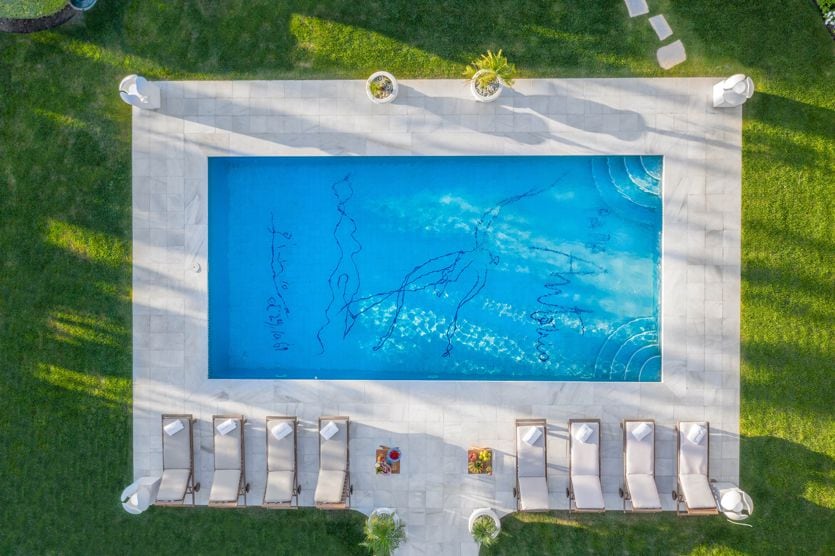
The history of 20th-century art is studded with works that have swimming pools as their subject, starting with Matisse - for his The Swimming Pool he cut silhouettes of sea creatures from a roll of blue paper and applied them to a white ribbon placed horizontally along the walls of his dining room - and ending with Slim Aarons' shots of the jet set and celebrities by the pool. As in the case of Hockney, not only paintings and photographs, but also real artist's pools were born from this attraction. Already Georges Braque in 1963 designed a mosaic with stylised fish, Les Poissons, for a pool in the garden of the Fondation Maeght in Saint-Paul de Vence, southern France, while a drawing by Picasso made for the flamenco dancer Antonio Ruiz Soler, known as El Bailarín, was reproduced on the bottom of the dancer's pool in his villa El Martinete in Marbella.
Loading...
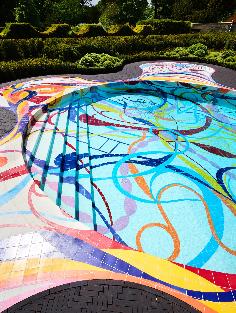
Today, especially the hotels most attentive to contemporary art aim to create unique environments for their guests, in which originality and the search for detail come to define even the space reserved for sport and wellness. A recent example is Le Sirenuse, a historic boutique hotel in Positano, on the Amalfi Coast, which has entrusted the renovation of its swimming pool to Nicolas Party, a Swiss artist living in New York, born in 1980, and star of the art market. Working with Bisazza mosaic, Party created abstract motifs on the floor and walls of the pool in a palette of colours between green and blue, recalling waves and water, sky and clouds. In the centre, a golden disc evokes the sun. "Diving into the pool becomes like diving into the sky," explains the artist. The portraits, landscapes and still lifes, painted with his timeless style, sinuous lines and surreal colours, have won over collectors: the values of his works at auction have exceeded EUR 5 million.
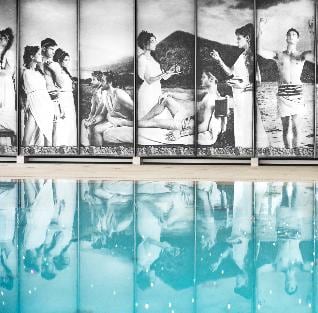
At the poolside of the Castello di Casole - At the Belmond Hotel, on the other hand, an in situ work by Daniel Buren, who has intervened in four other hotels of the group, from Copacabana to Cape Town, is installed for this summer only. It is a large circle with typical black and white vertical stripes - the French conceptual artist's signature - which, together with two other geometric figures, a square and a triangle, frames the beauty of the Tuscan landscape, creating three new focal points. A very different setting is the one created in 2012 by Karl Lagerfeld around the Odyssey swimming pool at the Hôtel Métropole Monte-Carlo: 15 glass panels with photographs depicting Ulysses' voyage make up a sort of contemporary frieze.
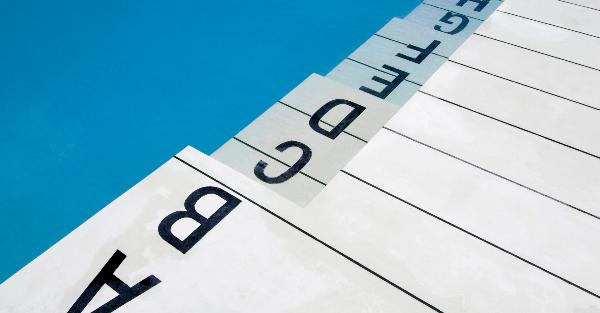
The artist's pool is a precious piece of furniture also found in many villas and private foundations, according to an approach that reveals a total propensity for art, which comes to permeate every living environment. To return to California, a number of conceptual creatives who have made history on the West Coast have ventured into this field, from Lawrence Weiner, with his iconic writings, to Edward Ruscha, who produced as well as an artist's book with a collection of photographs of motel swimming pools (Nine Swimming Pools and a Broken Glass), the floor of his brother Paul's swimming pool in Studio City, a neighbourhood of Los Angeles, replicating a registration form, with white tiles forming words such as "name", "address" and "phone".


Loading...
