Messy beauty: art and collecting at FAB Paris
The international event for collectors of antique and 20th century art also offered jewellery, desing and non-western art, price ranges for all budgets

-U45263625608uIV-1440x752@IlSole24Ore-Web.jpg?r=650x341)
7' min read
Key points
7' min read
On 19 September, the Fine Art Paris fair opened for the second time in the large space of the Grand Palais, with a new date in the crowded and competitive calendar of post-summer fairs. The fair, open until 24 September, aims to be an international appointment for collectors of antique and 20th century art, and objects of Western and non-Western traditions, following a transversal approach of free associations and visual collaborations, thanks to a hundred or so galleries and exhibitors of different categories, which include a strong presence of unique jewellery and works of furniture and design, as well as a core of paintings and sculpture from the Middle Ages to the 20th century. The presence of Parisian and French-speaking galleries is prevalent, although Spanish, German, British, North American and Italian dealers are also present.
The impression is that most of the works on offer fall below the €100,000 threshold, with the exception of 20th century art, which is below half a million (all prices quoted are asking prices, usually with taxes and costs aside). The common element is the qualitative choice and care of presentation that characterises practically all the stands; many gallerists are leading names, also known from their participation in Tefaf Maastricht, with 21 new participations out of 91 galleries, among them Landau Fine Art from Montreal.
Disorderly Beauties: one curator for five galleries
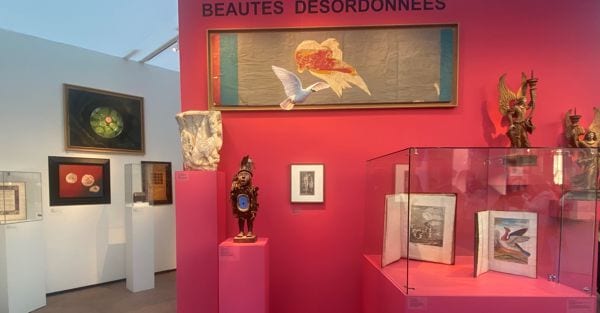
.A space shared by five galleries best represents the spirit of inter-category collecting that animates the fair, named Beautes desordonnees by curator Jean-Hubert Martin. The curator has brought together 138 works from five distinct areas: Galerie Bruno de Laroussilhe for medieval art, Galerie 1900-2000 for 20th century avant-garde, Galerie Georges-Philippe & Nathalie Vallois for modern and contemporary, Galerie Claes for non-western arts, and the Librairie Clavreuil for books and prints. The visual associations given by the proximity of such different objects and cultures are stimulating and suggest to collectors to step out of their self-imposed 'boxes': thus a large canvas byJacques Villeglé from 1962 (at €130k) forms the backdrop to a thirteenth-century Capitello con Sirene (asking €240k), overlooked by 2018's 'Paloma de guerra', a stuffed dove with a bullet in its beak by contemporary Pilar Albarracin, offered at €8k.Disorderly Beauties: one curator for five galleries
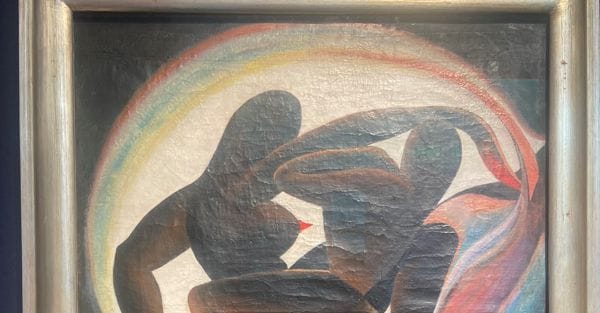
There was a strong presence of Surrealist works, including a paper by Max Ernst at €85,000, and paintings by Hans Bellmer, Oscar Dominguez and Hanna Hoch (asking prices in the hundreds of thousands of euro), and a focus on erotic art with prices starting at a few tens of thousands of euro for the scandalous images of Pierre Molinier.
The presence of sculpture ranged from a Limousin Corpus Christ (€150,000) and a 14th-century wooden sculpture of a French saint at €230,000 to hyper-realistic female nude mannequins byJohn De Andrea at €140,000 and a Yaoure' mask from the Ivory Coast at €75,000. Prices in the tens of thousands also for books and works on paper, including engravings by Goya (€85,000) and Hans Holbein (€25,000). An experiment that will hopefully also meet with commercial success and can be replicated on a larger scale.

The Italian presence
.There are only two Italian galleries present, perhaps also due to a concurrent fair in Rome, when it would be desirable to have more coordination of calendars between fairs to avoid overlapping. The Frascione gallery in Florence is often present in the French market and presents an interesting selection of works with a focus on the early 20th century starting at a few thousand euros, and brings three Futurist works including a well-known paper by Thayaht 'The Great Helmsman' of 1939 dedicated to the athletic transflight of Balbo at €30,000, a figure by Depero on paper at €13,000, and a 1932 canvas by Tato 'Dynamism from the African Dance' at €65,000. The central position, however, is given to Romolo Bernardi's large and dramatic symbolist composition 'Chastisement' from 1901 measuring over 2 metres. The Milanese Robertaebasta combines post-war Italian art such as Mondino, Burri and Salvo, with design from the same period including works by Sottsass.