Presidential elections

Contested Romania tries again, the 'hinge' country between East and West returns to the vote

There is a repeat of the first round that was resoundingly annulled by the Constitutional Court in December and the exclusion of the then winner, Calin Georgescu. But still leading in the polls is the populist and Eurosceptic right, now led by George Simion

by Roberto Da Rin

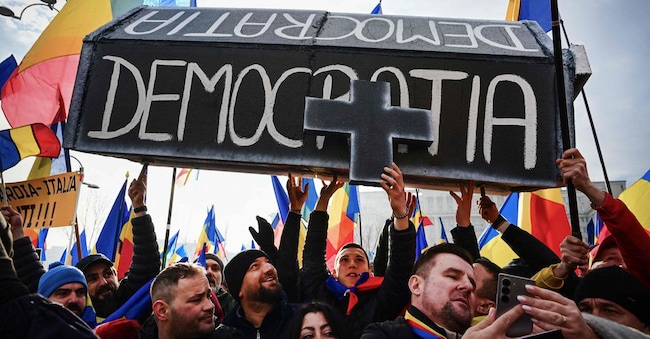
La protesta dei sostenitori di Calin Georgescu, il candidato di destra vicnitore del primo turno del novembre scorso poi annullato dalla Corte costituzionale, escluso dal nuovo voto.

3' min read

3' min read

Romania is trying again. After several 'false starts', Romanian voters will try to elect a new president. Today they are voting in a country wearied by a triple crisis: political, institutional and economic. Presidential elections in an EU country evidently 'watched' by Moscow and Brussels. Romania is a 'hinge country', as they say in Moscow, and plays a double game, internally and internationally.

In the first case in a contest between democrats and conservatives, albeit polluted by a nationalism that pervades both camps. In the second, some observers have revived the pattern of a proxy war between Russia and Europe, determined not to give up their 'influence' on Bucharest. And the annulled vote, in that first round in November 2024 unexpectedly won by the pro-Russian Calin Georgescu, has generated growing tension, inside and outside the Romanian political palaces.

Loading...

Now the favourite is George Simion, 38, leader of the Alliance for the Union of Romanians (Aur, right-wing): he is a Eurosceptic nationalist, with anti-EU and anti-NATO positions. He currently leads the polls with 30-34% of the vote. The US has sent a pool of 'observers'.

The cancelled November 2024 vote

.

The latest outburst of tension dates back to 10 March, in Bucharest, which became the scene of demonstrations and clashes after the electoral office rejected, by rejecting an appeal, the candidature of Georgescu, a right-wing, pro-Russian nationalist, in today's elections. He is the key man in the Romanian vote: the stone guest who cannot stand again today but who in the first round, last November, had unexpectedly defeated his competitors: he obtained 22%, just a few percentage points more than Elena Lasconi, pro-European, who stood at 19%.

The alleged irregularities in his campaign, played out mainly on social media, led the Constitutional Court to annul the election. This paradoxically strengthened the number of pro-Romanian Romanians, and thus Georgescu's position, close to 45%, according to the latest polls, despite being unable to stand.

Russia, according to the Supreme Court ruling, allegedly financed and favoured Georgescu, in ways similar to those adopted a few years ago, by foreign trolls, in the scandal dubbed 'Cambridge Analytica' on the occasion of Brexit: a scandal related to the management of data to influence election campaigns. The popularity of the independent leader of the Romanian ultra-right, considered by many to be close to Russia, has not been dented, and the squares have been filled with supporters shouting about a coup against Georgescu.

Favourites

.

Attention - apart from the favourite Simion, who, however, is not expected to reach the 50% threshold necessary to avoid the 18 May runoff - is centred on three other candidates: Crin Antonescu (65), former leader of the National Liberal Party (NLP), supported by the pro-EU government coalition. He has a moderate, pro-Western profile and is positioned with 20-23% in the polls, slightly ahead of the other centrist candidates.

Nicusor Dan (55) is the independent mayor of Bucharest, known for his anti-corruption platform and support for European integration: he is considered a reformist and has a strong following among the urban electorate.

Victor Ponta (52) is a former social democratic prime minister who has veered towards ultranationalist positions with his 'Romania First' platform. He has 8-11% support. He is critical of the EU and opposes military aid to Ukraine.

Crin Antonescu and Nicușor Dan are competing for second place, with Antonescu slightly favoured.

The election campaign was influenced by the massive use of social media, especially TikTok, where Simion has a significant following among young voters. The outcome of these elections will have a significant impact on Romania's international standing. A Simion victory could lead to a shift away from pro-EU and pro-NATO policies,

The country 'under special surveillance'

.

The elections in Romania are a test case for democracy in the digital age. The lawfulness and instrumentalisation of the use of social platforms is one of the key issues. An unstable balance between voter disillusionment, technological manipulation and geopolitical tensions. This is why the focus on this vote goes far beyond Bucharest and lands in Brussels. The EU is called upon to counter foreign interference without, however, exerting undue pressure in favour of pro-European candidates. This is a delicate task precisely because the EU should simultaneously take responsibility for regulating platforms and preventing foreign interference.

Romania represents a crucial link in the Eastern European security chain. His presidency will have direct effects on the country's strategic positioning with respect to NATO and the ongoing conflicts on its borders. NATO would like to deploy 10,000 soldiers by 2030 at the Mihail Kogalniceanu base. In that very region, voters in November gave strong support to pro-Russian Georgescu.


Copyright reserved ©
Loading...

Brand connect

Loading...

Newsletter

Notizie e approfondimenti sugli avvenimenti politici, economici e finanziari.

Iscriviti