Emotional maps

Do ‘places of the soul’ really exist?

From the Ngorongoro to the genius loci, from monarch butterflies to GPS neurons, from Maylis de Kerangal to Ece Temelkuran: a reflection on the joy of simply calling ourselves ‘earthlings’

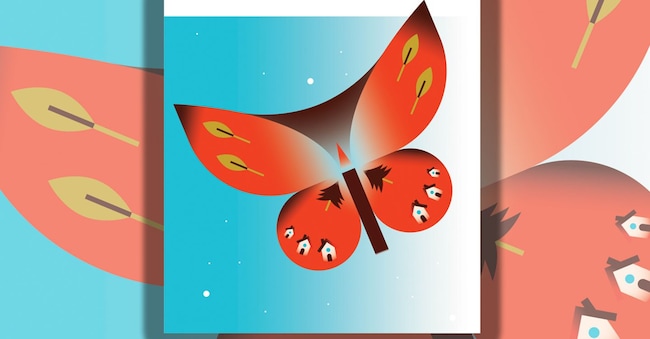
 (Illustrazione di Chiara Morra)

5' min read

Translated by AI
Versione italiana

5' min read

Translated by AI
Versione italiana

Anyone climbing towards the ridge of Ngorongoro, in northern Tanzania, will find that when they reach the top, what opens up before them is not a valley, but a vast caldera – perfectly defined and intact – the largest of the complete calderas found on the mainland. Standing there, you can make out elephants and rhinos dotting the plain at the bottom of the crater, and a lake with a pinkish rim, coloured thus by the backs of thousands of pink flamingos as they probe the shallow waters with their curved beaks. If you sleep at the campsite on the edge of the slope, you can hear the elephants climbing up the slopes at night and moving amongst the tents; in the distance, the sounds of the wildlife inhabiting the rich ecosystem nestled within what remains of the extinct volcano.

If there is one place where I have ever felt I belong, it is this plateau in central-eastern Africa. The Olduvai Gorge, to the north-west – also known as the cradle of humanity or the valley of the dawn of man (and woman...), because traces of almost every stage of human evolution have been found in various rock strata – and further still, the Serengeti National Park, with its vast savannah that turns crimson every year when millions of wildebeest gather there, accompanied by zebras. A savannah dotted with acacia trees and tall grasses, beyond which, perhaps, our ancestors first began to stand on two legs.

Loading...

Is my sense of belonging a matter of choice, or a sort of ‘genetic memory’ of our truest origins? Do we truly belong to a place? Every four generations, hundreds of millions of monarch butterflies leave North America, travelling as far as 4,500 kilometres, to spend the winter in Mexico, all gathering in the same areas – which cover no more than a few square kilometres – and which are completely blanketed in orange wings.

Why they all end up there remains unclear, even though for several years now many researchers have been trying to understand the mechanisms that make this spectacular migration possible: how do they manage to find their way (using the sun, by comparing its position with that measured by their internal circadian clock? Using the Earth’s magnetic field? Through the polarisation of light? Various hypotheses backed by evidence have emerged in recent times), how they recognise places they have never been to before (it takes 3–5 generations to complete the entire journey), and why they go to certain – very few – places and not to others. Is it written in their genes? And how does a biological map work?

Ours appear to be made up of ‘place cells’, the main class of neurons in the hippocampus, discovered by John O’Keefe. For this discovery, in 2014, he was awarded the Nobel Prize in Medicine alongside Edvard and May-Britt Moser, who, in turn, identified the ‘grid cells’ – nicknamed, along with the ‘boundary cells’, ‘GPS neurons’: together, they are thought to constitute our brain’s positioning system. Some studies also suggest that if they fail to function, episodic and autobiographical memory is also lost. We forget what happened in those places, as if those places embodied our very memory itself

Given that we are also shaped by our memories, it is reasonable to ask whether and how the places where we grow up influence our personalities in any way. This is also the theme of *Atlante Appennino. An Ecobiography* by Elisa Veronesi (Piano B Edizioni), a hybrid work that brings together narrative, essay, images and personal narrative. Drawing inspiration from the ideas of the French philosopher Jean-Philippe Pierron, it explores the interplay between life stories and the environment, inviting us to trace the connections and encounters with nature that have shaped – or might shape – our existence. And, of course, the words of Marcel Proust, Cesare Pavese, Virginia Woolf, James Joyce, Toni Morrison and Mario Rigoni Stern spring to mind...

The Latins spoke of the *genius loci*, the spirit of the place. The work of the original French writer Maylis de Kerangal, for example, revolves around this concept. Speaking to *Domenica*, the Sunday supplement of *Il Sole 24 Ore*, about her novel *Corniche Kennedy* (Feltrinelli), she explained how it had ‘been born of a place’. From the coastal road that separates Marseille from the cliffs, the evening refuge of a rabble of youngsters who gather here – rejected, wounded, filthy, excited and thirsty – ‘when spring is ripe, taut, June, then—harsh and breezy June—not yet the holidays but school beginning to fade away, gradually overexposed to the light, and the afternoon drags on and on, devouring the evening, plunging straight into the heart of the black night’. Indeed, ‘the characters are as if they had emerged from the stone, as if they had taken shape from the landscape, which is a frontier between two somewhat antagonistic places: behind, the city, a place of law and men; and in front, the sea, a place of emotions and sensuality’. Even her most recent work, *Giorno di risacca* (Feltrinelli), seems to spring from Le Havre, where she grew up, just as *Lampedusa* (Feltrinelli) does from the island of the same name, or *La diga* (Prehistorica), written with Joy Sorman, from an alpine lake. *Un mondo a portata di mano* (Feltrinelli) revolves around that prehistoric marvel, the Lascaux cave, where anyone who enters it (today, only via the reconstruction) suddenly feels like a woman or man from the Palaeolithic era, such is the depth and immediacy of the aesthetic experience.

But can we – who are descended from those nomadic beings who scanned the savannahs, who are still genetically hunter-gatherers – truly belong to any one place in particular? How much of this is a construct, or at least a cultural exaggeration, with ambiguous, if not catastrophic, consequences? The Turkish writer Ece Temelkuran, in her latest book *Strangers Like You. The Nation of the Excluded in the New Millennium (Bollati Boringhieri), speaks of a nation of strangers that is growing ever larger and also includes those who, politically and morally, do not feel at home in their own country. ‘It may be that what we call home is no longer tied to a place,’ she told *Il Sole 24 Ore*. ‘In the 21st century, home might be made up of people and words.’ What if we were to start – or rather, start afresh – from here? What if we were all, like Elisa Veronesi, happy to define ourselves, quite simply, as ‘earthlings’?

© ALL RIGHTS RESERVED © ALL RIGHTS RESERVED

Copyright reserved ©
  • Lara Ricci

    Lara Riccivicecaposervizio curatrice delle pagine di letteratura e poesia

    Luogo: Milano e Ginevra

    Lingue parlate: Inglese e francese correntemente, tedesco scolastico

    Argomenti: Letteratura, poesia, scienza, diritti umani

    Premi: Voltolino, Piazzano, Laigueglia, Quasimodo

Loading...

Brand connect

Loading...

Newsletter

Notizie e approfondimenti sugli avvenimenti politici, economici e finanziari.

Iscriviti