
Do you know what ‘spite houses’ are? Examples from Italia and around the world

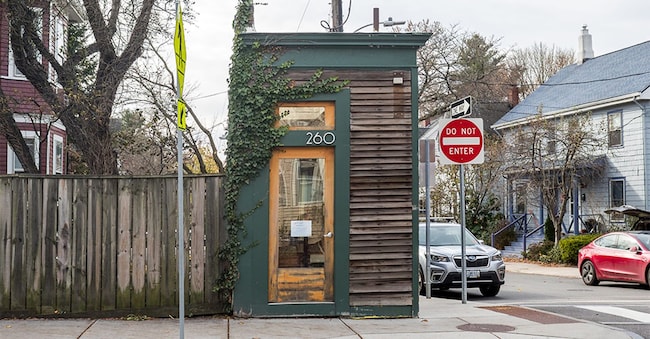
Some people build a house to defend their land, whilst others use it to hinder a neighbour, block a view or protest against a public decision. spite houses are buildings born out of personal disputes, inheritance disputes and planning conflicts, often characterised by narrow, irregular or deliberately bulky shapes.
These structures represent the most unusual aspect of the relationship between building and private interests. They are not merely architectural anomalies: behind every building lies a story of rights, restrictions, disputed land and strained relations between owners.
The phenomenon is known in Anglo-Saxon countries as spite houses. From Sicily to the United States, via Bergamo, Sarajevo and London, some of these dwellings have become genuine tourist attractions. Their fame stems precisely from the contrast between their residential function and their original purpose: to transform a building into a silent declaration of war.
Among the best-known ‘houses of spite’ in Italia is the Casa du Currivu in Petralia Sottana, a village in the Madonie mountains in the province of Palermo. The name, in Sicilian, means ‘house of spite’ or ‘house of anger’ and directly describes the origin attributed to the building.
The story dates back to the 1950s. The owner of a house reportedly wanted to add another storey to the building, but to do so he needed the consent of his neighbour, with whom he shared a party wall. Consent was not granted, partly because of the potential loss of the panoramic view. The result was a structure approximately one metre wide – essentially uninhabitable, but sufficient to block the view. The inner façade, the one facing the neighbour’s windows, is said to have been painted black.
In Bergamo Alta, near the Basilica of Santa Maria Maggiore, there is a building that now houses the Local Police Headquarters. The building appears symmetrical, but on closer inspection of one of the side walls, one notices windows that are always closed and appear to serve no purpose.
These are false windows, created to maintain the aesthetic uniformity of the façade. Behind that wall, however, there are said to be openings belonging to pre-existing dwellings, which once overlooked an internal courtyard.
The transformation of the area is thought to have taken place following the demolition of the church that stood in the courtyard, between 1839 and 1840. In its place, a solid wall was erected, very close to the neighbouring dwellings, thereby reducing natural light and the view from the windows. The building is often associated with ‘case del dispetto’ (houses of spite) precisely because of the effects it had on the residents.
- Properties for sale in Bergamo
- Properties to let in Bergamo
- Holiday homes in Bergamo
The world’s most famous spite houses
The phenomenon of spite houses is not confined to Italia. In the United States, Europe and the Middle East, there are numerous buildings associated with family feuds, protests against expropriation and disputes with local authorities or neighbouring property owners.
Some stories are documented, whilst others have been passed down as local legends. In both cases, the physical manifestation of the conflict has transformed private properties into points of architectural and tourist interest.
In the North End neighbourhood of Boston, Massachusetts, stands the Skinny House on Hull Street. Its most distinctive feature is its extremely narrow width, barely more than three metres in some places.
Legend has it that two brothers inherited a plot of land and that, whilst one was away, the other built a large house occupying almost the entire plot. On his return, the brother who had been left with no space is said to have built a narrow house directly in front of the building, with the aim of blocking out the light and the view.
In Sarajevo, Bosnia, the Inat Kuća has a history dating back to the late 19th century, when the Austro-Hungarian authorities decided to build the town hall on the site occupied by the home of an elderly man named Benderija.
The owner refused to give up his house, despite negotiations. Eventually, in exchange for a substantial payment in gold coins, he agreed to have the building dismantled, brick by brick, so that it could be rebuilt identically on the other side of the river. In 1895, the house was faithfully rebuilt in its new location, and today Inat Kuća is home to a very popular restaurant and stands as one of Sarajevo’s most recognisable landmarks.
Brand connect


Newsletter RealEstate+
La newsletter premium dedicata al mondo del mercato immobiliare con inchieste esclusive, notizie, analisi ed approfondimenti
Abbonati