
Docsy: artificial intelligence applied to forensic science

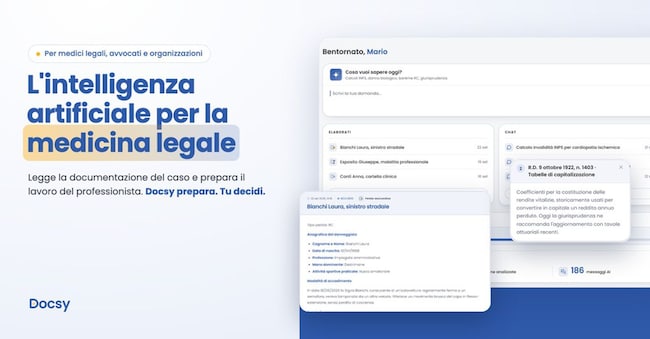
Docsy is an artificial intelligence platform developed in Genoa and dedicated to forensic medicine. It analyses the clinical documentation for a case and prepares a draft of the expert report, which the professional then checks, supplements and signs. It is now in daily use by hundreds of medical examiners and solicitors.
The work leading up to the assessment
Following a road traffic accident, an accident at work or a case of alleged medical negligence, the assessment of personal injury involves the medical examiner, the injured party’s solicitor and the firm handling the case. For all parties, the starting point is medical records, reports, test results and documents, which can amount to thousands of pages to be read, organised and analysed in accordance with legal criteria.
This is the most time-consuming and error-prone stage, and the expectations of those awaiting an expert report or a response depend largely on it. This is where Docsy steps in, freeing up professionals’ time currently taken up by repetitive tasks and offering shorter turnaround times and a more thorough investigation. This is the approach set out in Law 132/2025, which, in Article 13, permits the use of AI in the liberal professions solely for instrumental and support activities.
A tool for professionals dealing with personal injury claims
Medical examiners. Whether acting as a court-appointed expert, a party-appointed expert or an insurer’s representative, the forensic doctor entrusts Docsy with analysing and organising documentation, reconstructing the clinical history, calculating damages and drafting the initial report. The professional retains responsibility for the examination and assessment, which form the core of the service.
Solicitors. For law firms, the distinctive feature is the forensic medicine engine on which Docsy is built. Artificial intelligence solutions commonly used in the legal sector work on legal sources; Docsy analyses clinical documentation using the medical examiner’s methodology and links it to the criteria for assessing damages. It derives an initial assessment of the case’s medical-legal merit, any missing documentation and the extent of the damages, to be explored further with the medical examiner. During litigation, it supports the analysis of expert reports and the drafting of legal documents.
Personal injury claims firm. When dealing with large volumes of cases, Docsy provides a consistent initial review of each file, helps to set priorities and delivers cases to professionals in an organised state. In every area, the final assessment remains with the professional, who reviews and corrects each step.
Artificial intelligence built on forensic medicine
Italian forensic medicine follows its own rules: the same impairment is assessed using different criteria following an accident at work, a road traffic accident or under an accident insurance policy. Docsy is built on this framework (legislation, scales, INAIL and INPS tables, case law, scientific literature) and on an internally developed engine that works in stages, just like a professional: it analyses the documentation, ensuring that no page is omitted; it drafts the report; it verifies the bibliographic sources; and it reviews the text before delivery.
The protection of health data
Expert reports involve the processing of health-related data, which the GDPR protects as a special category. Docsy processes this data as a data processor, in accordance with Article 28 of the GDPR, on behalf of the professional, who remains the data controller. The data is stored on infrastructure within the European Union, and the content of the reports is encrypted before being saved. The artificial intelligence models used by Docsy do not learn from the documents they process: cases handled on the platform are not used for any training purposes. The platform also applies a Zero Data Retention policy: uploaded documentation is irreversibly deleted once processing is complete.
From pilot phase to market launch
Docsy was launched in 2026, following a pilot phase in which around thirty forensic pathologists used it on their own real-life cases. ‘The most significant factor is its daily use: professionals open it at the start of the day and use it on their current cases,’ explains Riccardo Basso, co-founder and CPO of Docsy. ‘Every week we release updates that eliminate a manual step from their work.’
Relations with institutions
In its first year on the market, Docsy sponsored the national congress of SIMLA, the Italian Society of Forensic Medicine and Insurance, and is developing agreements and partnerships with institutions and organisations in the sector, such as the provincial medical associations. “We were the first to invest in this project, using our own resources, because we believe that artificial intelligence can improve a sector that affects the lives of many people,” says Davide Fenati, co-founder and CEO of Docsy. “The next step is to forge an ever-closer relationship with institutions and professional bodies: improving the work of those dealing with personal injury means providing a better response to those who need it.”

