
Wanda Marasco's doctor triumphs at the Fenice

3' min read
3' min read
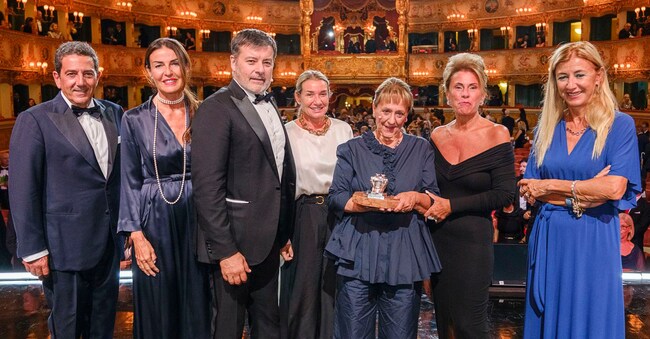
A narrow victory at the Premio Campiello. Winning the literary prize created by the Veneto industrialists in 1962 was Wanda Marasco's 'Di spalle a questo mondo' (Back to this world) by Neri Pozza, the true story of Ferdinando Palasciano, a doctor who lived in Naples at the end of the 19th century and was interned in an asylum for a year due to his delusions.
The novel received 86 votes from the popular jury of 300 readers (282 actual votes). Only 3 votes behind (such a small difference not seen in a long time) was 'Bebelplatz' by Fabio Stassi (Sellerio). Third place, with 58 votes, for the collection of short stories "Inverness" by Monica Pariani (Polidoro). Next was "Troncamacchioni" by Alberto Prunetti (Feltrinelli), 36 votes, and finally "Nord Nord" by Marco Belpoliti (Einaudi) with 19 votes. The ceremony took place, as per tradition, at the La Fenice Theatre in Venice and was broadcast live by Rai 5 with the conduction of Giorgia Cardinaletti: each book was introduced by a BookToker description, a sign that even the Campiello winks at young people and is aware that those who talk about books on TikTok are able to influence the rankings. Luca Barbarossa and the Social Band then associated each book with a song. It is no coincidence that for Wanda Marasco's novel, the choice fell on Franco Battiato's "The Cure" because the cure was a true obsession for Ferdinando Palasciano: he cured the poor and even enemies in war, a 19th century Gino Strada the author defines him as having used man's madness as a form of knowledge "because," says Marasco, "madness has the capacity to lead us to the truth of man".
Another kind of madness, the destructive madness of the Nazis, is investigated in "Bebelplatz" by Fabio Stassi (Sellerio): a journey through the book burnings carried out in Germany in the 1930s. Also blacklisted were Italian writers such as Emilio Salgari, considered anti-imperialist, and a writer of romantic novels homologated to the fascist power, Maria Volpi, "guilty" of having written novels in which women were free and autonomous. 'Without realising it, she wrote against patriarchy,' says Stassi, 'which is the foundation of all authoritarian power'. More historical facts in "Troncamacchioni" by Alberto Prunetti (Feltrinelli), facts taken from court documents and memories handed down by common people. The rebellious and proletarian Maremma of the first half of the 20th century with young men who deserted during the First World War and men who shortly afterwards opposed Fascism. "I tell the story of the last," says Prunetti. "Even today, history is made by the losers who have no words, such as those fleeing Gaza.
Human relationships, from friendship to love, are the focus of the short story collection 'Inverness' by Monica Pariani (Polidoro). The unusual geometries of love, the desire to be seen and chosen. 'Inverness is a Scottish town,' Pareschi explains, 'but it is also a word that evokes winter, the inner winter that many of these stories have in common'. Personal memories, encounters and places are, finally, at the centre of 'Nord Nord' (Einaudi) in which Marco Belpoliti alternates the story of some of the protagonists of the world of culture, especially Milanese, with the tale of details such as the nests of ladybirds in the garage of his house in the countryside, 'because,' says Belpoliti, 'we must have the ability to be surprised by small things'. This brings to a close the 63rd edition of the Campiello, 'a prize,' says Raffaele Boscaini, president of Confindustria Veneto and Fondazione Il Campiello, 'born from the commitment of Veneto industrialists to culture, a form of restitution, a gesture that yesterday as today is not taken for granted. An award that has solid roots, but is constantly evolving'.

