Pharmaceuticals: Dompé to invest one billion in innovation over the three-year period 2026–2028
By 2025, global revenue is projected to reach €1.704 billion. Exports accounted for 86%. Between 2025 and 2026, 11 new clinical trials were launched
Key points
‘We have secured a voucher from the US Food and Drug Administration to reduce the regulatory review period from 10–12 months to 1–2 months for one of the most innovative studies into the intranasal formulation of Cenegermin-BKBJ for NAION, non-arteritic anterior ischaemic optic neuropathy, a condition for which there are no approved treatments.” When discussing scientific discoveries with Sergio Dompé, founder and chairman of the pharmaceutical company of the same name, the conversation seems destined to go on indefinitely. It is somewhat similar to what happens with the innovation on which, over the next three years (2026, 2027, 2028), Dompé Farmaceutici “will invest around one billion euros in both production and research,” says the entrepreneur, “with the bulk of this in Italia and the United States. In 2025 we invested 400 million and this year we will increase the budget by 100 million. In 2026, investment in research will grow by over 50% for clinical trials.”

11 new clinical trials in 2 years
Between 2025 and 2026, 11 clinical trials were launched, 8 in 2025 and 3 in 2026. The company is placing great emphasis ‘on the protein that earned Rita Levi Montalcini and Stanley Cohen the Nobel Prize, NGF (Nerve Growth Factor), convinced that its full potential has not yet been explored,’ continues Dompé. Innovation happens when there is research, and investments in innovation are the most rewarding, whether they succeed or not. The history of research is never a story of successes alone, but of failures too: it is the stubborn determination to search and search through the intricacies of experimentation that allows us to arrive at a confirmed hypothesis and a drug.”
Research areas
The group is currently focusing its research on ophthalmology, neurology and pain management. In the first area, in addition to NAION, it is conducting research into atopic keratoconjunctivitis, persistent corneal epithelial defects and graft-versus-host disease of the eye, in the field of neurology, on cerebral palsy, head injury and neonatal hypoxic-ischaemic encephalopathy; whilst in the field of pain management, on chronic pain and osteoarthritis.
The 2025 accounts
Revenue in 2025 exceeded €1.7 billion, an increase of almost €500 million from the €1.234 billion recorded in 2024. The company employs 1,100 people, 56% of whom are women, and 46% of these women hold leadership positions. ‘Let’s not forget that the pharmaceutical sector is subject to a great deal of pressure. There are new patents, expiring patents, but also innovations that succeed and others that do not, and in any case a company does not realise the value of a project until it has the regulatory licence,” explains Dompé. “It is a complex world, but ours is a trend of strong growth. We are proud to be part of that ‘Made in Italy’ legacy, which is now recognised more widely than in the past, and where there are many stakeholders who, over the last 30 years, have been able to restore our country to a leading role, as demonstrated by the export figures. On average, the pharmaceutical sector exports 75% of its production, amounting to almost €70 billion; we are at over 86%, representing a 46% increase compared to the previous year.” However, the entrepreneur adds, “we pay our taxes in Italia, and our 2025 financial statements, fully consolidated in our country, recorded taxes of over €393 million, almost double the turnover generated in Italia. This is another reason why we are asking for close attention. Five minutes after the pandemic ended, when everyone was saying how strategic it was to have pharmaceutical production in Italia and to be self-sufficient, they all forgot about it. Over the last 15 years, we have seen an overall decline in Europe. Whilst China and the United States continue to play their part and forge ahead, we have lost 20–25% of our competitiveness, a figure that would be far higher were it not for the pharmaceutical sector. The European institutions need to take Mario Draghi and Enrico Letta’s document back into their hands: it is not a simple wish list but an absolute necessity that requires immediate action. The time factor has become critical; we have documents like Mario Draghi’s that have either not been considered or where the actual follow-up is languishing. The risk is that highly competitive companies will prioritise investing in other countries, something I am doing my utmost to avoid because I have a very strong sense of belonging to Italia: we will continue to invest in the country, but the sector needs more attention.”

The L’Aquila campus
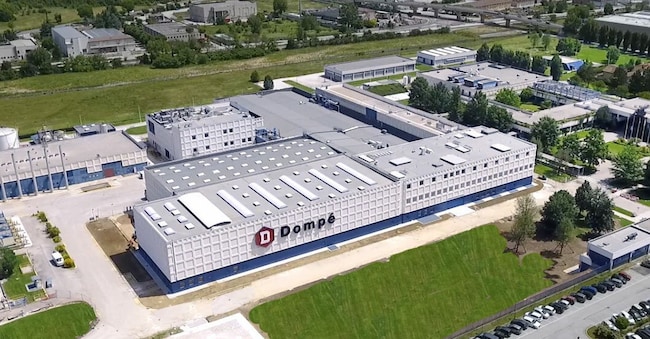
To illustrate this with an example, on the industrial front, Dompé’s production hub in L’Aquila has expanded its operational capacity with a new line dedicated to syrups and oral liquids, bringing the total number of operational lines at the site to nine. The plant incorporates a high-capacity filling system, capable of handling over 10,000 bottles per hour, equipped with state-of-the-art control systems.