
Don Quixote burns with the wisdom of peace
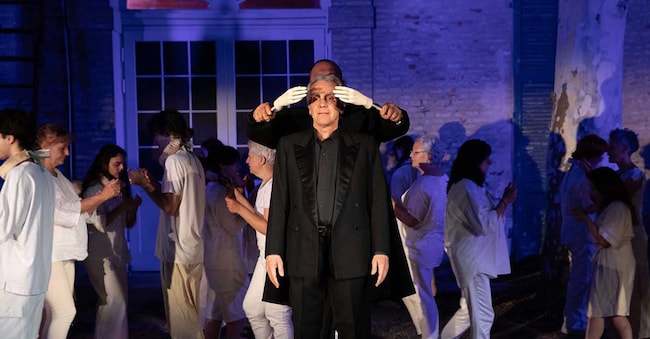
Theatre. Ermanna Montanari and Marco Martinelli stage Cervantes' masterpiece in stages, in which the leading actors are accompanied by citizens to embody the visionary nature of the mancero

3' min read
3' min read
It will be two magicians, Ermanita and Marcus, who will guide us into the fantastic universe of Don Chischiotte, performing the spell of transforming performers and spectators of their spell into the figures of a polyptych arranged on three panels, in a journey through as many places in Ravenna. But it will certainly not be difficult to discover behind the profile of the two enchanters Ermanna Montanari and Marco Martinelli, founders of the Ravenna-based formation of the Teatro delle Albe, which for many years now has been one of the most interesting companies on our scene, always striving to create occasions of great strength and spectacular complexity, yet constantly imagined as possibilities for thought and deep reflection.
The two, who came out "a riveder le stelle" after the itinerary taken in Dante's Inferno, Purgatory and Paradise, begun in 2017 and built together with a multitude of citizens of all ages, not only from the city of Romagna, now re-propose the same idea of a "public call" to give life to a rich and articulated narrative about the knight with the sad figure, in a renewed desire for a relationship with the great masterpieces of literature. It is no coincidence that this year's Festival programme also includes Lisistrata by Aristophanes, realised by Martinelli in Pompeii with young people from the Neapolitan hinterland as the fourth stage of a fieldwork. Martinelli says of the texts tackled: 'The classics are great machines for asking questions about life,' adding, with respect to Cervantes, 'his narrative and thought labyrinths are the labyrinths of our modernity, where truth, dream and illusion are mixed together, around an individual considered insane but animated, instead, by a profound wisdom. It is no coincidence that his becomes a word of prophecy. One need only think of the speech against weapons and wars delivered by the hidalgo. But, adds Montanari, 'Like Dante, the Spanish author proposes a spiritual question, and shows us a figure that emanates light, in eternal conflict with everything that is everyday and coarse'. This is why the title of the stage action is Don Quixote to burn, because if the book, in a consumerist and materialist society like ours, would deserve to be burnt at the stake, from another point of view the character's profile and actions light a fire inside us, "that of a vocation, of a madness, something interior, not visible from the outside", Ermanna adds.
So, three successive stages to compose this sacred representation in stations, with the protagonist embodied by Roberto Magnani, the squire Sancho Panza by Alessandro Argnani and the beloved Dulcinea by Laura Redaelli, and around them the small crowd of two hundred citizens per evening, alternating between the five hundred who answered the call, not only inhabitants of Ravenna, but coming from places where the Albe have realised similar projects, from Milan to Kosovo, with ages spanning the arc of existence, from adolescence to old age. The itinerary will start from the eighteenth-century Palazzo Malagola, seat of the voice research centre founded by the Albe, in a succession of appearances, among wheat fields and taverns, to then go to the palace of Theodoric, where we will walk on an overlay of carpets in an ideal reference to the mosaic tesserae present a few steps away, to then arrive at the Rasi theatre.
Yes, because in all this there is also a sort of "poetic autobiography", as the two illusionists define it, ready to guide us between the stalls and the stage, to show us the fragility of that place and of theatrical communication itself, even more precarious (but perhaps for this reason even more necessary) in an era of virtuality and artificial intelligence. An infinity of colours, of suggestions, of concrete traces or fleeting signs overlap and intersect in this polyptych, with Stefano Ricci's live drawings appearing and dissolving in the many rooms crossed, and a precise sound universe created by the rock band Leda with the voice of Serena Abrami.
THOSE OTHER PALACTICS
Between the audacity and fragility of heroism moves the theatrical billboard of the festival. Starting with the warrior Arjuna, despondent before battle, in Bhagavadgītā, the sacred Hindu text, staged at the Grande Teatro Lido di Adriano by Luigi Dadina and Lanfranco Vicari.
While Marco Baliani with his Silent Courage, reflects on valiant action that does not need glory or rewards.
Fanny & Alexander in Ghosts move instead among the ghosts of Edith Wharton, and into a different sensory perception leads us Nerval Teatro with Beckett's Finale di partita, created by actors with different abilities and dedicated also to deaf and visually impaired spectators.

