
Donatello and the Fragmented Renaissance of Ferrara
Three fragments of the 'Funeral of the Virgin' found: in the 15th century, the Emilian city was the crossroads of cultural innovations

3' min read
3' min read
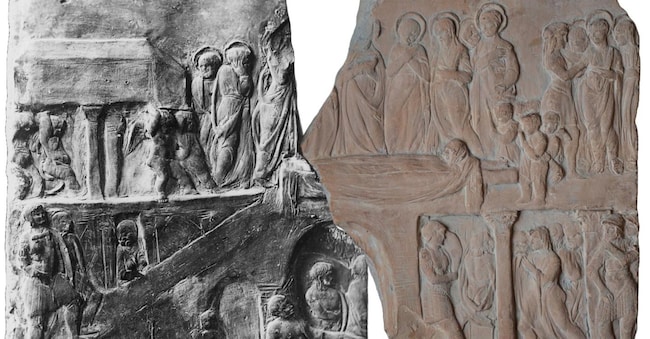
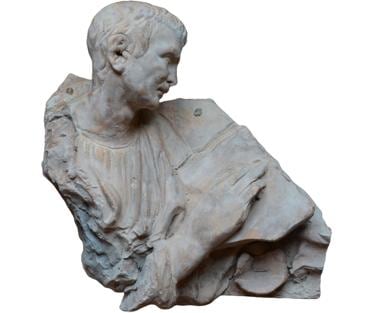
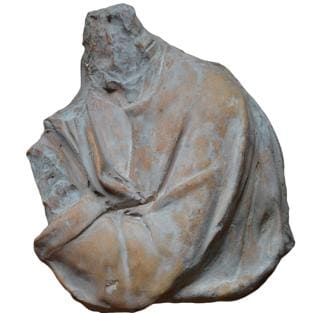
In certain Italian realities, the Renaissance is short-lived, it is really the present. Everyday history. But in spite of the shadows that have recently involved the artistic heritage of Ferrara, Marco Scansani's discovery sheds light on the disagreements and synthesises Donatello's highly topical revolution. In a single fragment found in the stronghold of the Este family, one of the artists who most contributed to the development of Western visual culture in modernity emerges: from the measurability of space to the cognition of the human figure, from the representation of emotions to that of the vitality and motion of 'motionless' sculpture. The 32-year-old researcher recognised in a piece of terracotta crammed with barely-reliefed and sketched figures, a portion of the lost 'Funeral of the Virgin' assigned to Donatello. The relict piece together with the full-length outlines of two Evangelists has slept undisturbed for at least sixty years in the house of a citizen. He unaware, and the terracotta nameless.
The stolen (and forgotten)
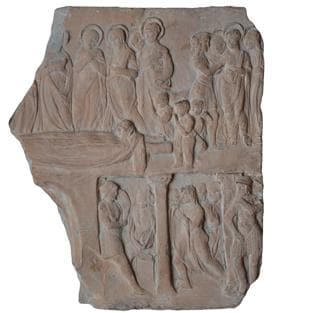
.Scansani narrates the prologue of a very Italian affair: 'In 1916, during work in the church of Santo Stefano in Ferrara, a portion of a terracotta relief was found that critics unanimously recognised as a work by Donatello. Just five years later, however, that fragment was stolen from the Schifanoia Museum where it had been deposited. Having lost the object, studies over time have ignored the importance of that crucial find for the Renaissance. Crucial certainly, since the 1450 work testified not only to the Tuscan artist's passage through the Este city - while he was busy producing his masterpieces in Padua - but also to the blossoming of the Renaissance in Ferrara and its propagation in Emilia. The theft of the 'Funerale della Vergine' also stole the memory of the people of Ferrara and that of historians for the Donatello panel. Scansani, for his part, has reconstructed its provenance, dating and attribution: 'They had re-emerged in 1962 from the well of a private house not far from the church of Santo Stefano - where the 'Funerale della Vergine' was found in 1916 - and together they undoubtedly constitute sketches made by the Florentine artist during his documented stay in Ferrara in 1450'.
The Madonna divided in half
.The fragmentary bas-relief adheres perfectly to the one discovered already mutilated on the right side and taken away from Schifanoia, or rather, to what remains of it: a sharp photograph in which a vertical fracture leaves only a glimpse of the feet of the Madonna lying on the bier, above an architecture crowded with chubby angels, weeping disciples and other toiled, armed, dynamic figures. The right side with the rest of the Virgin is the one found in the well. Scansani recalls Donatello's influence on Ferrara: "If the anecdote evoked by Angelo Poliziano in his 'Pleasant Sayings' is true, the artist in the years of Cosimo il Vecchio is said to have travelled to the Emilian city, with the intercession of the Florentine lord and the permission of the Este marquis, to kill one of his young disciples with whom he had had a quarrel (an intention that later ended in a completely painless and burlesque manner); in 1450 he received ten ducats from the judge of the Twelve Saviours of Ferrara, Agostino da Villa, it is not clear for what assignment, but it is probable that on that occasion the master gave important instructions to his pupil Niccolò Baroncelli for the execution of the Crucifixion for the cathedral'.
A Fragmented Renaissance
.Donatello's imprint was also imprinted by the Ferrara artists' trips to Padua; as Roberto Longhi observed, several painters from the Officina Ferrarese discovered the Renaissance revolution by travelling to Padua, 'dreaming in the shadow of Donatello's chriso-cupro-elephantine altar'. However, considering Baroncelli's long presence in Ferrara, and the documented incursions of the Tuscan master himself, local artists could come into contact with those novelties without the need to travel to Veneto. On the other hand, the Este capital must have had a vocation for the 'Transito della Madonna': if it can now boast the discovery of the three portions of Donatello's preparatory work, the Pinacoteca Nazionale, on the upper floor of the Palazzo dei Diamanti, exhibits the cymatium of the 'Morte della Vergine' that Mantegna painted in 1462 for the neighbouring Gonzaga relatives in Mantua, where Christ with the animula of the Mother is depicted. Separate fate: the panel is in the Prado, the upper part in Ferrara. The Renaissance fragmented, in wells or around the world.

