Art

Double Schiele in Vienna: two exhibitions for the Expressionist artist

The Leopold Museum focuses on the production of recent years while the Horten Collection delves into the early stages of his work

4' min read

4' min read

It is a vast exhibition that the Leopold Museum offers on Egon Schiele's last years of activity, and it is well worth a visit because although it presents works that are well known even to the general public, it broadens the widespread perception of an artist confined within Expressionism, all aimed at subjects torn apart by inner desires and the malaise of living, depicted with broken, nervous, angular lines.

Curated by Kerstin Jesse and Jane Kallir, the 130-part exhibition is well-calibrated and informative, and allows us to dive into the final phase of the production of one of the most important artists of the early 20th century who, as the Leopold Museum's initiative shows, in the last part of his short life (he died in 1918, not yet 28) had taken new artistic paths, not only worthy of note, but also a sign of a turning point: 'What was before 1914 belongs to another world. Each of us must bear our own fate, in life and in death: we have hardened ourselves, and lost our fear,' Schiele wrote to his sister Gertrude on 23 November 1914.
Loading...

The trauma of war

.

It is precisely the experience of the horrors of war, which saw him enlisted for some time, that seems to have prompted him to rethink, along with the conscious decision in 1915 to marry not the beloved model Wally Neuziel, with whom he had been having an affair since 1911, but Edith Harms, with whom at the age of twenty-five he began a more bourgeoisly regulated existence. His gaze stopped focusing on himself and became more open to the world around him. In his new family situation, Egon seems to move away from the inner tangles that had characterised his earlier production and his style changes.

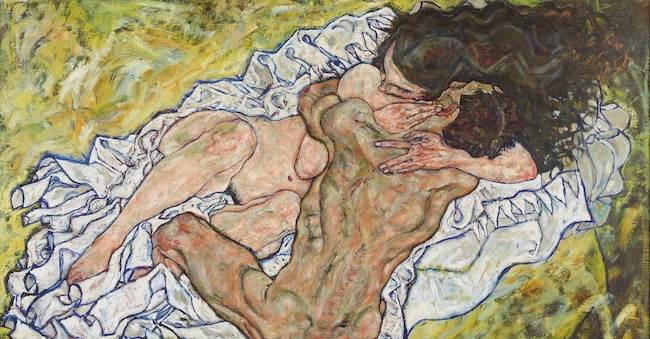
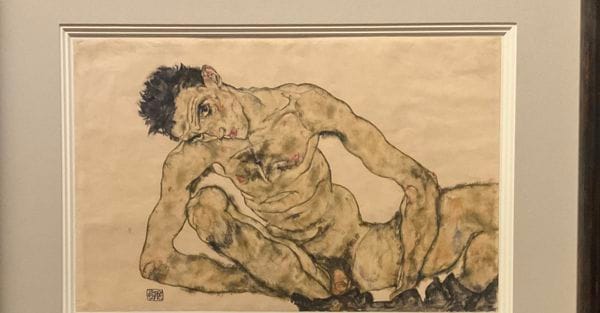
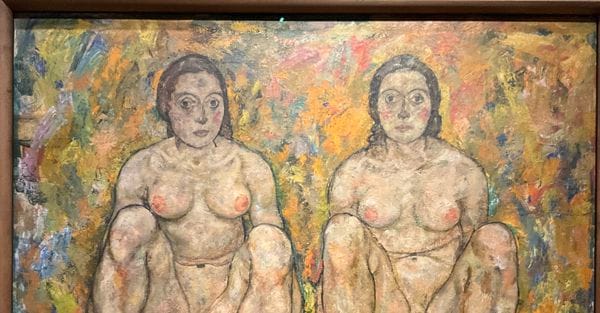
In his painting, the last years saw his forms soften and even become florid; the lines became more fluid, the colours became brighter, the depictions often of both heterosexual and homosexual couples became more realistic, while in contrast his drawings veered towards monochrome. In the war year of 1916, stationed in Mühling, some 100 km from Vienna, he was allowed to paint in a warehouse. This resulted in some 40 portraits of soldiers and officers of the Austro-Hungarian army and prisoners, particularly Russians.

By 1917, he was back in the capital, where he could dispose of models with pronounced fleshiness and explicit poses.
In the exhibition, which illustrates both the biography and the artistic production, some paintings that seem to evoke Asian inspirations also stand out: not only the meagre and stylised saplings that are already familiar, but also landscapes in which water and waves play a leading role and colours fade into shades of green, blue and grey, as in 'Mill in Ruins' of 1916, or 'Creek' of 1918.

Photographic materials and letters are also on display

.

The exhibition also presents photographic material and numerous letters, including the heartfelt ones from the autumn of 1918, when Schiele reports on the desperate condition of his wife, who was six months pregnant and infected with the 'Spanish' flu, which at the very end of the First World War was killing more than battles. Egon also contracted the disease and died three days after Edith, on 31 October 1918, right in the midst of the last gasps of the war.

Both in the exhibition and in the catalogue, his wife's diary, which he wrote during their brief marriage between 1915 and 1918, is presented for the first time: a useful, moving tool to enter into the life of the couple and the dark atmospheres of those years.

The Early Expressionist Schiele at the Horten Collection

As a corollary to the Leopold Museum exhibition, the Horten Collection instead enters the folds of Expressionism, immersing Egon Schiele in the Austro-German context of the first decades of the 20th century. The curatorial team devotes particular attention to silent films and the mournful and disturbing atmospheres that baptised the genre of both horror and science fiction films, and especially between the two wars galvanised the public's interest with films that went down in history, such as Heinrich Galeen's 'The Golem' (1915, with variants from 1917 and 1920), Robert Wiene's 'The Cabinet of Dr. Caligari' (1920), Friedrich Wilhelm Murnau's 'Nosferatu' (1922), or Fritz Lang's 'Metropolis' (1927). The selection of material on offer offers clips as well as sketches revealing great contiguity between cinema and figurative art, advertising materials, as well as a conspicuous series of set photos, which are striking for their special clarity.

The Horten Collection exhibits a number of valuable paintings by Schiele, also from private collections, and a focus is dedicated to the strong gestural expressiveness typical of silent films, with the hands becoming key elements in Schiele's numerous self-portraits and portraits, and emblematically found in the gnarled, contracted fingers of the vampire Orlak in the posters of 'Nosferatu'.

The context created by the paintings and drawings exhibited at the Horten Collection does not always seem to fully adhere to the main theme and seems to fray the exhibition somewhat into numerous rivulets. Nevertheless, there are many valuable and interesting works by Oskar Kokoschka, Max Oppenheimer, Richard Gerstl, Broncia Koller-Spinell, Max Pechstein and Alexej von Jawlenski, among others.

Times of Change. The Last Years of Egon Schiele 1914-1918, curated by Kerstin Jesse and Jane Kallir Leopold Museum, until 13 July

Experiment Expressionism. Schiele meets Nosferatu, curated by Agnes Husslein-Arco, Rolf H. Johannsen and Roland Fischer-Briand, Horten Collection, until 31 August

Copyright reserved ©
Loading...

Brand connect

Loading...

Newsletter

Notizie e approfondimenti sugli avvenimenti politici, economici e finanziari.

Iscriviti