
Double shock for the French stock market: early elections after the European vote

4' min read
4' min read
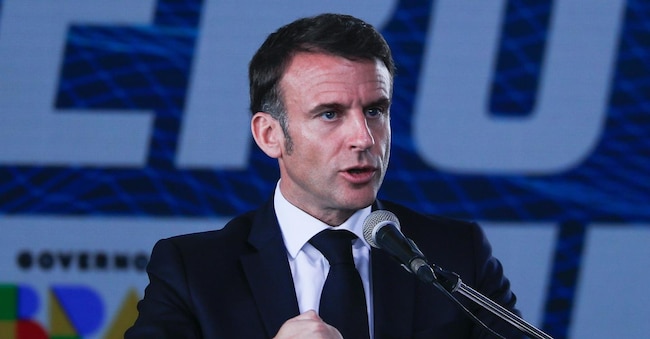
"Earthquake", "shock", "lightning strike", "harakiri or bet?". In France's 'day after', the comments and questions focus mainly on the early legislative elections announced on Sunday evening by President Emmanuel Macron, in the wake of the outcome of the European vote. The victory of the RN of arch-rival Marine Le Pen and her dauphin Jordan Bardella, although in the predictions, came with a 32% share, more than double the 14.5% collected by Macron's Renaissance party. The dissolution of the National Assembly with the decision to call a return to the polls on 30 June, with a second round on 7 July, was in any case a complete surprise. The early dissolution of Parliament, the first since 1997, opens a phase of uncertainty for France that first hit the markets beyond the Alps.
The Paris Stock Exchange in the late morning lost about two per cent. Banks were the main losers, starting with Societé Generale, the black jersey of the Cac 40 with a drop of more than seven percentage points, Bnp Paribas and Credit Agricole, both with drops of close to five points, but also public works or utilities companies such as Vinci, Engie and Eiffage. French stocks thus occupy the last places in the Stoxx Europe 600 index. As traders note, the financial sector is very sensitive to political stability, due to the direct implications on investor and consumer confidence, whileuncertainty immediately increases the risk premium. The utilities and concessions sector is in turn affected by developments in the cost of debt and, of course, also by the strong impact of public policies on the sector.
"Political risk is generally very low in France because the president has broad powers and double majority voting generally guarantees stable majorities. The latest events create uncertainty at a time when the latest economic results, such as budgetary results, are rather mediocre,' comments Bruno Cavalier, chief economist at Oddo BHF. 'This situation of uncertainty could create chaotic market developments,' warns Sebastian Paris-Horvitz, research director at asset manager LBP AM. Rising political risk is beginning to show on government bonds: the yield on the 10-year Oat has risen to 3.17%, causing the spread with the German Bund to widen to 53bp. Even the downgrades by Fitch in 2023 and S&P last month had no impact on the cost of sovereign debt, because institutional stability was taken for granted.
The market has to reckon with the possibility of a victory for the extreme right even at national level and with an election campaign that promises to be short, but full of the unknowns that investors notoriously detest. Will the extreme right, i.e. the RN of Le Pen and Bardella and Eric Zemmour's Reconquete, manage to gather the 289 deputies needed to have a majority in France against the current 88? The double-round elections do not facilitate this outcome. This is probably what Macron is banking on, as he is hoping for a recomposition of the traditional parties, opponents of the extreme right, as happened in the last two presidential elections, from which Le Pen emerged defeated. Or - and this is another theory - the president, in the event that the national elections confirm the European result, is counting on the attrition of a possible right-wing government in the years remaining until the end of his term in 2027, paving the way for a new presidential tilt. However, cohabitation is likely to be heavy if not prohibitive: the early dissolution of Parliament decided in 1997 by President Jacques Chirac opened the way for Lionel Jospin's socialist government, making life difficult for both the Elysée and Matignon.
An arrival of the extreme right wing in government, protectionist and nationalist, would force investors to hastily review their bets on France. Foreign funds in particular could adopt a wait-and-see attitude. Even if RN no longer evokes 'Frexit', his economic programme, if implemented, risks devastating France's already problematic public accounts. The reduction of VAT on hydrocarbons from 20% to 5.5%, envisaged by Marine Le Pen in 2022, alone would have an impact of EUR 10 billion per year, according to the Institut Montaigne. This is an unbearable burden for a public budget after the deficit/GDP jumped to 5.5% in 2023 and the target to reduce it to 4.4% this year seems optimistic, not to mention the debt/GDP at 110.6%. Even without an RN victory in the legislative, the new parliament could turn out to be even more fragmented and unstable than the current one, where Macron and the young premier Gabriel Attal cannot count on an absolute majority, commentators warn. With the dissolution, Emmanuel Macron is making 'an extremely risky bet', even though 'there will certainly be very different voting behaviour' between the legislative and European elections, comments historian Jean Garrigues, raising the question: 'will these elections put the French people in front of the choice: do we want a government' of the extreme right?

