
Down with minimalism! Have fun with neo-pop objects and the energy of colour
Form follows pleasure, not function. Gustaf Westman’s design language has a strong visual identity, focusing on abundance and accumulation. Episode 1

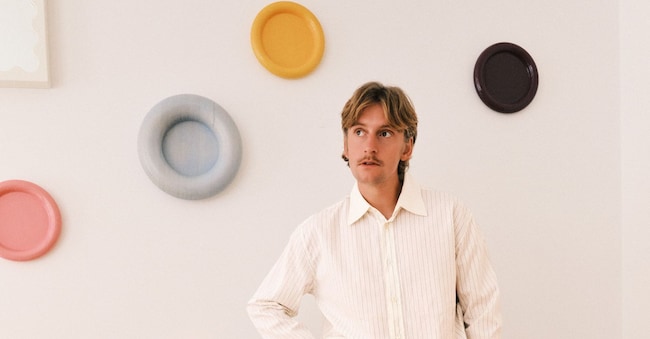
A new generation of creatives is subverting the clichés of Nordic minimalism – synonymous with discipline, clean lines, a restrained colour palette and an unshakeable faith in function. Everything is changing: where there was once subtraction, there is now abundance and accumulation; where neutral tones once dominated, pastel palettes and rich colours are now making their mark. There are echoes of Postmodernism and the radical irony of movements such as Memphis or Alchimia, but without nostalgia. Here, there is simply a taste for fun. Among the leading figures of this new wave is the designer Gustaf Westman, who creates objects that could easily be taken straight from a cartoon fairy tale.
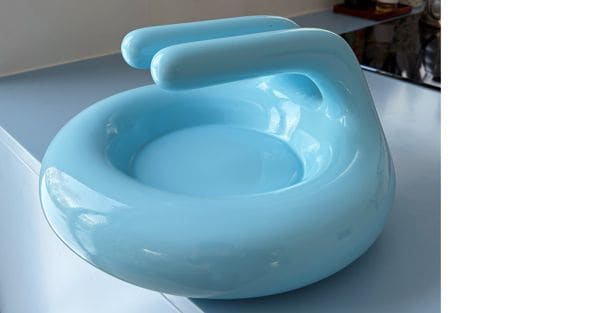
Designer Gustaf Westman’s studio and workshop is situated in a quiet corner of the island of Södermalm, in Stockholm. You can spot it from the street: pale pink curtains frame three large windows that stand out amongst the houses in the suburb, not least because they provide a backdrop to a riot of ceramics, plates with rounded rims, carafes balanced on bulbous feet and tall candlesticks with soft lines, in shades ranging from pastel pink to powder blue. Inside, the space is spacious; every shelf and every surface is covered with all manner of objects. ‘It’s all very chaotic, but colourful,’ says the designer with a smile, as he picks up a cobalt-blue carafe and holds it next to a cup in the same shade: it’s the new colourway for an existing tableware collection. ‘It took me ages to find the right colour. I wanted a blue that wasn’t too purple-tinged, nor too light,’ he explains, referring to his meticulous approach to colour, which, he says, is entirely intuitive. ‘I like decisions that don’t seem like decisions,’ he says, looking around. “This is a cup, it’s blue, end of story! I just do what makes sense to me.” She must have thought the same thing when, in the midst of Milan Cortina2026, she wanted to pay tribute to the Swedish siblings Rasmus and Isabella Wranå, Olympic curling champions, with her Curling Bowl in sorbet blue, an aperitif bowl with a glass holder inspired by the stone used in the sport.
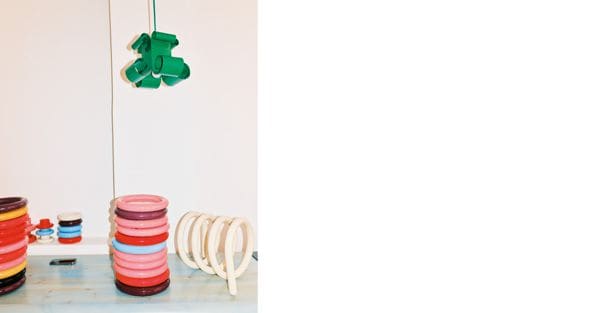
Westman founded the studio in 2020, after studying architecture in Gothenburg and moving to Stockholm. The breakthrough came with a mirror featuring a wavy frame (Curvy, 2,400 euros). Originally created for a Swedish clothing brand, it proved a huge hit online, thanks in part to high-profile orders, including those from American rapper Tyler, The Creator and singer Olivia Rodrigo. The ‘Olympic champion of snacks’ – as he described himself on social media following the launch of the bowl – is now 31 years old and creates collections characterised by a design language with a strong identity. “I love brands where everything seems to be part of a single universe; it’s about developing a code around which everything revolves,” he says. “My pieces have the energy of the person who designs them,” he says, referring to his creations such as the Blob sofa (€2,400), the Curvy (€750), the flower-shaped mirrors (€430) and the oversized wine glasses (€85). “Perhaps, in the eyes of a purist, they don’t suit every setting, but in my opinion they look good anywhere: they really stand out.”
Westman’s works go beyond mere aesthetics. Behind the eccentricity lies a talent for making the functionality of objects fun. The Chunky cup – cylindrical in shape with soft lines, which sits perfectly on a rounded saucer (65 euros) – is a clear example of this. ‘I wanted something simple to hold in your hand,’ he says, sipping coffee from his own cup – a deep coral colour with a matching saucer. ‘If you spill anything, the saucer catches it.’
Westman’s playful spirit is also evident in his collaborations with brands and in the pop-up shops that have helped raise the profile of his work. He has designed everything from a candy-pink Mercedes-Benz – more a work of art than a car, with giant wing mirrors and a built-in picnic table – to a pop-up store in Brooklyn housed in an industrial space transformed into a sort of museum. Recently, he has collaborated with Kindred, the home-swapping platform, to set up pop-up shops across Europe, which he furnishes and decorates with his own designs: the openings have become hugely successful events – such as the one organised for 3daysofdesign in Copenhagen, where there was a very long queue of Gen Z youngsters. ‘“We tried to find the most characteristic flats in the city and give each one a twist, whilst keeping the genius loci intact,” he says. By the end of 2025, Westman’s pop-up collaborations also included Ikea: he created twelve pieces for a Christmas tableware collection for the Swedish furniture giant. The most famous is a long, light blue rectangular plate with a raised-rimmed recess in the centre designed to hold exactly eleven meat or veg balls.

