
Draghi: time for EU reforms, you can't always say no

2' min read
2' min read
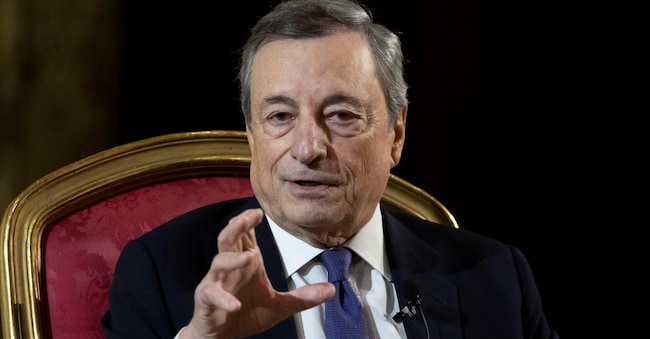
"They asked me at the end of Ecofin what is the order of the reforms needed for the EU, what is the order I don't know, but please, it is time to do something, you decide what but please do something, you cannot spend all your time saying no". This was said by Mario Draghi, according to Ansa, speaking to the chairmen of the Eurochamber committees meeting on the competitiveness dossier, on which the former prime minister has been asked to compile a report.
Last weekend, the former Italian prime minister had also presented the report to the European finance ministers. On that occasion he insisted on the need to mobilise huge investments to enable Europe to compete with the US and China, both public and private investments.
Single market needs much improvement
'Money,' he added, 'is only one aspect of the problem. The other aspect is a profound review of the rules we have built and worked on. The single market is another example: we used to call them structural reforms. That's what we have to do now: structural reforms, at EU level. The single market is highly imperfect: there are hundreds of directives that are not implemented, or are implemented differently in different countries'.
We cannot pay electricity twice as much as the US
.'The electricity market,' he continued, 'is another area we have to look at, because clearly Europe cannot be competitive if we pay twice as much for electricity as it costs in the US and five or six times as much for natural gas. There are many things we have to do, of which money is only one,' he concluded.
Achievements
.The former central banker recalled that 'in recent years, the European Union has achieved a lot: from the adoption of world-leading climate and digital policies, to the definition of the tools guiding Europe's recovery from the pandemic of and reducing our dependence on Russian energy imports'. At these junctures, the European Parliament 'has been instrumental and often led the way'. And yet 'despite our successes in dealing with crises and shocks in recent years, we find ourselves at a critical moment'.

