
Draghi: on tariffs the EU can negotiate with Trump but with one voice
The former premier recalled that Europe is very dependent on the US and China. And he urged not to repeat the mistake made on solar power in favour of Beijing

4' min read
4' min read
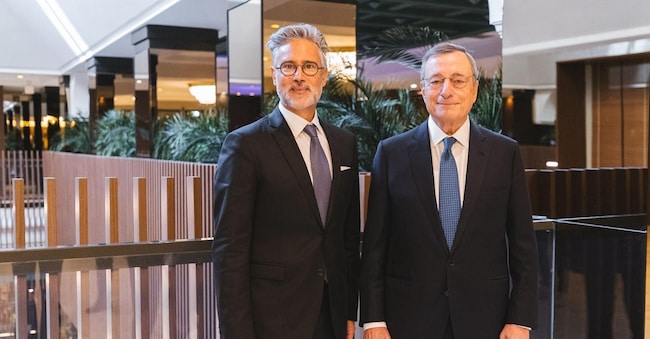
What will happen to Europe with the return of Donald Trump to the White House? The million-dollar question of the moment was put to Mario Draghi, former president of the Council and former president of the ECB, by some fifty CEOs, Italian and otherwise, attending the prestigious annual Milanese Executive Lunch organised by Porsche Consulting.
Draghi, who could have evaded the question with his trademark irony (no one knows exactly what will happen with the new US administration and so it is 'pure speculation') focused instead on one of the few certainties about Trump's next moves: tariffs.
For Draghi, there is no doubt that the new US president will introduce tariffs on important products in the US from China and Europe. But he will do so with a substantial difference between the two markets, which will allow the EU some room for manoeuvre. The duties on Chinese products 'will be higher and will be non-negotiable' while according to Draghi the duties on European products will be more moderate than those imposed on China and above all 'will be negotiable'.
In short, Europe will have a chance to interact, and it will be better if it does so with one voice, with Trump: there will be a chance to open negotiations to reduce duties on European products. 'Europe, for example, could guarantee the level of public spending on defence that Trump is demanding, and thus bring down tariffs,' Draghi speculated, underlining the fact that Europe - unlike China - could find itself in a position to respond to Trump's moves: but it will then have to be ready to act.
Europe, Draghi reminded well aware that he was addressing a very qualified audience, is much more dependent on the US and China than these two countries are on Europe. Europe's GDP depends 50% on trade, while for the US and China the percentage is around 25%-30%. Europe is dependent on the US in the conflict between Ukraine and Russia: 80% of aid to Ukraine comes from the US. And the US is the EU's largest trading partner, with a trade in goods of more than EUR 800 billion, and is the first or second largest trading partner of many European states (e.g. Germany). So it is inevitable that any decision of the Trump administration will have a strong impact on Europe. Dependencies, such as Europe's towards the US, make it vulnerable. And this is also why, according to Draghi, the EU must act: even more so with Trump's return to the White House.


