
Draghi: 'Europe risks becoming subordinated, divided and deindustrialised. The US seeks the fragmentation of the EU'
The former prime minister received an honorary degree in Leuven, Belgium. Costa: "Draghi and Letta at the EU leaders' summit on 12 February"

Key points
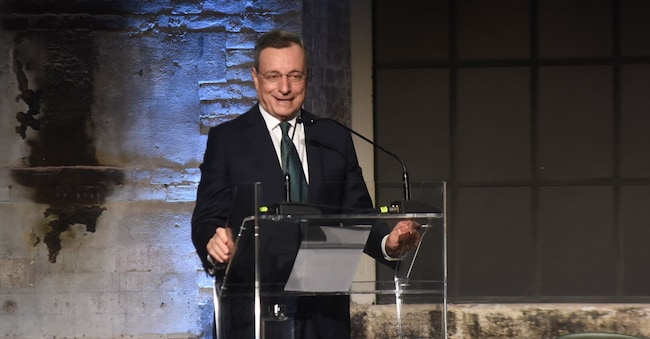
Europe faces 'a future in which it risks becoming, at the same time, subordinated, divided and deindustrialised'. This was said by former Prime Minister Mario Draghi speaking at the University of Leuven, in Flanders, Belgium, while receiving an honorary degree. Draghi emphasised that 'a Europe incapable of defending its interests will not be able to preserve its values for long'.
Draghi: "US seeks EU domination and fragmentation"
"The United States, in its current position, seeks dominance along with partnership," Draghi said. China sustains its growth model by exporting its costs to others. European integration is built in a different way: not on strength, but on common will. Not on submission, but on shared benefit'. The US, he pointed out, today 'impose tariffs on Europe, threaten our territorial interests and make it clear, for the first time, that they consider European political fragmentation functional to their own interests'.
According to the former ECB president, the rules-based global order, the US multilateralism that has governed the world since the end of World War II, is 'defunct' and, although he finds it hard to believe that it is forever, the facts must be taken 'for what they are'. "Since its inception," he continued, "the architecture of the EU has embodied the belief that the international rule of law, supported by credible institutions, promotes peace and prosperity. Since no European state was able to defend itself alone, our security doctrine was shaped by the protection offered by America. In alliance with the United States,' Draghi recalled, 'we were able to face any threat and bring peace to Europe among ourselves. Without the guaranteed security and with trade flowing primarily within that alliance, we could safely pursue economic openness as the basis of our prosperity and influence'.
"But the now defunct global order," continued the former ECB president, "did not fail because it was built on illusion. By the way, while I say it is defunct, I find it hard to believe that it is actually defunct, dead. I just heard today that your extraordinary and beautiful library was destroyed twice, once during the First World War and a second time during the Second World War. On both occasions it was rebuilt with the help and under the encouragement of US presidents. But that is what it is today. And, for the time being, I think we should take the facts for what they are'.
'With China's accession to the WTO,' Draghi said, 'the boundaries of trade and security started to diverge. We had always traded outside the alliance, but never before with a country of this size, and with the ambition to become a separate pole itself. Global trade has moved away from Ricardo's principle that trade should follow comparative advantage'. Some states, Draghi said, "have pursued absolute advantage through mercantilist strategies, imposing deindustrialisation on others, while the remaining gains have been shared unequally. We have forgotten about inequality. This sowed the political backlash that we now face".

