
Driverless racing cars: the University of Modena and Reggio Emilia at the top of the world

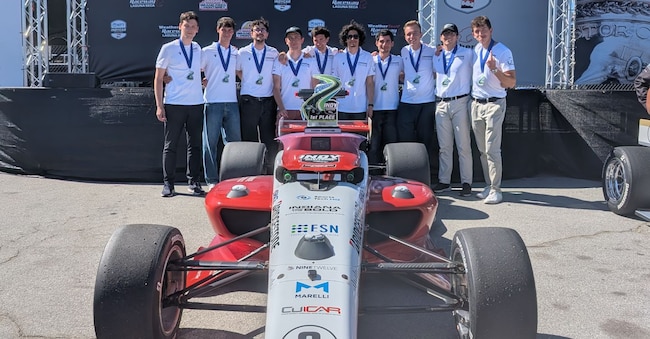
Three overtakes on the Corkscrew, with no driver in the cockpit. At Laguna Seca, an iconic circuit in world motorsport, the University of Modena and Reggio Emilia won the Indy Autonomous Challenge, beating Purdue University from the US in the final head-to-head. At the wheel of the Unimore Racing single-seater were not human hands, but software developed by the university’s students and researchers: a digital ‘driver’ capable of reading the track, choosing the racing line and launching the attack. It did so three times at the Corkscrew itself – the sequence of plunging bends that forged the legend of Laguna Seca and which, from today, bears the name of Alex Zanardi, thirty years on from his ‘The Pass’ in 1996. The victory came at the end of the head-to-head race in the Indy Autonomous Challenge, a competition that transforms the circuit into a high-speed laboratory for autonomous driving. Eight university teams competed in California: alongside Unimore and Purdue, AI Racing Tech – comprising Berkeley, Hawaii, San Diego and Carnegie Mellon; Auburn University; Caltech; Indiana University; the South Korean KAIST; and PoliMove-Tet, led by the Politecnico di Milano alongside Tecnológico de Monterrey and in collaboration with Michigan State University and Lawrence Technological University. The second Italian team also made it onto the podium, finishing third. Two Italian teams among the top three, confirming the significance of Motor Valley and Italian automotive research.
What makes this unique is that the hardware is the same for everyone. Competitors in the Indy Autonomous Challenge build their AV-24s using a Dallara chassis (once again, with an Emilian heart at its core) derived from the Indy Nxt, adapting it for driverless operation. On board are radars, cameras, positioning systems and high-performance computers. The sensors map out what is happening around the car; the software merges the data and decides in real time how to brake, accelerate, steer, defend its position or overtake. This is where the race is decided: in the algorithms, the ability to predict, and the speed with which the system reacts at speeds exceeding 200 kilometres per hour. The AV-24 is designed to exceed 190 miles per hour – over 300 kilometres per hour – turning the track into an extreme test bed for technologies also intended for ADAS systems and autonomous road vehicles.
For Unimore, this success is the result of long-term effort. The team led by Professor Marko Bertogna has been working for years on real-time computing, control systems and autonomous driving, and back in 2025 had already set a record at the Modena Autodrome with the very same AV-24: 58.3 seconds per lap, one second faster than the previous record set by a Lamborghini Huracán. At Laguna Seca, the next step was to ensure the algorithm made not only quick decisions, but competitive ones, whilst navigating traffic and racing against an opponent. The schedule leaves little time for celebrations. Tomorrow, 5 September, Unimore and PoliMove will be back on track at Imola for the European debut of the Abu Dhabi Autonomous Racing League (A2RL), alongside the German teams Tum and Constructor and the Kinetiz team from the UAE. The cars will be identical Dallara Super Formula SF23s and, once again, it will be the software that makes the difference. Unimore will once again start from pole position: from Laguna Seca to Motor Valley, in less than forty-eight hours, the driverless car challenge is becoming increasingly Italian.

