Europe

Drought: nearly 70 per cent of France under water restrictions. The Rhine set to be divided into two separate navigation zones

An official water shortage has been in force in the Netherlands since 16 July.

aggiornato alle 16:20

Aggiungi Il Sole 24 Ore
ai preferiti su Google
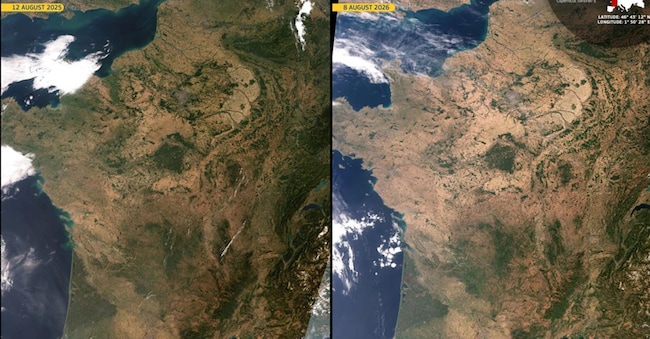
Secondo l’Osservatorio europeo sulla siccità (EDO), a metà luglio 2026 oltre l’85% del territorio della Francia era soggetto a condizioni di allerta o avviso di siccità, rispetto a circa il 65% nello stesso periodo del 2025 (e a meno del 2% nel 2024). Nell’immagine a destra, acquisita l’8 agosto 2026, i toni del beige e dell’ocra dominano il paesaggio dalla costa atlantica alle pianure settentrionali, mentre le aree più verdi sono per lo più limitate alle foreste e alle zone montuose. In quella di sinistra, acquisita il 12 agosto 2025, aree di colore marrone chiaro si estendono nella parte occidentale del paese e nel bacino di Parigi. Ansa/Ue, immagini Copernicus Sentinel-3  Ansa

5' min read

Translated by AI
Versione italiana

5' min read

Translated by AI
Versione italiana

Almost 70 per cent of France is subject to water use restrictions, due to an increasingly severe drought, exacerbated by the repeated heatwaves that have been affecting the country for months.

The figures come from the Ministry for Ecological Transition, which has announced that it has called a crisis meeting for Wednesday 12 August.

Loading...

“The effects of climate change continue to exacerbate pressure on water resources” and “almost 70 per cent of France’s territory is subject to water use restrictions”, the ministry said.

As of 9 August, all 99 departments (the equivalent of Italian provinces) in mainland France were at least at the ‘vigilance’ level.

Of these, 67 were classified as being in a crisis situation (the highest level) and a further 21 as being on heightened alert.

At crisis level, water use is restricted to priority purposes, with restrictions on agriculture, filling swimming pools, car washing and the maintenance of green spaces.

France braces for a fifth wave, with temperatures expected to reach 40 °C

France is bracing for the fifth heatwave of the season.

The national weather service, Météo-France, warns that temperatures will reach 40 °C from Tuesday 11 August 2026 in the south-east of the country.

Across Europe, the extreme heat began in May and helped to trigger widespread wildfires, a prolonged drought and record-breaking temperatures, resulting in thousands of deaths.

In France alone, heatwave warnings were issued for the first time ever in May, with more than half the country recording new monthly temperature records.

Loading...

The heatwave intensified in June, a period during which, according to the French public health agency, there were at least 5,700 more deaths than the average.

Météo-France has stated that 23 June was the hottest day ever recorded in the country.

Temperatures reached 44.3 °C in the south-west.

In July, there were two further heatwaves, which exacerbated the effects of a fire of historic proportions in the south-west, forcing 220,000 people to flee their homes in one of the continent’s largest evacuation operations since the Second World War.

Netherlands: the Rhine at an all-time low – 1947 record broken

The flow rate of the Rhine in the east of the Netherlands has reached a new all-time low, falling below the previous record low set in 1947. This was reported by the Dutch broadcaster NOS. At Lobith, on the border with Germany, where the waters of the Rhine enter the Netherlands, the average flow rate over the last 24 hours has fallen to 614 cubic metres per second. In 1947, the daily low was 620 cubic metres per second.

According to NOS, the decline is due to the early snowmelt in the Swiss Alps and the lack of rainfall. The situation could worsen further due to the heatwave and drought that continue to affect Western Europe.

The Rhine is one of Europe’s main trade routes, linking the port of Rotterdam to the industrial areas of Germany and other countries. Low water levels are already forcing vessels to reduce their loads, driving up the cost of transporting petroleum products, metals, minerals, coal and chemicals. An official water shortage has been in force in the Netherlands since 16 July.
Drought alert in Germany too, with the Rhine heading towards record lows

The water level of the Rhine (1,326 km long) continues to fall – due to the drought and the lack of rainfall – raising the risk that Germany’s main waterway may no longer be navigable throughout its length.

The warning comes from the Bundesverband der Deutschen Binnenschifffahrt (Bdb), the German association for inland waterway transport. “Due to the lack of rainfall, a single-digit water level is forecast for the first time this week at the Kaub gauging station – this morning it stood at 17 cm, equivalent to a navigable depth of 130 cm – which is crucial for navigation and the economy”, said the Bdb’s Director-General, Jens Schwanen, to the Rheinische Post. “In principle, the Rhine will therefore no longer be continuously navigable and will effectively be split in two”, he added. The previous lowest water level on record at Kaub was 25 cm in 2018

The water level at Kaub, between Koblenz and Mainz, is regarded as a benchmark for navigation on the Rhine. In this stretch, the riverbed is already relatively shallow and, according to the BDB, the expected water levels are a cause for particular concern.

“With water levels this low, commercial shipping in the region will no longer be able to transport goods”, warned Schwanen. The same problem would also affect tourist boats and cruise ships. This would result in two separate shipping lanes.

In the north, traffic would continue to operate between the ARA ports (Amsterdam and Rotterdam in the Netherlands, and Antwerp in Belgium) and North Rhine-Westphalia, as far as the Cologne area, via the Rhine and the canal network of western Germany.

Further south, however, traffic would continue on the Neckar, Moselle and Main rivers and on the Main-Danube Canal, a major international link to south-eastern Europe and the Black Sea.

Transport companies are being forced to increase the number of journeys, which significantly raises logistics costs. Last Thursday, the German Transport Minister, Steffen Bilger, hinted at the possibility of temporarily suspending the ban on heavy goods vehicles on Sundays and public holidays, in order to boost road freight transport. Some German federal states, such as Saarland and Rhineland-Palatinate, have already adopted this measure.

The largest reservoir in the US is at an all-time low; drought alert in the West

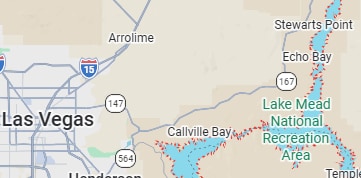
 Lake Mead, the largest reservoir in the United States and a vital source of water for over 25 million people in the south-west of the country, has fallen to record lows, with the entire region grappling with a devastating drought. This is reported by the New York Times.

Lago Mead

Grande bacino del fiume Colorado, al confine tra gli stati del Nevada e dell’Arizona

mappa estrapolata da Google maps

This negative record, first reached on Thursday evening and then surpassed in the days that followed, is merely the latest warning sign regarding the state of the Colorado River, which has been in crisis for years. The river system, the lifeblood of at least seven states, is threatened by rising temperatures and decades of over-exploitation. “It’s a major wake-up call,” said J.B. Hamby, chair of California’s Colorado River Board. “We need long-term solutions to steer us away from the brink.”

The states in the upper Lake Mead basin — Colorado, New Mexico, Utah and Wyoming — and those in the lower basin — Arizona, California and Nevada — have been negotiating for years, without success, over how to allocate the water. And in February, the federal government announced its intention to impose its own plan. The Donald Trump administration’s proposal envisaged drastic cuts for the lower basin.

Communities across the south-west are now awaiting details from the Department of the Interior’s Bureau of Reclamation, which will set out the specific cuts that the states will have to implement over the next two years.

Copyright reserved ©
Loading...

Brand connect

Loading...

Newsletter

Notizie e approfondimenti sugli avvenimenti politici, economici e finanziari.

Iscriviti