Test drive

DS No. 8, here's what it looks like, how it goes and how much it costs, the French car born in Italy in Melfi

The first model based on the Stla Medium platform produced in Italy at the Jeep Compass plant in Melfi, the suv-coupé is at the top end of the range for DS Automobiles, which has long had the premium sector in its sights with a range composed of versions powered by three different electric powertrains, which also integrates long range two- and four-wheel drive variants.
by Massimo Mambretti

5' min read

5' min read

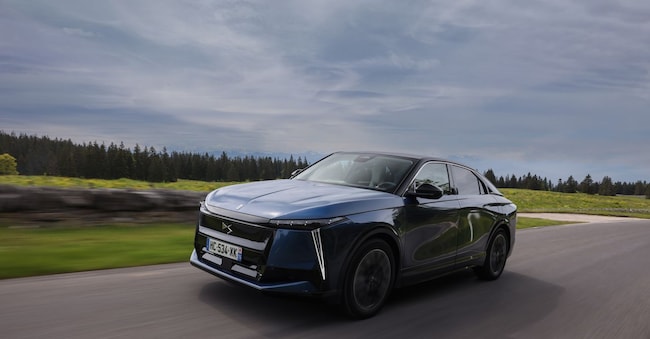
DS Automobiles embarks on a relaunch with the DS No. 8. It is a large electric suv-coupé emphasised by its body design and is, to all intents and purposes, the transalpine brand's most luxurious flagship. It is the progenitor of a new generation of DS also conveyed by the name completed by the letter N, which has already been combined with that of the DS 4 fastback but, above all, it is the first car of this brand produced in Italy. Its debut at the first tests was accompanied by the underlining fact that the styling, presentation of the cabin, finish and powertrain are French, much less by the fact that it is produced at the Italian plant in Melfi. A plant from which so many Fiat 500 X, Jeep Renegade and Compass cars have come out over the past decade, but whose fate, along with that of other Italian plants, has also been tied to the lengthy confrontation between Stellantis and our government, but which, in the end, is back in the game by relying heavily on the skills of those who work there, capable of guaranteeing a high level of quality. In fact, let us remember that after this DS in Melfi the new Jeep Compass will be produced on the same multi-energy Stla Medium platform starting in the coming months and the Lancia Gamma in 2026.


Loading...

DS No.8, architecture already known, powertrain partly unpublished

.


With a length of 4.82 metres, a width of 1.90 metres, a height of 1.58 metres and a wheelbase of 2.90 metres, the N.8 uses the Stla Medium platform also employed by the latest Citroën and Peugeot SUVs. The range consists of the front-wheel drive version powered by a 230 horsepower powertrain already in operation on other large French Stellantis electrics powered by a 73.7 kWh battery promising a range of 550 kilometres, and its long range evolution combining a 245 horsepower electric unit with a 97,2 kWh battery pack promising a range of 750 kilometres, and its four-wheel drive evolution with a 350-horsepower twin-engine system also powered by the larger capacity battery pack, which can cover almost 670 kilometres before plugging in. All incorporate a boost function that, according to the powertrain, briefly raises power from 25 to 35 horsepower. The batteries can be recharged either with alternating current at 11 kW or direct current at up to 165 kW, for a 20 to 80 per cent refuelling in half an hour or a 200-kilometre journey in ten minutes. However, the fact that the Stla Medium is a multi-energy architecture leaves room for speculation that versions with plug-in systems may also arrive in the future.

Supporting the efficiency of DS's latest model are several car configurations, which on the four-wheel drive N.8 also integrate a dedicated mode, three regenerative braking steps and the one-pedal function. The all-wheel-drive version also comes standard with predictive adaptive suspension, which is self-adjusting to optimise comfort and behaviour according to what a front camera detects. The Adas equipment supports the advanced level 2 semi-assisted driving system, which also includes an automatic lane change function.


DS N.8, le foto della prova dell’ammiraglia elettrica

Photogallery13 foto

DS No.8, a little bit suv-coupé, a little bit fastback


The term crossover refers to a mix of characteristics and, perhaps for this very reason, seems to us the best way to define the line of the N. 8, a little bit suv-coupé and a little bit fastback. Its line echoes and evolves the canons of the smaller N. 4 with its taut lines, the long but high front, personalised by a specific light signature together with the sloping profile of the pavilion, but in the end, with the complicity of its dimensions it generates an authoritative appearance thanks also to the complicity of the sustained posture, imprinted more than by the ground clearance of the rims that reach up to 21", the ribs that dilute the taut lines of the sides, the muscular wheel arches and the lower and side body protections. The outfit also does not conceal tricks designed to benefit aerodynamics.


DS No. 8, inside is spacious, hi-tech and sophisticated

.


Continuing to reduce the extensive presence of chiselling and inlays that characterised, above all, the first DS spin-offs from Citroën, on the N.8 the DS interior design generates an ambience in which minimalism is balanced with hi-tech. The atmosphere of the large cabin, in which even three people can travel comfortably in the rear, is hi-tech and refined, enhanced as much by the execution as by the extensive use of fine materials and craftsmanship. The linear dashboard is softly connected to the door panels, supporting a 12.25" digital cockpit that can be configured but not extensively, to which is added a large head-up display, and the 16" display of the always-connected infotainment system integrated by ChatGpt and wireless interaction for smartphones, but not very intuitive in some menus. For example, the navigation one as we found when we reset the final destination. Most services and functions remain, fortunately, entrusted to physical buttons, many of them on the wide, floating centre console that houses ample storage, a refrigerated compartment, USB sockets and the charging plate for smartphones, clearly separating the driver from the passenger who, on the other hand, travel on large seats with electric adjustments, massage and thermal functions and even air neck warmers. The environment offers high comfort thanks to extensive insulation, which also makes use of effective laminated glass. The cargo area has a capacity of at least 620 litres and has a long loading platform, but also has a somewhat high access threshold from the ground: at 77 centimetres.


DS No.8, how does the 350-horsepower Awd Long Range go

.


Together with 350 horsepower, the twin-engine powertrain of the Awd Long Range also delivers 509 Nm of torque, numbers that push the most powerful of the No. 8s up to a self-limited speed of 190 km/h and 100 km/h in 5"4, against an average consumption of 17.4 kWh/100 km. This is not too far from the 18.7 kWh/100 km recorded by the on-board computer at the end of our test, which took place almost entirely on mountain roads, mostly in Switzerland, where the observance of obsessive speed limits monitored by battalions of cameras does not invite overdoing. In any case, from the driver's seat, one is not impressed by the powertrain's performance because it is entirely adequate to what its numbers promise and its constitutional inclination to always adequately respond to throttle commands. In short, the leitmotif is the classic electric drive and that, of course, is only modulated by the power and torque available as well as the inputs of the car configuration used, because the delivery is always linear. On a dynamic level, the suv-coupé proves to be reliable enough to offer instinctive driveability, while always offering a truly high level of comfort.


DS No. 8, versions, equipment and prices


The range is divided into the Pallas trim, downgraded from the top of the range of the iconic ID/DSs of the past to entry-level and reserved for front-wheel drive versions on sale at prices starting at 59,000 euros, Ètoile, which is joined by the all-wheel drive variant and whose price list starts at 66,000 euros, and Jules Verne. A customised collection that includes only the Long Range two- and four-wheel drive versions, with prices starting at 76,000 euros.

Copyright reserved ©
Loading...

Brand connect

Loading...

Newsletter

Notizie e approfondimenti sugli avvenimenti politici, economici e finanziari.

Iscriviti