
Dubai Opera, an Italian behind the attendance record. 'Courage is needed in the choices'
Paolo Petrocelli, superintendent of the largest cultural institution in the Emirates since 2013, speaks
5' min read
Key points
5' min read
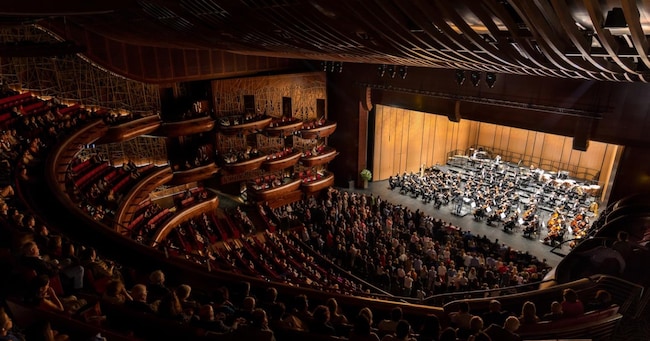
"After almost two years at the helm of this institution, which represents a unicum on the international scene, since it is an entirely privately owned cultural project, in the hands of the Emirati group Emaar, I can affirm that a theatre can generate profit and be an excellent driver of economy and value." Paolo Petrocelli, 40, has been the superintendent of the Dubai Opera House since the beginning of 2023. Since 2016 it has been the largest performing arts centre in the Emirates, with an auditorium seating more than 2,000 people and a programme that every season hosts productions by some of the world's most important cultural institutions, which bring their shows, ballets and concerts here. Last year also, on the occasion of COP 28 in Dubai, La Scala di Milano and the Opera di Roma brought their orchestra and ballet corps here, respectively, enjoying great success and helping to spread Italian culture in front of an international audience of over 30 thousand people.
Who is Paolo Petrocelli
Born in Rome, a violinist, musicologist and cultural manager, Paolo Petrocelli has been a member of the board of directors of the Teatro dell'Opera in Rome, the Fondazione Accademia Musicale Chigiana in Siena and the Benedetto Marcello Conservatory of Music in Venice. Nal 2023 was also appointed Young Global Leader by the World Economic Forum, which annually selects 100 of the most influential personalities under 40 globally.
At the helm of the Dubai Opera House (which just today inaugurates its new 2024-2025 season with more than 50 international productions), he managed to achieve a record number of tickets sold last year, with more than 250,000 spectators for a calendar of 100 productions and 200 performances, ranging from opera to jazz to rock, from ballet to circus shows, and Arab and world music.
A varied proposal that responds to two fundamental needs: that of ownership, private, which is business-oriented and therefore needs the economic return of the cultural project; and that of a very global and young community, that of Dubai, where 200 different nationalities coexist. "There is an underlying theme of innovation, in the world of culture and entertainment, which we deal with in a way that is perhaps more natural and spontaneous than in Europe and Italy, because we live in a context that is highly projected into the future,' Petrocelli observes. 'This gives us greater serenity in experimenting and meeting a public need that is more connected to the present. Another interesting element is the composition of the audience, which is not only from all nations, but also very young: over 40% of the spectators are under 40 years of age.
An advantage that also brings with it complex challenges, namely finding a balance between artistic quality and accessibility to the spectacle: 'The risk of a model that is very oriented towards economic returns is that of being unbalanced towards an extremely commercial dynamic,' adds the superintendent. My commitment is to find the balance between a business and commercial approach and a European sensitivity'.

