Two wheels

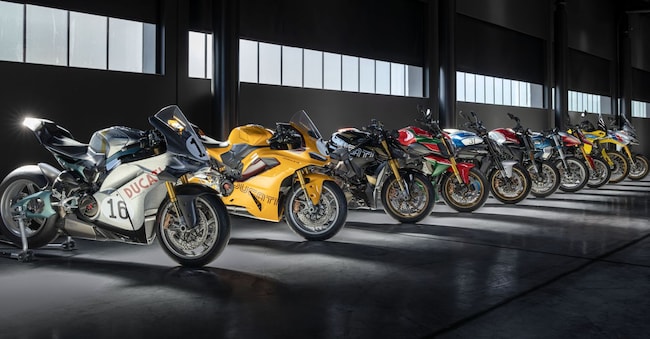
Ducati Collezione 100, ten limited edition models to celebrate the Centenary

The manufacturer from Borgo Panigale launches a special series celebrating models of the past

by Simonluca Pini

7' min read

Translated by AI
Versione italiana

7' min read

Translated by AI
Versione italiana

Ducati continues its celebration of 100 years of history by presenting the Collezione 100, ten models, ten numbered editions limited to just 100 examples each, which retrace ten moments in the history of the brand from Borgo Panigale. Each example is made unique by special equipment, the livery inspired by an iconic bike from Ducati's history, the Alcantara or leather saddle with embroidered Ducati 100 logo, and the Centenary Bronze colour. Each bike is accompanied by a dedicated rear stand, motorbike cover, certificate of authenticity and a pair of numbered art multiples signed by one of the great protagonists of Italian art of the second half of the 20th century, Ugo Nespolo. The V4 models will be delivered in an exclusive customised wooden case.

Ducati Panigale V4 S 100 (750 Imola Desmo - 1972)

The Ducati Panigale V4 S 100 is inspired by the graphics of the bike that won the first edition of the Imola 200 Miglia in 1972 with riders Paul Smart and Bruno Spaggiari. The Panigale V4 S 100 is enriched by an Alcantara saddle with embroidered Ducati 100 logo, carbon fibre wings, mudguards and engine and exhaust covers, and bears the name and progressive number on a Bronze Centenary plaque riveted to the billet aluminium steering plate. The dry clutch and titanium and carbon fibre Akrapovic exhaust also make the sound of the Panigale V4 S 100 unique. Standard equipment includes the mirror and number plate removal kit, open clutch cover and aluminium fuel filler cap from billet in Centenary Bronze colour, for track use only. The 750 Imola Desmo was developed on the basis of the 750 GT, Ducati's first road twin-cylinder. The bike conceptually took up the mechanical basis of the 750 GT, but used the desmodromic distribution system, not provided on the GT, and was fitted with the 500 GP outfit, which was created for racing in the premier class. The characteristic 'glittered' silver colour had already been used in production by Ducati for the 250 and 350 Desmo single-cylinder, later applied to the 500 GP first, and then to the 750 Imola Desmo.

Loading...

Ducati Collezione 100, le foto delle dieci moto dedicate al passato

Photogallery26 foto


Ducati Panigale V2 S 100 (750 Super Sport Desmo - 1975)

The livery of the Panigale V2 S 100 was inspired by the graphics of the 750 Super Sport Desmo used by Franco Uncini in the 1975 season for the Italia speed championship when he won the title. At the end of 1973, Ducati decided to entrust the management of the team to Bruno Spaggiari, a former rider and founder of his own team, supported by the Bolognese manufacturer to participate in the

championship in Italy for production-derived motorbikes with the powerful 750 Super Sport Desmo, a motorbike that was highly appreciated by the knowledgeable public. The yellow of the livery recalled the 750 Sport road bikes and was combined with details in a special brown/bordeaux colour that was used at the time on inboard marine engines assembled in the Borgo Panigale factory. The Panigale V2 S 100 is enriched by the Alcantara saddle with embroidered Ducati 100 logo, the sports half handlebars machined from billet, the steering damper, and the name and progressive number on a plate in Centenary Bronze finish riveted to the steering plate also machined from billet. In addition, this Panigale V2 is the first model in the new Ducati V2 family to be fitted with the dry clutch, developed specifically for this model, which makes the engine particularly compact.

Ducati Streetfighter V4 S 100 (Ducati 900 Sport Desmo Darmah - 1979)

The livery of the Streetfighter V4 S 100 is inspired by the graphics of the 1979 900 Sport Desmo Darmah. In the 70s and 80s, black and gold graphics were extremely fashionable in the world of motorsport and Ducati was no exception, in particular it applied this colour scheme to the 900 Sport Desmo Darmah. In Italia, there was also a strong fascination with exotic countries, a fascination that translated, at Borgo Panigale, into pure fantasy names, such as Darmah, or into details, such as the characteristic tiger head depicted on the side panels of the 900 Sport Desmo Darmah. The head is an extremely characteristic graphic element, also taken up in the undertail of the Streetfighter V4 Collezione 100 and in the matching helmet and jacket.

Monster 100 (Monster S4Rs Tricolore - 2008)

The tricolour livery of the Monster 100 is inspired by the graphics of the Monster S4Rs Tricolore of 2008. The Monster S4Rs Tricolore in fact represented a sort of final edition for the first generation of Monster, the one that Ducati produced from 5 March 1993 until 2008, becoming one of the most recognisable models not only for the Borgo Panigale manufacturer but for the world of two wheels in general. The Monster 100 is made unique by the dry clutch, complete with carbon fibre cover supplied, the Alcantara saddle with embroidered Ducati 100 logo, and the fairing and seat cover kit that gives it a single-seat look. The nameplate with the name and serial number of the model is in Centenary Bronze colour and is riveted on the steering knuckles made from billet. The colour is also used on the tank cap ring and on the brake callipers, as is the case with all the bikes in the Collezione 100.

Ducati XDiavel V4 100 (750 Super Sport 'California Hot Rod' - 1977)

The livery of the XDiavel V4 100 is inspired by the graphics of the special 750 Super Sport called "California Hot Rod", a bike with which Cook Neilson made Ducati history by winning on the Daytona Circuit in 1977. The event had great significance as it was the first time an Italian motorbike won a race for production derivatives in the United States, an event that significantly increased Ducati's fame and sales overseas. In the mid-1970s, in fact, Ducati's visibility in the United States was practically limited to just one model, the Scrambler, an almost off-road model imported by the Berliner brothers, but in 1977 things changed thanks to Cook Neilson's memorable triumph on the Daytona oval track.

Diavel V4 RS 100 (900 Replica - 1979)

The livery of the Diavel V4 RS 100 is inspired by the graphics of the 1979 900 Replica road bike. At the time, after Ducati's victory at the 1978 Tourist Trophy, the Borgo Panigale factory started the production of a series of bikes that would evoke the livery of the 900 that won on the Isle of Man. Thus was born the 900 Replica, in fact the first road replica of a Ducati racing bike, which immediately became one of the most coveted items among Ducati enthusiasts. The distinctive green and red livery with white piping, which echoed the colour scheme of the bike that won the Tourist Trophy, was also a very first case of an "almost" tricolour livery, which would later be applied by Ducati to some of the most sporty and exclusive models of its production in the years to follow. The 900 Replica was one of Ducati's most successful models, produced for five years until production was discontinued at the end of 1984. The Diavel V4 RS 100 is built on the technical basis of the Diavel V4 RS, equipped with the Desmosedici Stradale engine.

Ducati Multistrada V4 RS 100 (500 SL Pantah - 1979)

The livery of the Multistrada V4 RS 100 is inspired by the graphics of the 500 SL Pantah of 1979, i.e. the first Ducati equipped with a trellis frame, still far from the trellis that has distinguished the brand for almost fifty years, and the Pantah engine, which abandoned the bevel gearing, in use since the days of the Gran Sport Marianna (1955). The bike, which sports the squared-off design typical of bikes from the early 1980s and a livery featuring the logo designed for Ducati by car designer Giorgetto Giugiaro, is praised for its easy handling and light weight. As the Multistrada V4 RS 100 was developed on the technical basis of the top of the range Multistrada V4 RS, featuring the Desmosedici Stradale engine, the livery also features the Desmo logo on the tail.

Ducati Scrambler 100 (250 Scrambler - 1962)

The livery of the Scrambler 100 is inspired by the graphics of the 1962 250 Scrambler, the first version of Ducati's Scrambler, produced exclusively for the US market. The birth of the Scrambler is closely linked to the figure of the first American importer Joe Berliner, the man who strongly wanted a brand new model to be sold overseas. Ducati was coming off the media success of Monetti and Tartarini's 1957 round-the-world race, and the clamour of the feat also reached America, where interest in the hitherto almost unknown Bolognese brand grew. Berliner asked Ducati for a dirt track bike, an off -road bike, which had certainly not yet been thought of in Borgo Panigale, but which came to fruition with the 250 Scrambler in 1962.

Ducati Hypermotard V2 SP 100 (Ducati 860 "24 Horas de Montjuïc" - 1975)

The livery of the Hypermotard V2 SP 100 is inspired by the 860 "24 Horas de Montjuïc". After the victory at the Imola 200 Miglia in 1972, Ducati's management felt that the right way to bring the brand back to popularity was through "racing" derived from mass production, particularly in endurance racing. To this end, Ducati needed to expand its range of twin-cylinder engines with a larger displacement engine than the classic 750, which could withstand the "stress" of long endurance races such as the Bol D'Or and the 24 Horas de Montjuïc, races where the Borgo Panigale company won several editions. The Ducati 860 saw its winning debut back in 1973 with the Ducati 860 Desmo prototype, which would later become the Ducati 900 Super Sport in the road version. In 1975, riders Salvador Canellas and Benjamin "Min" Grau, who had already won in 1973 with the twin-cylinder Bolognese bike, repeated their success in the Catalan race, but in the flamboyant colours of Nepoti and Caracchi's Ncr team. The Hypermotard V2 SP 100 is based on the SP version, featuring Öhlins suspension and forged wheels.

Ducati DesertX 100 (Pantah "Ice" - 1981)

The livery of the DesertX 100 is inspired by the graphics of the 1981 Pantah 'Ice', which represents one of the most curious product placement episodes in Ducati's history. The Pantah "Ice" was nothing more than a modified Pantah 500, in particular for the curious studded tyres and the elimination of the braking system, in order to allow its use on icy tracks. Ducati, in fact, at the time was run by the state-owned holdings, which also controlled car manufacturers such as Alfa Romeo. Eefim, the body that controlled both Ducati and Alfa Romeo, organised a championship for Alfasud cars on the icy tracks of the Alps in the early 1980s. The races were held in two heats; in the break between the first and second races the colourful Pantah 'Ice' cars provided the spectacle for the public. The Pantah Ice were made in different liveries; the one chosen for the DesertX 100, yellow with blue stripes, belongs to a model that was part of the Ducati Museum collection until a few years ago.

Copyright reserved ©
Loading...

Brand connect

Loading...

Newsletter

Notizie e approfondimenti sugli avvenimenti politici, economici e finanziari.

Iscriviti