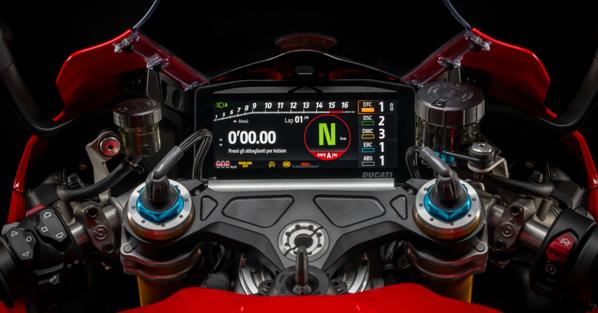
Ducati Panigale V4, what the new superbike from Borgo Panigale looks like
The new version of the Panigale V4 improves aerodynamics, ergonomics and chassis to be even more powerful on the kerbs
3' min read
3' min read
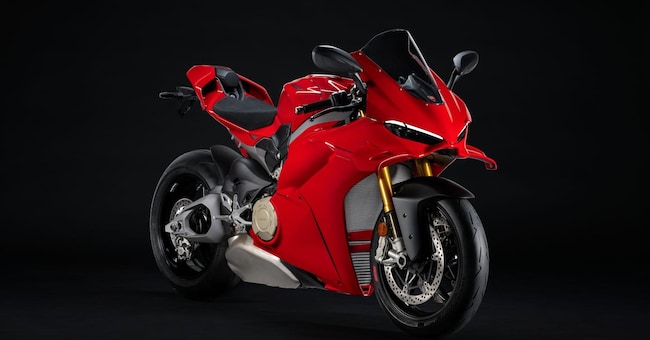
On the eve of the World Ducati week 2024 - three days of full immersion dedicated to red bike fans based at the Misano circuit - the Borgo Panigale company has taken the veil off the 2024 model year of its flagship model, the Panigale V4, which represents the seventh generation of Ducati Superbikes, from the 851 to date. The new version stems from the evolution of the race model that won the Superbike World Championship for two consecutive years: the Panigale V4 has been completely redesigned in terms of design, technical base and ergonomics, so much so that it weighs only 187 kg in the S version, two less than the previous model, and has 0.5 more hp despite the "castrating" Euro5+ homologation.
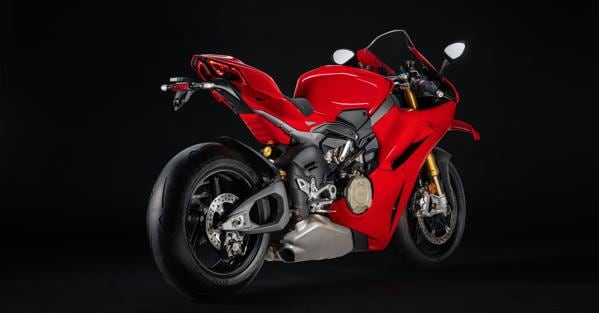
More effective aerodynamics
.The new fairing reduces aerodynamic drag by 4% and better protects the rider in a straight line, keeping him in a sort of 'bubble' of calm air. The highly efficient double-profile wings are integrated into the shape of the front end, keeping the downforce contribution unchanged from the previous model. The set back of the leading edge of the fairing with respect to the front wheel, then, makes the Ducati more agile in high speed changes of direction, while the improved shape of the mudguard and the conveyor upstream of the radiators increases the efficiency of the cooling system, in particular the oil cooler.
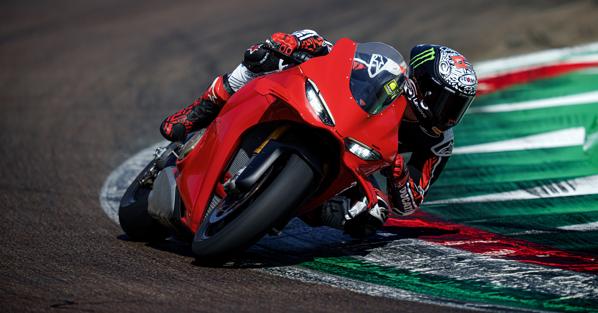
Better pilot support
.The new Panigale V4 offers greater roominess in the seat-tank area, with greater freedom of longitudinal movement, but without risking interference with the helmet chin guard, thanks to the deep recess in the upper part of the tank. In addition, the rider is now better supported during braking, entry and cornering: it is easier to anchor with the knees to counteract deceleration and to lean out of the saddle once the bike has entered a corner, reducing the strain on the arms and thus overall fatigue. The footpegs have been moved 10mm inwards compared to the current Panigale V4, increasing the ground clearance and allowing the rider to have his feet and legs positioned further inwards.
Race motor
.The Desmosedici Stradale is derived from the Ducati MotoGP engine, with which it shares much, starting with the architecture: it is a 90° V4 with desmodromic distribution, counter-rotating shaft and Twin Pulse timing, which gives the Panigale V4 a sound very similar to that of the Desmosedici GP. Some improvements in the distribution and intake have made it possible to obtain 216 hp (228 hp in track configuration) at 13,500 rpm with a maximum torque of 120.6 Nm at 11,250 rpm.
Cycling derived from MotoGP
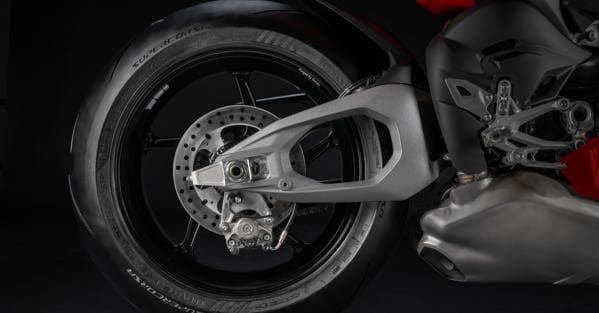
.Ducati Corse asked the Panigale designers for new stiffness targets for the Front Frame and the new double-arm swingarm (both also lighter) in order to exploit the potential of the slick tyres used in Superbike; the lateral stiffnesses were designed to maintain grip at lean angles now over 60°, while maintaining high longitudinal stiffness values to exploit the engine torque under acceleration and braking power under braking. In particular, the new swingarm reduces lateral stiffness (-37% compared to the previous single-sided swingarm) and weight, improving traction coming out of corners and the rider's feeling when accelerating. The stability of the Panigale V4 is also guaranteed by the third-generation electronically controlled Öhlins Npx/Ttx suspension, both on the road and on the track. Also arriving, for the first time on a production bike, are the high-performance Brembo Hypure calipers that work with the all-new Race eCbs braking management system, developed by Bosch in collaboration with Ducati.