
Duties, Cottarelli: 'Trump will not go 50%, an agreement will be found in the end'
The Economist: Markets are rewarding our government's prudence. From Big Tech risks for democracy

4' min read
4' min read
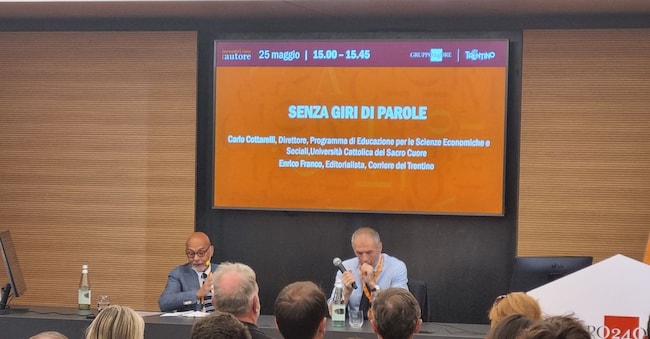
The dangers for democracy linked to the power of Big Tech. And then the risks of a loss of confidence in the Tresury, the growth of China, Europe's impasse in the face of the challenge of the other big areas. That of Carlo Cottarelli, economist and director of the education programme for economic and social sciences at the Catholic University (but in the past also Executive Director of the International Monetary Fund and Commissioner for Public Spending Reform) is a wide-ranging argument. Just as wide-ranging is the spectrum of topics dealt with in the book presented in Trento, 'Senza giri di parole', which ranges from the major global issues to the functioning mechanisms of the Italian State.
First of all, we speak of a transitional phase, one triggered by the growth of China, which has now become a superpower in terms not only of labour but also of capital and production, producing, for example, 54% of the world's steel, a third of global manufacturing output.
'For the first time since the Second World War,' Cottarelli explains, 'we have two cocks in a henhouse and the speed of this turnaround has been astonishing, achieved in just a few decades. In the tariff war the real target is actually China, because however big they are, the US cannot challenge the whole world on its own. But even here Trump has realised that he has to act gradually, because the immediate replacement of Beijing's products is impossible'.
A relevant role could be played by Europe, which however for Cottarelli finds itself mired in the middle of the ford, unable to make further progress after the launch of the single market and the euro. "The EU budget is worth barely 1 per cent of European GDP and governance is also complicated, with decisions in part only possible with unanimity, in part codeliberated by Parliament and the Council, often with qualified majorities. In short, there is little money and no executive power comparable to that in Washington. This is the situation the US had for 13 years, until 1789, when the new constitution came into force. Here, nationalist parties are advancing, the United States of Europe is receding, many citizens do not want any more integration. I don't think this is a good thing, because among the many doubts set out in this book there is instead one great certainty: if we Europeans do not present a united front, we will count for nothing in front of the other areas'.
A fragility exacerbated by the growing power of big tech in the stars and stripes, which by now is larger than the GDP of entire states, posing real problems for democracy. "A single person," comments Cottarelli, referring to Elon Musk, "is able to turn off satellites on a territory influencing the outcome of the war in Ukraine, while in general in artificial intelligence everything is now in the hands of these companies, which have invested hundreds of billions. What to do? European fines are coming, but they are of minimal impact for these giants. Anti-monopoly laws have worked in the past, but these are no longer used to block new acquisitions. The alternative is to launch 'splits' as happened with AT&T. But there is no clear and easy solution at the moment'.


