
Duties, Orsini: US fundamental but building new outlets. We need an industrial plan, on energy we dialogue with the government
"In the Dl bills some companies were left out. Renewables must be decoupled, hydro and Gse energy must have long-term contracts. The cost of energy is out of control'

3' min read
Key points
3' min read
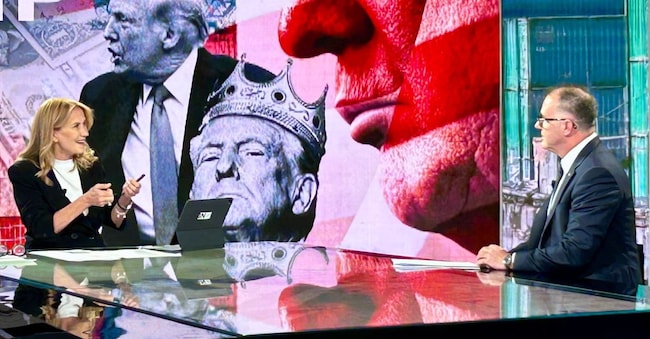
"For industry the United States is an important destination, so not having clarity on duties generates uncertainty". Interviewed on the programme In mezz'ora, aired on Rai 3, the president of Confindustria Emanuele Orsini reflects on the first effects of the measures established overseas by the new president Donald Trump. If some Made in Italy products are continuing to arrive in the United States, for others, "those that take months to develop, there are problems". At a time when the trade picture is chaotic, with continual reversals on duties, 'for us it is a problem', especially since 'Italy is coming from 25 months of declining productivity'.
U.S. key market, but new outlets
The suspended status for companies is uncomfortable, as well as a cost in itself. "The US is a key market for us, but we need to support investment. From a certain point of view, we have to start building new markets, so we have to run on Mercosur, Latin America, India and new markets, the Emirates, Saudi Arabia,' Orsini further explains. This is to be able to 'compensate to a certain extent' for the uncertainty created by the US duties.
Competitive problem if Chinese products pour into the EU
.In the trade clash between the US and China, one of the debated issues is that if the US were to stop absorbing large quantities of Chinese products, these could spill over into Europe and 'this can be a risk'. The numbers tell the potential scenarios. "I always start from the concept of positive balances, with China we have a negative balance," so if large quantities of Chinese products are shipped to Italy "there will also be an issue of social responsibility," notes the number one industrialist. 'We cannot think of absorbing products, but especially low-cost products, because this would become a competitive problem for us'. So in the current phase, the issues of competitiveness, energy costs, and bureaucracy become 'a major problem in Europe'.
Demanded government industrial plan for country
"We need an industrial plan for our country, we have asked the government for it. We must be more competitive, our companies must be made more competitive'. Thus the number one of the industrialists commenting on the IMF forecasts on global and Italian growth. As for the areas on which to work, Orsini points out 'the digital front on which we must grow, and then there is the issue of the cost of energy, which puts our companies in difficulty and creates a problem of competitiveness'.
Referendum on Jobs act? A return to the past
The referendum 'on the Jobs Act is a leap into the past and a return to the past', because the Jobs Act 'is an instrument that has been there for ten years and is working well, it is giving answers'. There is talk of the forthcoming 8-9 June consultation, with four of the five questions centred on labour. "I believe that, today, on labour issues, we cannot think of going back to talking about this. We are missing one hundred thousand people in the world of work today. We are doing missions abroad to bring people to our companies in Italy and also for this reason we launched the Home Plan, so today talking about Jobs Act means taking a leap into the past,' in Orsini's reasoning. The number one problem remains energy. "In the Dl bills some companies were left out. We need to decouple renewables, hydro and Gse energy must have long-term contracts. The cost of energy is out of control'.


