The summit

Tariffs, it's a US-China truce. Wsj, with tariffs in April record receipts for the US: 16 bn

US Treasury Secretary and Trade Representative Scott Bessent and Jamieson Greer and Chinese Vice-Premier He Lifeng met in Geneva

Aggiornato lunedì 12 maggio 2025 alle 16.42

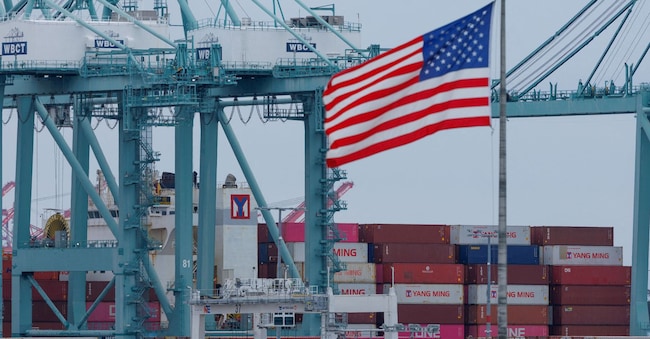
Container su navi nel porto di Los Angeles. REUTERS/Mike Blake/File Photo

6' min read

6' min read

The US will raise tariffs on Chinese products again if the two countries fail to reach a trade agreement within 90 days even if they do not raise them to 145 per cent. This was said by US President Donald Trump at a press conference in Washington in response to those who asked him whether at the expiry of the 90-day tariff suspension agreed on 11 May in Geneva by the two delegations the duties would return to 145 per cent. "No, but they would go way up," Trump replied, adding that "at 145% you really get to decoupling and nobody would buy anymore... but they could go up," Trump said.

Wsj: record US receipts of $16.3bn in April

Meanwhile, the first financial balance sheet of the tariff policy pursued by Washington is positive. The US collected USD 7.6 billion more in customs duties in April than in March, for a record USD 16.3 billion. This was stated by the Treasury Department, as reported by the Wall Street Journal. Since the beginning of the fiscal year in October, the US collected $63.3 billion in customs duties, an increase of $15.4 billion over the same period last year. Although positive for the government budget, the deficit for the current fiscal year to April is still about $1.050 billion, about 23% higher than the previous year.

Loading...

The truce on US-China tariffs

The US and China will therefore suspend part of their punitive customs duties for 90 days. According to a joint US-China statement from Geneva, the suspension will come into effect 'by 14 May'. China will review 'additional duties' on imports of US goods, the Ministry of Commerce reported on the joint note after negotiations in Switzerland.

US Treasury Secretary Scott Bessent had already announced 'substantial progress' in the ongoing negotiations in Geneva with Chinese Vice-Premier He Lifeng, aimed at defusing the trade war between the world's two largest economies. Bessent informed President Trump and will provide more details on Monday. US Trade Representative Jamieson Greer also signalled that the distances between the parties are smaller than expected. In parallel, Commerce Secretary Lutnick foresaw new agreements in the next three months and reiterated the goal of reducing the record low tariffs between the two countries.

"I am pleased to report that we have made substantial progress between the United States and China in major trade talks," said Bessent, quoted by the White House press service.

The talks take place against the backdrop of very high tariffs: 145% by the US and 125% by China, introduced during the Trump administration with the aim of boosting American manufacturing. US Treasury Secretary and Trade Representative Scott Bessent and Jamieson Greer and Chinese Vice-Premier He Lifeng met in the Swiss city.

Trade Interchange

.

In 2023, bilateral merchandise trade between the United States and China reached USD575 billion, with a trade deficit to Washington's detriment of USD 279 billion. This was reported by the Unimpresa Study Centre, noting that imports from China reached USD 427 billion, while exports to Beijing stopped at USD 148 billion. The deficit with Beijing accounts for about 40 per cent of the total US trade deficit in 2023, with the US continuing to rely on imports of cheap industrial and consumer goods. "The new balances between Washington and Beijing will not be neutral for the other players on the international market: it will also be European exports, and in particular Italian-made products, that will either suffer or benefit, depending on the trajectories that trade policies take," comments Unimpresa vice-president Giuseppe Spadafora observing that "the progressive reallocation of value chains, dictated by the logic of 'friend-shoring' and the reduction of dependence on Chinese suppliers in strategic sectors, could open up market spaces for Italian companies in high value-added sectors, such as agri-food, precision mechanics, design, fashion and pharmaceuticals". At the same time, he warns, a tightening of relations between the US and China 'risks triggering protectionist chain dynamics that could penalise Italian exporters on both fronts'. For Italy, a country with a vocation for exports and a strong rooting in global markets, "the new balance between the United States and China will not just be a fact of global geopolitics, but a concrete knot to be tackled in terms of industrial policy, economic diplomacy and market penetration strategies," concludes the vice-president of Unimpresa.

Trump: Europe 'tougher than China, will have to pay more for healthcare'

On Monday afternoon (Italian time), the US president commented on the agreement, attacking the European Union, calling it 'tougher than China' on the trade and regulatory front. "The EU will have to pay more for healthcare," he said.

Trump also predicted a downsizing of the EU in economic terms: 'It will go down a lot', he said, accusing Brussels of taking 'more aggressive attitudes than China' in its relations with the US.

Instead, the US president's tone is very conciliatory in his statements towards China: he states that relations between China and the US have reached a 'reset' and announces that he will talk to Xi Jinping at the end of the week. 'Yesterday we reached a total reset with China after the productive talks in Geneva,' he said at the White House today, 'the relationship is very, very good. I will talk to President X, maybe later this week."

The meetings

.

China's talks on the trade dossier with the US underway in Geneva are an "important step" in a response to the problems between Beijing and Washington. "The contact in Switzerland is an important step to promote the resolution of the issue," the state-run Xinhua news agency reported Saturday in a commentary, without providing further details on the status of the negotiations. The tone, however, confirms a change in the Chinese narrative, anticipated by Beijing's motivations in recent days to engage in a confrontation with Washington in spite of the extremist "fight to the end" posture.

The direct de-escalation talks between the US and China are the first between the two major players in the global tariff war inaugurated by the Trump administration.

Wsj: Xi's security adviser also at talks

President Xi Jinping's top security advisor Wang Xiaohong is also attending the trade talks. The move, noted the WSJ, demonstrates the importance of the fentanyl affair, the synthetic drug that is a social scourge in the US, in the discussions between the parties.

Trump's opening

.

US President Donald Trump set the stage for the talks by evoking the possibility of reducing the heavy tariffs imposed against the rival superpower, while at the same time calling on Beijing to open its market to the US. "An 80 per cent tariff on China sounds about right! Depends on what Scott B. tells me," the US president wrote in Truth.

Dramatic reduction of tariffs on China possible

In his post, the tycoon did not specify whether the reduction of duties on Chinese products from 145% to 80% would be the final one or whether it would be an interim status. According to various American media, the administration is planning to cut the duties on Beijing much more. A first step on Washington's part, in the hope of a reciprocal tariff reduction by the Dragon, which in turn has imposed a harsh 125% on American goods. According to Bloomberg, the goal would be to go below 60%, while informed sources told the Washington Post the administration could go as low as 54-50%.

The strategy

.

On the other hand, Trump's strategy has two levels: the first is a basic 10% tariff on all imports into the US from any country, the second level is the so-called 'reciprocal tariffs', which have been applied to some 60 countries. The base tariff, reiterated White House spokeswoman Karoline Leavittt, "will remain for everyone". China, which was already subject to a 20 per cent tariff, was hit with another 34 per cent immediately and a further 90 per cent after its reaction. Beijing insisted that the US must eliminate the duties 'first' and promised to defend its interests. Bessent meanwhile kept expectations low, saying the meetings in Switzerland will focus on 'de-escalation' and not on a 'grand trade deal'. "The treasury secretary will go and talk to his Chinese counterparts and we will see what happens," the spokeswoman said, stressing that Bessent has "total confidence" in the president.

Copyright reserved ©
Loading...

Brand connect

Loading...

Newsletter

Notizie e approfondimenti sugli avvenimenti politici, economici e finanziari.

Iscriviti