
Dyson challenges floor physics: Spot+Scrub Ai, the robot that wants to see dirt
With Spot+Scrub Ai Dyson enters the hybrid robot market with machine vision, self-cleaning roller and a high-end price tag of €1,199

It's a long preamble before I tell you how the test of Spot+Scrub Ai the first hybrid cleaning robot from Dyson went. So bear with me. Domestic cleaning robots have come of age. but vacuuming crumbs is one thing and mopping a floor is not the same as vacuuming crumbs. Putting the two functions together means playing a chess game against physics. And often dirt wins. In particular, dry cleaning is a matter of power and airflow. You have to generate enough vacuum to lift dust, sand, debris. But inside a disc just over ten centimetres high. With batteries that have to last. And with a container that cannot become a black bag with wheels. It is a balance between motor, cyclones, filters. Too much power and you drain the battery. Too much filtration and you lose suction. Too much autonomy and you increase weight and costs.
Wet cleaning is another story. Vacuuming is not enough here. You have to dissolve. Dose the water. Don't flood the parquet. Don't drag dirt from room to room like a clumsy brushstroke. Traditional robots have solved this with passive wet wipes. A little water, a little friction. It works, but it's like mopping with your eyes closed. If you find a stubborn stain, you often smear it. If the roller gets dirty, you keep smearing.
The knot is always the same: understand what is on the floor. And to react.
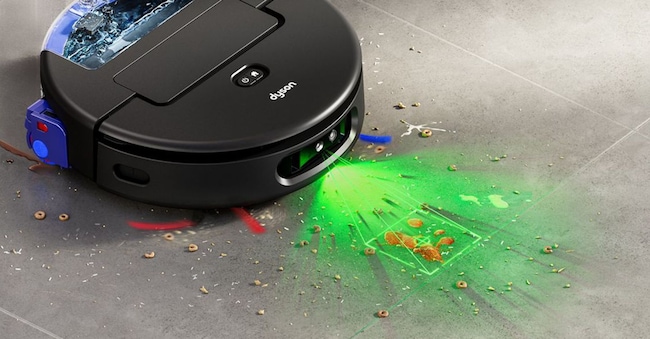
Dyson's first hybrid robot, the Spot+Scrub Ai is an important debut. Because the company founded by James Dyson comes late to the robot market, but arrives with the idea of changing the rules of the game. At the heart of the system is a 'laser-like' green light machine vision system that promises to recognise up to 190 objects and almost 200 types of substances. It basically turns on a spotlight on the floor and looks for differences in textures and reflections that the human eye often overlooks. It is a bit like using a digital magnifying glass to flush out invisible spots. When it finds one, it doesn't just pass over it: it insists. It repeats the cycle until the algorithm decides that the surface is clean. It is cleaning by iteration, not by a single pass .
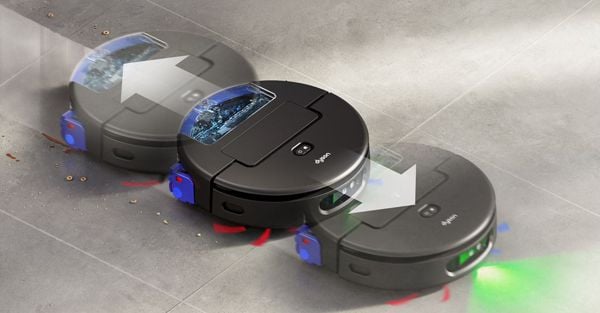
From an engineering point of view, the most interesting choice is the self-cleaning wet roller. A 12-point hydration system distributes clean hot water across the entire width, 27 centimetres, while the microfibre washes with each rotation . The idea is simple to explain and complex to implement: never drag dirty water over the already treated surface. The dock completes the cycle with washing at 60 degrees and drying at 45 degrees . In theory, mould and odours stay out of the door.


