
Live
EU budget under discussion in Brussels. Macron: ‘There will be no agreement at this summit.’ De Cos set to join the ECB
Lagarde: the Governing Council discussed the possibility of raising interest rates as early as that meeting, but it was subsequently decided to wait until the December meeting
For feedback, please contact
english@ilsole24ore.com
 Aggiungi Il Sole 24 Ore
ai preferiti su Google
Summary by key points
- Metsola: Kyiv needs credible funding
- At the EU summit, the budget session gets underway after the leaders’ lunch break
- Lagarde says rise in spread linked to AI bonds
- Merz: no to taking on new debt
- Luxembourg: we cannot exempt certain countries from their obligations towards Kyiv
- Costa presents a new proposal for the EU budget: ‘A good basis for reaching an agreement’
- Meloni: no cuts, safeguard the CAP and cohesion
- Metsola: a 46 billion cut to cohesion funding is difficult to explain to the public
Merz: ‘The EU budget cannot grow indefinitely’
“The overall budget should not grow excessively. Europe also needs to exercise restraint when drawing up its budget. The budget cannot therefore grow without limit, and the burden of this budget must be shared fairly. We are not there yet.” German Chancellor Friedrich Merz made these remarks on the sidelines of the EU summit in Brussels.
26 November 2026
Macron: ‘There will be no agreement on the EU budget at this summit’
“I think I can say that we will not be able to reach an agreement on the budget during this European Council meeting.” This was stated by the French President, Emmanuel Macron, at a press conference on the sidelines of the European Council meeting currently taking place in Brussels.
26 November 2026
Costa continues consultations on the budget and meets with the ‘Friends of Cohesion’ countries
The second ‘round of consultations’ on the EU’s multiannual budget has just begun in Brussels. The President of the European Council, Antonio Costa, is now meeting with the 17 ‘Friends of Cohesion’ countries. Taking part in the discussion are Italia, Romania, Bulgaria, Cyprus, Croatia, the Czech Republic, Estonia, Greece, Hungary, Lithuania, Latvia, Malta, Poland, Portugal, Slovenia and Slovakia, as well as France, which is representing Spain. Earlier, Costa met with the group of ‘Frugal’ countries.
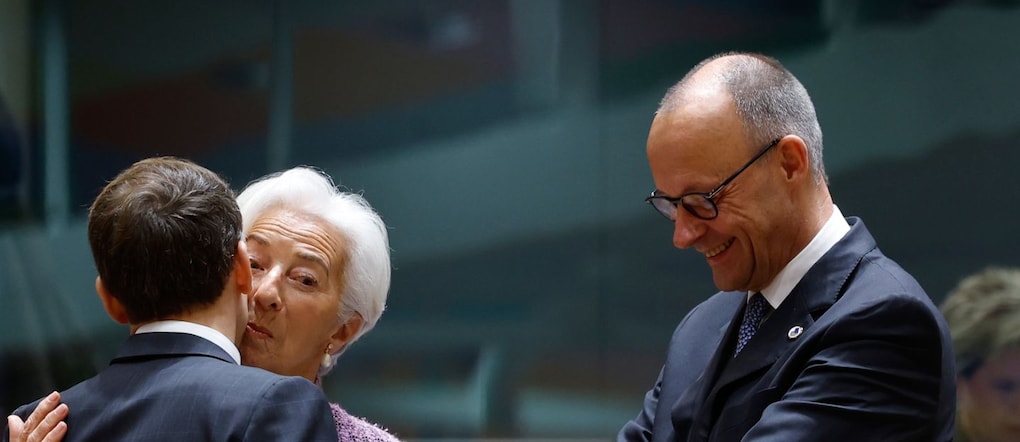
Da sinistra, il presidente francese Emmanuel Macron (di spalle), la presidente della Banca centrale europea Christine Lagarde e il cancelliere tedesco Friedrich Merz durante il vertice dell’Ue a Bruxelles, giovedì 26 novembre 2026. (AP Photo/Geert Vanden Wijngaert) APN
Ask the editorial team
Have questions or feedback about this article? Contact our editorial team.
26 November 2026
ECB, Costa: Governing Council recommends de Cos, Boone and Brunnermeier
“The euro area Member States have agreed to recommend Pablo Hernández de Cos as President of the ECB and Laurence Boone and Markus Brunnermeier as members of the ECB’s Executive Board. I will propose that the European Council begin consultations with the European Parliament and the ECB’s Governing Council. This will pave the way for the European Council to formally appoint the ECB’s new leadership in December.” President Antonio Costa announced this on X.
26 November 2026
EU sources: it will become clear whether there has been a breakthrough on the budget following the ‘one-on-one talks’
The President of the European Council, Antonio Costa – according to reports – will only be able to assess whether there has been a “breakthrough” in the negotiations once the meetings with the groups of countries, scheduled from late afternoon onwards, have concluded. At the end of the so-called ‘one-on-one meetings’, the leaders will reconvene for the plenary session, where Costa will take stock of the situation (scheduled for around midnight). If it makes sense to continue, talks will go ahead tomorrow as well. Otherwise, Costa will arrange for the 27 to meet again at the European Council in December. It is, in fact, during the group negotiations that ‘a genuine negotiating dynamic’ can emerge. The E6 session (France, Germany, Italia, Spain, Poland and the Netherlands) is considered the most important in terms of geographical composition, the weight of the economies involved and the level of commitment across various fields.
26 November 2026
EU sources: ‘A new draft budget text may be drawn up following today’s discussions’
Following today’s discussions at the EU Summit on the multiannual financial framework, “it would be logical to draw up a new proposal to serve as a basis for further discussions. The timing of this will depend on the outcome of the discussions to be held during the meetings” with the leaders. This was reported by an EU source on the sidelines of the extraordinary European Council currently taking place in Brussels. “Today we expect the leaders to provide guidance on their negotiating margins and how far they are prepared to go; this concerns own resources, the overall budget level and individual policies, on which Member States have different priorities,” the source explained. In the discussions on the new multiannual financial framework, “everyone has recognised the need to reach an agreement by the end of the year”, the source continued, noting that “positions will inevitably have to evolve towards a compromise” if an agreement is to be reached at the European Council in December.
26 November 2026
ECB: EU leaders pay tribute to Lagarde; focus on energy, interest rates and the digital euro
The President of the European Council, Antonio Costa, paid a farewell tribute to Christine Lagarde at the opening of the Euro Summit, thanking her on behalf of European leaders for her “steady and professional” leadership of the European Central Bank during a succession of crises. Costa, according to an EU official, also acknowledged the clarity of her analyses, her excellent cooperation and the commitment she had shown to Europe during her seven years as ECB President. The other leaders also thanked Lagarde for her service to the Union. During the meeting, the ECB President and the President of the Eurogroup, Kyriakos Pierrakakis, shared their respective analyses of the macroeconomic situation in the euro area and global developments with the leaders. Among the topics discussed were the impact of energy prices on inflation, rising financing costs and the links with the boom in investment in artificial intelligence. The discussion also covered progress on the digital euro project and its importance for European sovereignty, as well as the resilience of the EU economy, underpinned by policy choices such as the energy transition and the diversification of trade.
26 November 2026
Euro Summit: the economy is resilient, but inflation and uncertainty are weighing on it
The euro area economy has shown resilience in the face of new external pressures, with economic activity holding up better than expected, a robust labour market and a stable financial sector. This is stated in the declaration of the Euro Summit, which met in an inclusive format, though it also highlights the risks associated with rising inflation, rising global interest rates and increased uncertainty. In the face of these challenges, economic policies must focus on strengthening resilience, maintaining sound and sustainable public finances, and improving competitiveness. “Effective coordination of our economic and fiscal policies is essential to ensure sustainable and inclusive growth,” the leaders emphasised, calling on the Eurogroup to continue monitoring economic, fiscal and financial developments and to report regularly on progress towards strengthening the euro’s international role.
The leaders also reaffirm their determination to press ahead swiftly and decisively with the Savings and Investment Union. On the digital euro, they recall the commitment set out in the “One Europe, One Market’ to reach an agreement by the end of 2026 and stress the importance of swiftly completing the legislative work and accelerating the subsequent preparatory stages, so as to enable the Eurosystem to proceed with the issuance of the instrument within the planned timeframe. Finally, the statement welcomes the information provided by the Presidents of the ECB, the European Commission and the Eurogroup on recent exchanges with the world’s major economies regarding the global economy and macroeconomic imbalances. The dialogue, it states, will contribute to a common understanding of the causes of these imbalances and the measures needed to foster an orderly rebalancing. The three presidents are invited to report back to the summit on the outcome of these discussions.
26 November 2026
The Council’s plenary session on the budget has concluded. Costa is now due to meet with the ‘Frugal’ states
The European Council’s plenary debate on the Multiannual Financial Framework has just concluded. The Eurosummit declaration has also been adopted.
Work is now being suspended for consultations with a group of Member States. The first meeting for the President of the European Council, Antonio Costa, will be with the ‘Frugal’ group: the Netherlands, Austria, Belgium, Germany, Denmark, Sweden and Finland.
26 November 2026
Metsola to the 27 EU leaders: ‘Do not underestimate the European Parliament’s vote on the budget’
On the multiannual financial framework, “I would therefore like to make it clear from the outset: the European Parliament wishes to reach an agreement, and wants to do so as soon as possible. We demonstrated this back in April, when Parliament adopted its position. The President of the European Council has now presented revised figures. There are areas where we agree and others where we still need to work; that is entirely normal. But if you find it difficult to reach an agreement amongst 27 Member States, do not underestimate what it takes to reach an agreement amongst 361 MEPs.” This was stated by the President of the European Parliament, Roberta Metsola, in her address to the 27 EU leaders during the extraordinary European Council meeting on the budget currently taking place in Brussels. “I have said this before: the Parliament has never been, nor will it ever be, a body that merely passively rubber-stamps the decisions of others. In this parliamentary term, as we have seen on several occasions, building a majority is a more complex task,” she reiterated. “However, I can assure you that there is a majority of MEPs in favour of a budget capable of stimulating economic growth, supporting the social safety nets on which citizens rely, and strengthening our Union’s role on the world stage,” she added.
26 November 2026
Hungary: ‘Zero chance of an agreement on the EU budget; unlikely even by Christmas’
“An update from the crucial EU summit in Brussels. I have just outlined to the other 26 heads of state and government Hungary’s priorities and the red lines we do not intend to cross. Having listened to the diametrically opposed positions expressed around the table, I believe the chances of reaching an agreement today are practically nil. Even an agreement by Christmas seems unlikely.” Hungarian Prime Minister Peter Magyar wrote this on X.
26 November 2026
ECB: procedure launched for the appointment of de Cos, Boone and Brunnermeier
Coreper, which brings together the Member States’ ambassadors to the EU, has confirmed agreement on the text of the three Council recommendations to the European Council concerning the candidates to be nominated for the post of President of the ECB and other members of the Executive Board. It has been decided to use the written procedure for formal adoption, a process which will be completed this evening so that the European Council can decide, later this week, to consult the European Parliament and the ECB’s Governing Council. This was indicated by sources from the Irish EU Presidency. The nominations, as is well known, concern the Spaniard Pablo Hernández de Cos as President; the Frenchwoman Laurence Boone and the German Markus Brunnermeier as members of the Executive Board.
26 November 2026
The way is clear for De Cos at the ECB, with the Netherlands also giving its backing
The Netherlands will support a European consensus on the three appointments to the ECB’s Executive Board. This was reported by an EU diplomatic source, who explained that Dutch Prime Minister Rob Jetten had informed European Council President Antonio Costa that the Netherlands attaches importance to “a consensus decision on the ECB presidency”, as “an important signal to the financial markets”. This suggests that they have accepted the candidacy of the Spaniard Pablo Hernández de Cos for the presidency, against whom they had previously put forward Klas Knot. The appointment procedure will be formalised at the meeting of EU ambassadors scheduled for 3.00 pm.
26 November 2026
Energy: EU Parliament approves two-year postponement of emissions obligations for importers
The European Parliament has approved the agreement reached with the Council (341 votes in favour, 224 against and 31 abstentions) on a two-year deferral of the obligations to monitor and report methane emissions for importers of oil, gas and coal. Importers will have until May 2030 to demonstrate that supply contracts concluded or renewed from 4 August 2024 onwards relate exclusively to fuels subject to monitoring, reporting and verification measures equivalent to those of the European Union.
26 November 2026
Lagarde on the rate rise
During the press conference, the President Christine Lagarde, in response to a journalist’s question, had said that there had been a “debate” within the Governing Council on the possibility of raising rates as early as that meeting, but it had subsequently been decided to wait until the December meeting. “We had that debate,” she said. “We looked at the figures, the rise in risks, the tightening of financial conditions due to long-term interest rates, the pros and cons, and views were expressed along the lines of: perhaps now, why not? At the end of the discussion, a unanimous decision was reached: we were in a strong enough position to be able to wait for further information, and the period between meetings will yield plenty of information.”
“With these six weeks of additional data,” he added, “we will have much more information on core inflation, and that is what we will be paying particular attention to. Without neglecting the inflation outlook. We will continue to monitor the inflation outlook. We will continue to monitor the risks. We will most likely draw up new scenarios in December. And, of course, we will look at the dynamics and strength of monetary policy transmission.”
26 November 2026
ECB minutes: many governors in favour of a rate rise in October
A large number of members of the ECB’s Governing Council could have supported a rate rise as early as the meeting on 28–29 October, in light of data that had confirmed the need for further monetary tightening. This is evident from the minutes of the meeting, which concluded with unanimous support for Chief Economist Philip Lane’s proposal to leave rates unchanged.
For these members, the worsening inflation outlook justified further action, whilst acknowledging the high level of uncertainty, the impact of higher yields on financial conditions and the limited evidence, to date, of second-round effects. Energy prices had exceeded the levels projected in the adverse scenario of the September projections, and energy inflation was becoming more widespread and persistent. The outlook for headline inflation could therefore approach, or even exceed, that of the adverse scenario, requiring a more restrictive policy than under the baseline scenario. Unless there was a significant improvement in the outlook, according to these members, a further rate rise was necessary and “the only question was the timing”.
According to these governors, the benefits of waiting were considered to be rather limited, as a lasting resolution to the conflict in the Middle East had become less likely. The direction was sufficiently clear that no further information or the December projections were required. Furthermore, the tightening of financial conditions already observed was not considered sufficient to bring inflation back to target. The same members pointed out that the deposit rate, at 2.50 per cent, remained within the range of the point estimates for neutral rates produced by ECB experts, suggesting that interest rates were not holding back the economy.
A rate rise in October would therefore have brought forward a tightening that was necessary in any case. Postponing the response, they warned, could have delayed the return of inflation to 2 per cent, had a more lasting impact on expectations and made greater tightening necessary later on, harming households and businesses. Even in the absence of any already evident second-round effects, monetary policy should have prevented them. All members ultimately supported the pause, however, on condition that the statement emphasised the firm commitment to stabilising inflation at 2 per cent in the medium term and made it clear that, whilst no pre-emptive commitments to a rate rise were being made, the policy stance remained set unless there was a significant improvement in the outlook.
26 November 2026
Paris and Berlin are seeking to protect their budgets from Marine Le Pen
France and Germany are seeking to safeguard the EU’s next seven-year budget from a potential presidency under Marine Le Pen, after the far-right French leader threatened to scupper the agreement should she come to power.
Le Pen, who is leading in the polls ahead of the French presidential elections this spring, has stated that she would halve the country’s net contribution to the EU budget and cut off funding to Ukraine. She has also hinted that she might refuse to ratify an agreement on the EU budget, according to a source close to her.
According to two officials familiar with the negotiations, the French government is reported to have requested 35 billion euros in additional agricultural subsidies from the EU in the bloc’s budget from 2028 onwards. The request aims to maximise the benefits for France and make it more difficult for Le Pen to dismantle the agreement should she win the election.
Germany, for its part, wants future funding for Ukraine to be enshrined in the EU budget law, in an attempt to ensure that any further support for Kyiv is not blocked by a veto from France or any other Member State. The German request aims to make support for Ukraine “Le Pen-proof”, an official said.
26 November 2026
Procedure for appointing the ECB’s top management has begun
The 27 Member States have discussed the appointments to the ECB’s top posts and the Member States’ ambassadors will now meet to agree on a recommendation for the candidates for the presidency and the Executive Board. This is according to EU sources. Subsequently, the European Council will revisit the matter during today’s summit to formalise and launch consultations with the ECB and the European Parliament. The candidate to succeed Christine Lagarde is the Spaniard Hernandez de Cos.
26 November 2026
Metsola: Kyiv needs credible funding
“Ukraine needs credible funding; we must maintain our support not only out of solidarity but also as an investment in the country’s future. What is at stake extends beyond Ukrainian territory: more than two-thirds of citizens believe that the European Union needs greater financial resources to tackle global challenges. And in this regard, our message must be clear.” This was stated by European Parliament President Roberta Metsola at a press conference during the EU summit, referring to the EU funds earmarked to support Kyiv.
26 November 2026
At the EU summit, the budget session gets underway after the leaders’ lunch break
The session on the multiannual financial framework has begun at the EU summit. The session got under way after a short lunch break for the leaders. Earlier, the President of the European Council, Antonio Costa, gave a brief introduction, followed by a speech from the President of the European Commission, Ursula von der Leyen.
26 November 2026
Metsola: a 46 billion cut to cohesion funding is difficult to explain to the public
“The 46 billion cut to cohesion funds is difficult to explain to the public. Funds are needed to renovate schools, hospitals and roads. The value of the EU budget will be measured by the difference it can make to families and communities. Antonio Costa’s task is not an easy one, so we welcome his efforts, but the next MFF must prioritise security, jobs and energy.” This was stated by the President of the European Parliament, Roberta Metsola, at a press conference during the EU summit. “The work done on own resources is positive,” Metsola added, highlighting that these “will enable us to repay the debts” incurred in recent years. “Repaying debts must not be allowed to jeopardise our investments in the future,” she emphasised.
26 November 2026
Lagarde says rise in spread linked to AI bonds
The “intense” issuance of government and corporate bonds – particularly to finance infrastructure linked to the development of artificial intelligence – is playing a “key” role in the rise in long-term interest rates currently being seen in the Eurozone. This was highlighted by ECB President Christine Lagarde during this morning’s Eurosummit in Brussels, according to sources familiar with the discussions.
26 November 2026
Lagarde to leaders: passing legislation on the digital euro is crucial for EU sovereignty
Over the past seven years, Europe has made progress towards becoming more integrated and sovereign. According to sources close to the discussion, this was stated by the outgoing President of the ECB, Christine Lagarde, during the extended summit of eurozone leaders (Eurosummit).
Looking to the future, Lagarde believes that wholesale and retail payment infrastructures will serve to reduce dependence on non-European providers and safeguard the EU’s sovereignty in the financial sector.
For this reason, he has called on leaders to finalise the legislative process on the digital euro before the end of the year. The legislation in question is now the subject of final negotiations between the European Parliament, the Commission and national governments (the trilogue).
26 November 2026
Lagarde: energy, AI and interest rates are key factors for the economic outlook
At this stage, there are three factors influencing the economic outlook for eurozone countries: rising energy prices, artificial intelligence and higher interest rates on long-term government bonds. This is the picture painted by the outgoing President of the European Central Bank, Christine Lagarde, according to sources close to the discussions taking place today at the extended summit of eurozone leaders (Eurosummit).
The most significant factor was the rise in energy prices that followed the war in Iran, he explained. It pushed inflation upwards and slowed economic growth, although the latter proved more resilient to the shock than expected.
Meanwhile, Europe’s role in the global development of AI has been one of the factors driving growth to date, the outgoing ECB president asserted, according to the same sources.
Since the war in Iran began, long-term interest rates in the euro area have risen significantly, leading to higher borrowing costs for the economy and weighing on economic growth. This is partly reflected in market expectations that central banks will respond to higher inflation.
But the most significant factor behind this rise in interest rates, Lagarde went on to say, is the high volume of debt securities issued by governments and companies, particularly those involved in AI, which are issuing massive amounts of debt.
26 November 2026
At the start of today’s European Council meeting, European Union leaders discussed the renewal of the European Central Bank’s top leadership, with the aim of launching the procedure to fill the vacant posts. This was reported by an EU official. To proceed, the Council of the EU will need to draw up a recommendation for each vacant position, a step that could be taken at the level of Coreper, the Committee of Permanent Representatives of the Member States. The President of the European Council, Antonio Costa, aims to begin consultations with the European Parliament and the ECB’s Governing Council as early as today, in accordance with the established procedure. These consultations will pave the way for the final appointments of the ECB’s new leadership, which the European Council is expected to make in December.
26 November 2026
Meloni: ‘We are light years away from a solution on the EU budget’
++++
(ANSA) - BRUSSELS, 26 NOV - “Italia is here to say ‘no’” to the proposal on the table at the summit; on the multiannual budget, “we are light years away from a solution”. Prime Minister Giorgia Meloni made these remarks at a press briefing on the sidelines of the EU-27 summit. On the possibility of an agreement in December, Meloni clarified: “It is not the timing” that will determine the agreement, “we are setting conditions”. (ANSA).
26 November 2026
Magyar with Tusk: united in defending the Visegrád Group’s interests
“Poles and Hungarians, two good friends. Together with the Polish Prime Minister Donald Tusk and our partners in the Visegrád Group , we will defend the interests of the countries of Central Europe in Brussels at the EU summit which begins today”. Hungarian Prime Minister Péter Magyar wrote this in a tweet, posting a photo of himself with the Polish Prime Minister.
Magyar says he expects “long, difficult and at times heated discussions and debates”. “I will drink my coffee strictly within the meeting room,” he adds, in an implicit reference to the EU summit at which his predecessor, Viktor Orbán, walked out of the room when the decision was taken to grant Ukraine EU candidate status.
Finally, Magyar adds a postscript about the volleyball match with Ukrainian President Volodymyr Zelensky, which took place on the sidelines of their meeting in Transcarpathia, a region in western Ukraine home to a significant Hungarian minority. “Many people,” he writes, “have asked me if I’d brought a volleyball with me. The photos of the friendly match in Beregszász have been seen all over the world.”
26 November 2026
Merz: the budget is still too high; no to taking on new debt
“The proposals we have on the table so far do not, in our view, provide a basis for reaching an agreement. The figure is still too high; after all, all of this must be financially sustainable for the Member States. Europe needs sound finances; within the European Union, we cannot, nor should we take on new debt”. This was stated by German Chancellor Friedrich Merz on his arrival at the European Council.
26 November 2026
Luxembourg: we cannot exempt certain countries from their obligations towards Kyiv
“There are, of course, links between the European Union’s next multiannual budget for 2028–34 and Ukraine. However, the country needs the funds now. What we must do is make a show of solidarity: everyone must play their part, and I am clearly suggesting that we cannot exclude certain countries from our obligations towards Kyiv”. This was stated by Luxembourg’s Prime Minister Lui Frieden upon arriving at the EU summit in Brussels. “It is a matter of international solidarity, democracy, the rule of law and the defence of Europe,” he added.
26 November 2026
Costa: I will try to bring the leaders closer to an agreement on the European budget
“My aim today is to bring leaders closer to an agreement on three key points: 1) the overall size of the budget; 2) the allocation of funds across the various priorities set out in the budget; 3) defining a balanced and effective set of new own resources, so as to keep national contributions within reasonable limits.”
This was stated by the President of the European Council, Antonio Costa, ahead of the start of the EU summit on the 2028–2034 EU budget. It is clear from his remarks that a final agreement is unlikely to be reached today or tomorrow and we will have to wait until the European Council in December.
There remains a deep divide between the ‘frugal’ countries, which want to reduce the size of the budget, and the ‘cohesionists’, who defend the priorities of cohesion policies (Italia is also part of this group). This morning, eurozone leaders are discussing the ECB appointments: no formal decision is expected.
26 November 2026
The topics: the budget, the euro and Ukraine
The proceedings of the extraordinary European Council were opened by the Euro Summit, held in an expanded format comprising all 27 Member States. The President of the European Central Bank, Christine Lagarde , and the President of the Eurogroup, Kyriakos Pierrakakis, will provide an update on the current European economic situation, followed by an exchange of views on policy coordination, strengthening the euro’s international role and the digital euro.
This will be followed by a working breakfast attended by all 27 Member States, focusing on the next Multiannual Financial Framework for 2028–2034, based on the Irish Presidency’s new proposal, and on financial support for Ukraine for 2027 and for the period 2028–2034.
The second day of the meeting, tomorrow, 27 November, will provide an opportunity, it is anticipated, to assess the outcomes of the discussions held the previous day and to agree on the next steps to be taken.
26 November 2026
Costa presents a new proposal for the EU budget: ‘A good basis for reaching an agreement’
 from our correspondent Beda Romano

With a new European summit due to take place in a few days’ time – the third in just a few weeks – the President of the European Council, António Costa, presented a new negotiating proposal today, Saturday 21 November, regarding the 2028–2034 budget. In response to the concerns of many governments, the proposal provides for a further reduction in the total amount compared with the European Commission’s proposal.
26 November 2026
The EU summit on the EU budget has begun in Brussels
The extraordinary European Council meeting dedicated to negotiations on the next EU budget has begun in Brussels. According to the summit agenda, proceedings will open with the Eurosummit in an inclusive format to discuss the economic situation; at around 12:00, the European Council proper will begin with an exchange of views with the President of the European Parliament.
At around 12.30 pm, EU leaders will discuss the renewal of the ECB’s leadership and hold a working lunch during which they will examine the proposal by President Antonio Costa regarding the budget – also known as the QFP – and Ukraine’s financial needs for 2027. After lunch, the meeting will be suspended to allow for consultations amongst the member states’ groups. The European Council is expected to reconvene late in the evening to take stock of the outcome of the consultations.
26 November 2026
Meloni: no cuts; safeguard the CAP and cohesion policy
Prime Minister Giorgia Meloni and Romanian President Nicușor Dan co-chaired a new meeting of the leaders of the ‘Friends of Cohesion’ group this morning, prior to the start of the extraordinary EU Summit, dedicated to the forthcoming 2028–2034 EU budget. This was reported in a statement from Palazzo Chigi, according to which Meloni reiterated the need to halt the gradual reduction in resources in the forthcoming budget and to safeguard the funding allocated to the CAP and cohesion policy, which are essential for the Union’s growth, competitiveness and economic and social convergence.
