
Earthquake monitoring network to start in Potenza by the end of the year
Prevention. The Urban Seismic Observatory is a pioneering initiative on the Italian scene, with the observatories in Catania and the Campi Flegrei in Naples operating so far. The aim is to restore and update the seismic network that was set up in 1989

3' min read
3' min read
The first part of the Urban Seismic Observatory of Potenza (Osu-Pz) network will be operational by the end of the year. This is a pioneering initiative in the Italian panorama and is one of the few Osu to be operational after those of Catania and Campi Flegrei. The frequency of earthquakes in Basilicata calls for the implementation of appropriate seismic monitoring, prevention and population awareness strategies. Actions that, just after the March earthquake in the Potentino area, are being carried out by the Centre for Integrated Geomorphology for the Mediterranean Area (Cgiam) and the Materials and Structures Testing Laboratory (SisLab) of the Department of Engineering of the University of Basilicata, two internationally recognised centres of excellence in Basilicata.
"The Osu-Pz project, with the involvement of organisations, institutions and civil protection bodies," explains Cgiam president Rodolfo Console, "stems from the need to detect, monitor and analyse seismic phenomena affecting Potenza through the development of advanced technologies for forecasting and managing natural hazards. The aim is to restore and update the seismic network set up in 1989, after the earthquake in Irpinia under the impulse of engineer Maurizio Leggeri, and to equip the city with the most modern technologies in the field".
The network will consist of a series of seismic sensors (Mems technology) that, installed in urban areas on buildings, will allow real-time data transmission to a single 24-hour operations centre, providing detailed maps useful to planners, authorities and institutions on the most vulnerable areas to plan specific mitigation actions.
The Osu-Pz prototype will be installed on a dozen public and private buildings to monitor the effects of a possible earthquake and subsequent tremors, detecting the presence and progression of damage. Within minutes, the sensors, if installed on a sufficient number of buildings, will also give a precise picture of the area for emergency and evacuation plans.
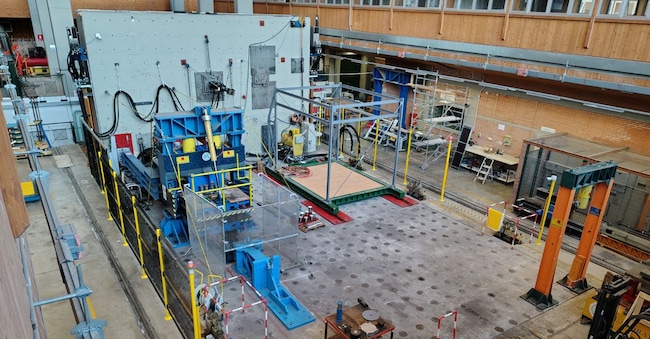
Not only monitoring but also support for urban planning and seismic improvement-adjustment policies at the Lucania university's Materials and Structures Testing Laboratory, which has been playing an increasingly significant role on the international scene since its establishment in 1990. A founding member of the Network of University Laboratories for Seismic Engineering (ReLuis), it acts as the Competence Centre for the Department of Civil Protection of the Prime Minister's Office, is one of the few Italian and European references for the qualification and acceptance of anti-seismic devices with equipment that is constantly being improved, and is involved in the drafting of the new seismic standards.

