
Earthquake-resistant work for two flagship pavilions of the San Martino hospital
Isaac completed the adaptation works on Monoblocco and Specialities, avoiding the interruption of clinical activities
Key points
A technical intervention by Isaac, an Italian company specialising in providing solutions for the structural safety of complex infrastructures, has just made the two most critical pavilions of the San Martino hospital in Genoa seismically safe in terms of continuity of care. The operation, worth about EUR 5 million, was carried out without interrupting operations and without closing the two buildings; it is also part of the programme of seismic improvement and retrofitting of strategic healthcare facilities envisaged by the NRRP.
The San Martino polyclinic, one of Italy's leading hospital centres, covers about 40 hectares, comprises more than 50 buildings and has 1,200 beds. It is a healthcare infrastructure of strategic importance, not only for Liguria but for the entire north-west of Italy: it welcomes thousands of patients, healthcare workers and visitors every day. Isaac's intervention involved the Monoblocco and the Speciality Pavilion, buildings considered essential for the continuity of surgical, diagnostic and emergency activities, with a particularly relevant role in neurosurgery and stroke.
Essential Structures for Continuity of Care
The decision, therefore, to focus an intervention on these two buildings, in particular, responds to the need to ensure the maximum seismic safety of facilities considered essential for the continuity of care, all the more so if an earthquake were to strike Liguria. The Monoblocco is, in fact, the heart of the surgical activities and a significant part of the diagnostics of the Genoese hospital; while the Speciality Pavilion houses highly critical wards and clinical pathways - such as the aforementioned neurosurgery and stroke - constituting a unique reference point for the entire region.
Isaac has been operating in Liguria for some time and has been responsible, among other things, for ensuring the seismic stability of the new pilot tower at the port of Genoa, designed by Renzo Piano. The company uses a patented technology, the Amd (Active mass damper) system, designed to improve the safety of buildings during earthquakes. The solution, the company's engineers explain, combines accelerometer sensors, advanced control algorithms and electronically controlled moving masses, capable of generating forces that oppose those induced by the earthquake in real time.
Evacuation of premises during work
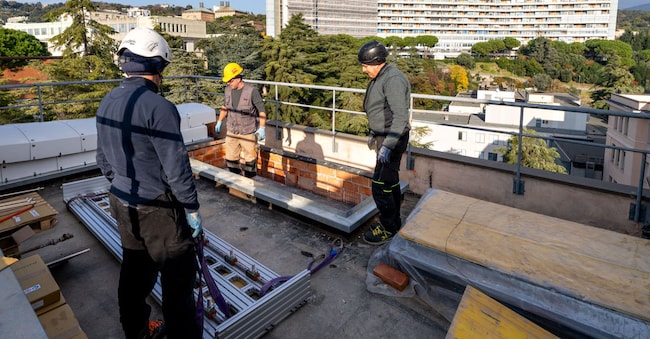
On the Monoblocco (a reinforced concrete frame building constructed in 1979, with 15 floors and a surface area of approximately 855 square metres per floor), the intervention included the installation of 50 Isaac devices (31 placed on the roofing slab and 19 on the balcony of the penultimate floor). To complete the intervention, local reinforcements were carried out, in partnership with other specialised operators: the reinforcement of six beams on the façade, the beams of the balcony on the penultimate floor and the joists of the roofing slab.


