
Earthquakes, Das installed to study the earth with fibre optics
Ingv, Federico II and the Lucanian company Metis collaborate on the innovative project financed by the Pnrr and located in Tito in the Irpinia crater
by Vera Viola
3' min read
Key points
3' min read
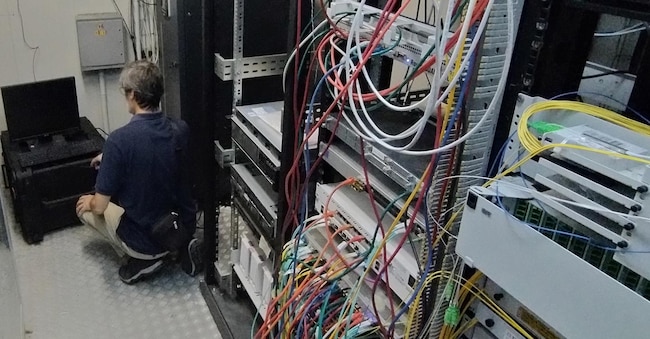
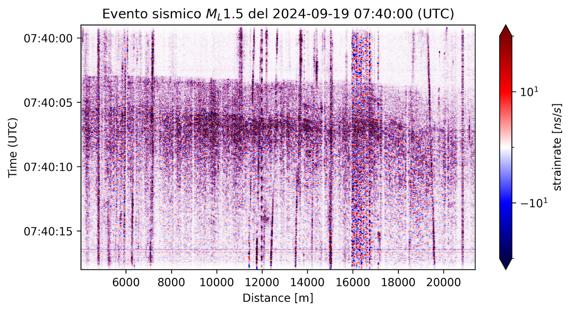
Experimenting with the use of optical fibre used for telecommunications as an innovative seismic sensor. This is the goal of the INGV and the Federico II University of Naples, which recently completed the installation of an acoustic sensing device (Das) in Tito Scalo, in the province of Potenza, where the telecommunications company Metis has made available to researchers a stretch of fibre optic cable about 20 km long.
We are talking about the Irpinia crater area, the one that was devastated by the 1980 earthquake. Scientific research has turned that area between central Campania and central-northern Basilicata into a magnifying glass to better understand the genesis of large earthquakes.
Earthquake Observatory
Das will be used by the Irpinia Near Fault Observatory (Nfo), which is the result of a collaboration between INGV and the University of Naples Federico II and is based in Naples at the same university. The observatory, set up as part of the European Plate Observing System (EPOS) and recently implenetrated and financed (1.9 million) by the PNRR Monitoring Earth's Evolution and Tectonics (MEET), aims to carry out state-of-the-art monitoring of the underlying fault system in this area, among those with the highest seismic hazard in Italy.
Objective: Create a constellation of monitoring stations
.There are two main actions: on the one hand, the transformation of individual seismic stations into constellations of stations, i.e. series of close sensors, capable of picking up local microseismicity even at extremely low magnitudes, and on the other hand, experimentation with the potential of normal telecommunication fibre optics to act as a seismic sensor.
Great potential of fibre optics
."The measurements come from a laser source that sends light pulses inside the fibre _ explains Gilberto Saccorotti, INGV researcher _ Every slightest deformation of the fibre modifies the optical path length of the pulses, and measuring this variation makes it possible to determine the deformation of the ground due, for example, to the passage of a seismic wave. The device is capable of making these observations hundreds of times per second, with a measurement point spacing of the order of a metre, distributed along fibres up to tens of kilometres long. This is an enormous amount of data compared to current seismometric networks, which is potentially capable of photographing the ground deformation associated with the seismic phenomenon in a much more detailed and continuous manner'.


