
Eating is an art form to be showcased
At the Chiostro del Bramante, the exhibition ‘FOOD: Five Centuries of Taste, Desire and Imagination’

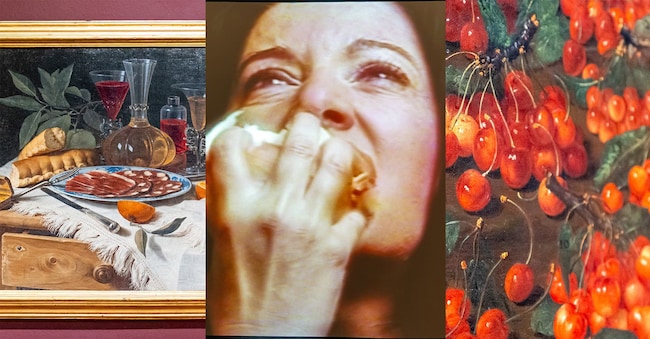
Eating is the most everyday of acts and, at the same time, one of the most meaningful aspects of our existence. To eat is to live, but also to remember, to seduce and to belong. Around a table, bonds are forged, traditions are passed down, rituals are celebrated, and food has always provided art with an inexhaustible source of inspiration – encompassing colours, shapes, abundance, transience and pleasure. One need only step into the Chiostro del Bramante in Rome to find oneself immediately immersed in this ambivalence. The first image to greet the visitor is The Onion by Marina Abramović: the Serbian artist eats an onion, slowly, whilst continuing to utter phrases that convey the bitter taste of the act and of life itself. The body becomes a stage, the chewing a physical ordeal and the onion an object almost unbearable in its elemental concreteness. Art begins in the mouth. This is where *Food* begins. Taste in Art, the exhibition curated by Suzanne Landau, features 190 works by over sixty artists, spanning from the sixteenth century to the present day.
The Cloister
An exhibition which, to mark the Chiostro’s thirtieth anniversary, brings together painting, photography, video, sculpture and installations, using food as a lens through which to observe society and its transformations. The contemporary bursts onto the scene with David LaChapelle’s photographs, where the saturated, glossy and over-the-top aesthetics of consumerism take on almost visionary contours. In Death by Hamburger, Beverly Hills and Leonardo DiCaprio: Unspoiled, food enters the spectacular world of celebrity, desire and excess. That photograph, in which the star is very young, dates back to the time of his fine film Happy Birthday Mr Grape, whose original title is What’s Eating Gilbert Grape – making it the perfect choice for this exhibition. Moving through the galleries, the table is transformed into a stage, the product into a promise, and abundance into a form of unease. With Sweet Memories, Simone Post transforms the space into a surprising domestic universe, built around the imagery of sweets and marshmallows: furniture and rooms evoke a home, from the dining room to the spaces dedicated to everyday life, right through to the children’s bedroom and the bathroom; and childhood, with its array of colours and treats, meets design and imagination. Visitors enter a world that seems to have stepped out of a fairy tale, suspended between sensory appeal and artifice. The second major installation, Pasta Shell Grotto by Bompas & Parr, takes pasta into the realm of fantastical architecture. Food becomes environment, surface and experience, and ceases to be merely something to look at, once again engaging the body through space and the senses. The exhibition takes a different turn in front of the still lifes by Bartolomeo Bimbi, Christian Berentz and Cristoforo Munari. Fruit, vegetables and food arrangements reflect the precision of a world in which every element is observed, classified and arranged according to a visual order. The richness of nature is transformed into painting, yet it already contains a reflection on time, and what appears perfect is destined to change. It is precisely on this boundary that the contemporary works are situated.
In Still Life, Sam Taylor-Johnson uses video to depict the decomposition of fruit, accelerating a process that the everyday gaze tends to overlook. Ori Gersht, with Pomegranate, draws on the tradition of still life to shatter its apparent serenity, Mat Collishaw, in the series Last Meal on Death Row, reconstructs the last meals of those sentenced to death through the compositional refinement of Flemish painting. Food is also about relationships, identity and memory. In the Kitchen Table Series, Carrie Mae Weems transforms the kitchen into a domestic theatre, where – thanks to her splendid black-and-white photographs – scenes of intimacy and everyday life unfold. Martha Rosler, in Semiotics of the Kitchen, uses the language of cookery television to question the roles traditionally assigned to women.
Sophie Calle, Le régime chromatique
Sophie Calle, in Le régime chromatique, weaves together food, colours and personal rituals, whilst Claire Fontaine, with Is it cake?, reworks Duchamp’s urinal, transforming it into a sculpture that looks like a cake. The exhibition – which runs until 29 March next year – ultimately extends to environmental issues and the contradictions of consumerism. In Flooded McDonald’s, the Superflex collective imagines a fast-food restaurant gradually being flooded, whilst Yinka Shonibare, with Food Man, links food production to colonial legacies and climate change. What unites such diverse artistic languages is the idea underpinning the Chiostro del Bramante project: the exhibition as a place of knowledge and participation. Alongside the artworks, an educational programme involves schools and families, whilst the audio guide Il gusto di Roma, conceived by Giovanni De Stefano, entrusts the interpretation of eight works to people who experience the city’s gastronomic culture on a daily basis. At the end of the exhibition, food appears for what it has always been: a material and symbolic substance, capable of uniting pleasure with memory, beauty with transience, and individual intimacy with collective history. You enter to view works of art and leave with a new awareness of what we put into our mouths every day and, without realising it, into our lives.
“FOOD: Taste in Art”, Rome, Chiostro del Bramante, until 29 March 2027

