The changeover in Frankfurt

The ECB steps up the pace on the post-Lagarde leadership succession

In the race for the presidency of the European Central Bank, the popular Pablo Hernández de Cos (regarded as a dove) is ahead of the Dutchman Klaas Knot (a moderate hawk)

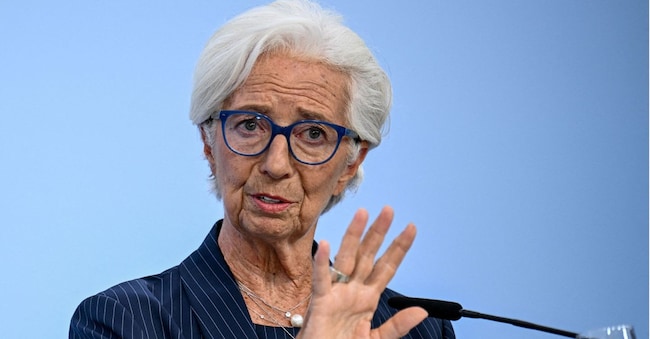
FOTO D'ARCHIVIO: La presidente della Banca centrale europea Christine Lagarde interviene durante una conferenza stampa al termine di una riunione del Consiglio direttivo della Bce presso la residenza degli ospiti della Deutsche Bundesbank a Berlino, in Germania, il 10 settembre 2026. REUTERS/Annegret Hilse/Foto d'archivio REUTERS

4' min read

Translated by AI
Versione italiana

4' min read

Translated by AI
Versione italiana

A major acceleration is on the cards for the major reshuffle of the ECB Executive Board, which – by replacing three or four of the six Board members in the space of a few months – could become the swiftest in the history of the European Central Bank.

At least that is what the financial markets are hoping for, which have been worn down by months of rumours about President Christine Lagarde’s departure, and it is also the aim of European politicians who would like to wrap things up by the end of the year, well ahead of 18 April 2027, the deadline set by the presidential elections in France.

Loading...

The list of potential candidates is extensive. But this race against time is also an obstacle course, due to the clash between hawks and doves, between large and small countries, between countries that have never nominated a president and those that have already done so once or twice, and between the majority of men and the meagre minority of women on the Executive Board.

The Times

In an exclusive report on 15 October, Reuters broke the news that the World Economic Forum’s Board, at its meeting on 2 November, could decide to appoint Lagarde as chair of the WEF. Realistically, the appointment is expected to take effect from 18 January 2027, at the annual meeting in Davos: it is unlikely to be immediate, leaving the ECB without leadership. Lagarde could announce her early departure on 29 October at the press conference in Frankfurt on the Governing Council’s monetary policy decisions; or she may do so at the press conference on 17 December, which could be her last. It is, in fact, up to Lagarde to officially set in motion the complex legislative process for the appointment of the new President, by means of an official communication addressed to the President of the European Council. The ECB’s line is that “we are kept in the dark”. However, it is out of the question that the ECB should find itself without a President – even for a single day.

The merry-go-round of names

Boris Vujčić of Croatia, who has held the post of Vice-President since June 2026, and Piero Cipollone of Italia, a member of the Board since November 2023, will remain in their posts. France and Germany will ensure that they have a hawkish President flanked by a dovish Chief Economist, or vice versa.

The two leading candidates to succeed Lagarde are the Dutch moderate hawk Klaas Knot (the Netherlands has already had Wim Duisenberg, but for five years, not eight) and the popular Pablo Hernández de Cos , “everyone’s friend” and a dove (Spain has never had a President). Last-minute surprises cannot be ruled out, as was the case with Lagarde. The name of a Greek central bank governor has briefly been mentioned as a candidate for the ECB presidency.

The former French governor François Villeroy de Galhau and the current president of the Bundesbank, Joachim Nagel – both pro-European, highly respected and extremely competent – are hoping to join the Board, but it is said they cannot aspire to the chairmanship. And they are men.

The simultaneous departure of the only two women on the Governing Council, Lagarde and Schnabel, has drawn attention to female candidates: for France, big names are being mentioned such as Agnès Bénassy-Quéré, Deputy Governor of the Banque de France, Laurence Boone, former chief economist at the OECD, and Hélène Rey, a world-renowned economist who has been in charge of monetary policy at the BIS since 1 September.

Berlin could put forward the Bundesbank’s deputy governor, Sabine Mauderer, the macroeconomist Monika Piazzesi, or Elga Bartsch, Director-General for Economic Policy at the Ministry of Economy. Germany, however, holds a rather unusual record: its Board members tend to resign before the end of their term of office.

This was the case for Jürgen Stark, Jörg Asmussen, Sabine Lautenschläger and now Schnabel, though not Otmar Issing. Meanwhile, Jens Weidmann, Draghi’s main opponent, tendered his early resignation as President of the Bundesbank.

The countries involved in the reshuffle

The Italian government appears to be staying out of the big picture, at least for now, having already secured the appointment of Carlo Comporti to ESMA, a post he will take up on 1 November 2026. Governor Fabio Panetta, a former member of the ECB’s Executive Board, does not appear to be a candidate put forward by the Meloni government.

Loading...

Germany, which already has Ursula von der Leyen as President of the Commission and Claudia Buch at the helm of the ECB/SSM, is aiming for the post of the ECB’s new Chief Economist (the Irishman Philip Lane’s term expires at the end of May 2027), the member of the Executive Board responsible for markets (Isabel Schnabel is due to step down in January 2027) or the Vice-Chair of the Supervisory Board should Frank Elderson leave early following Knot’s arrival, as happened with Lorenzo Bini Smaghi when Mario Draghi took office: there has never been a German ECB President to date, but it is said that the time is not yet right on this occasion either. And Nagel is too pro-European and not hawkish enough for a government grappling with the rise of the AfD.

France has already had two presidents, Jean-Claude Trichet and Lagarde, but is now demanding a dovish French chief economist – a post wielding considerable influence within the Governing Council, particularly when the ECB presidency is weak, as in Lagarde’s case; but this would not be the case with Knot, who knows his stuff: rumour has it that the Dutch ‘hawk’ is being backed by Paris in a bid to secure the post of chief economist for France.

Spain stands a good chance with de Cos, who is reportedly being backed by Berlin in exchange for the post of chief economist. A Spaniard and a Croatian at the helm? It wouldn’t be the first time the ECB’s president and vice-president have come from outside the ‘Big Four’.

Hawks and Doves

The ECB’s Governing Council comprises 27 members: 21 governors of the Eurosystem central banks and six members of the Executive Board. Over the past four years, more than half of the governors have changed, and the ‘hawkometer’ now indicates a neutral Governing Council. But with the arrival of three or even four new members on the Executive Board, the ECB’s composition is changing once again. The departure of Knot and Schnabel, regarded as leading ‘hawks’, is offset by the departure of prominent ‘doves’ such as Lane and De Guindos (the former Spanish vice-president). There are no ‘owls’ – such as Lagarde, who used to tout the Governing Council’s unanimous decisions – to be found.

Copyright reserved ©
  • Isabella Bufacchi

    Isabella Bufacchivicecaporedattore corrispondente dalla Germania

    Luogo: Francoforte, Germania

    Lingue parlate: inglese, francese, tedesco, spagnolo

    Argomenti: mercato dei capitali, ECB watcher, fixed income e debito, strumenti derivati, Germania

    Premi: Premio Ischia Internazionale di Giornalismo per l’analisi economica, Premio Q8 per giovani giornalisti economici

Loading...

Brand connect

Loading...

Newsletter

Notizie e approfondimenti sugli avvenimenti politici, economici e finanziari.

Iscriviti