
ECB: leaves borrowing costs unchanged, not excluding future hikes
European Central Bank Governing Council's indications on EMU monetary policy prepare for possible tightening

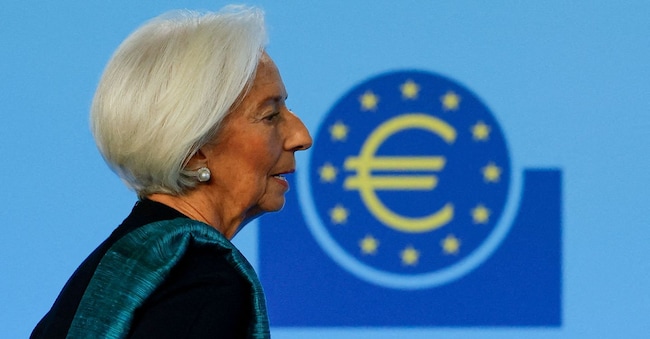
Rates unchanged at the ECB, which continues to closely monitor price developments. The Governing Council of the European Central Bank (ECB) decided to keep interest rates on deposits with the central bank at 2%, those on main refinancing operations at 2.15% and those on marginal refinancing operations at 2.40%. The decision was unanimous, although the possibility of a rate hike was widely discussed: a possibility that cannot therefore be ruled out at the next meetings. 'It is clear in which direction monetary policy is going,' President Christine Lagarde said at a press conference, while acknowledging that there could be 'huge changes' in the near future.
Increased risks
The communiqué issued at the end of the council meeting emphasised that "upside risks to inflation and downside risks to growth have intensified", although "the new information is broadly in line with the assessments of the recent past as far as price developments are concerned". "The conflict in the Middle East," the central bank explained, "has caused a sharp rise in energy prices, pushing up inflation and weighing on confidence. The implications of the war for medium-term inflation and economic activity will depend on the intensity and duration of the energy price shock as well as the magnitude of its indirect and second-round effects,' which could turn what is for the time being a simple change in relative prices - with not insignificant implications for growth - into full-blown inflation and would then require monetary policy intervention. The ECB has so far seen, Lagarde explained, some indirect effects, but no second-round effects, and this circumstance, coupled with the need to obtain more data, advised against raising rates on this occasion and to assess in June with the new projections whether and when to intervene. The ECB has already contemplated two rate hikes in its March projections, and financial conditions in the eurozone,' she added, 'have already tightened.
The latest data
April's inflation, according to Eurostat figures released a few hours before the press conference, showed an acceleration in prices to 3%, from 2.6% in March and 1.9% in February, all linked to increases in energy: prices of manufacturing goods rose by 0.8% (from 0.5% in March and 0.7% in February), while those of services slowed to 3%, from 3.2% in the previous two months. "The longer the war continues and the longer energy prices remain high, the greater the likely impact on broader measures of inflation and the economy," the central bank continued.
Braking growth
Growth, however, was also negatively affected by the war, Lagarde explained: 'Surveys indicate a slowdown in growth, while consumers and businesses have become less confident about the future since the war began. Longer delivery times and rising input prices suggest that supply chains are coming under pressure. Looking ahead, high energy costs are expected to continue to weigh on real incomes, making households and firms more reluctant to consume and invest'. The economy, Lagarde added, is moving away from the baseline scenario set out in the March projections. Uncertainty is also increasing and the forecasts will be widely revised in June.
No fear of stagnation
Growth risks are thus tilted to the downside. "The war in the Middle East," Lagarde explained, "remains a downside risk for the euro area economy, exacerbating an already volatile global economic policy environment. A prolonged disruption of energy supplies could push up energy prices further and keep them high for longer than currently expected. These factors would erode incomes and make businesses and households more reluctant to invest and spend. The drag on growth would intensify if the closure of important shipping lanes causes severe shortages of key inputs, forcing euro-area firms to reduce production'. However, the ECB, in Lagarde's words, does not seem to fear a possible stagnation of the economy, but only anticipates a slowdown in activity.


