
The green transition: Europe faces a moment of truth
The first Business Talk organised by the Green Routes think tank takes place in Rome: a discussion on how to turn the transition into an opportunity for growth and prevent it from becoming a hindrance to business competitiveness

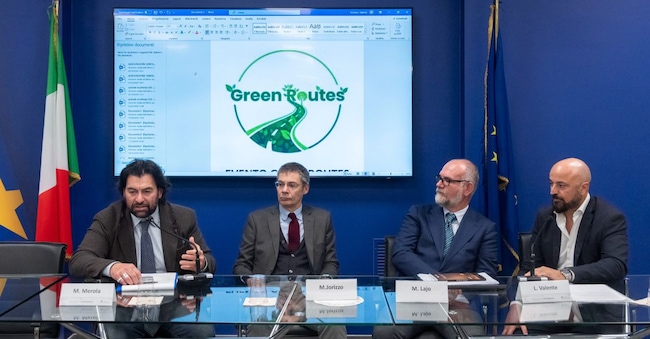
According to the latest report published in 2026 by Copernicus and the World Meteorological Organisation, Europe is the continent that is warming the fastest: over the last thirty years, the temperature has risen by an average of 0.56 degrees per decade. It was precisely with the realisation that swift action is needed to limit the damage caused by climate change that the Business Talk ‘Climate, Energy: Europe at the Crossroads. Scenarios for a Competitive Transition’, the first event organised by Green Routes, a think tank founded by journalist and science communicator Marco Merola and urban mobility expert and sustainability adviser Lorenzo Valente. The conference took place on 17 November in Rome, at the Europe Experience – David Sassoli venue.
A delicate balance
To inform, raise awareness and inspire. These are the objectives set by Green Routes’ Business Talk. The discussion was, in fact, inspired by the desire to tackle one of the most complex challenges of our time: striking a delicate balance between the need to meet decarbonisation targets, the need to ensure accessible and secure energy supplies, and the need to safeguard business competitiveness, whilst ensuring that Europe maintains a leading role on the international economic stage.
The discussion was based on the premise that the integration of sustainability into the business models of European companies – which has now become a strategic priority – can no longer be postponed. “The future of European competitiveness,” explained MEP and Vice-Chair of the S&D Group Camilla Laureti, a guest at the event, “is linked to the green transition. It is important that the value of this transition, and its absolute necessity driven by climate change and geopolitical tensions, is understood, including by the general public.”
Opportunities for growth
The need to strike a balance between reducing emissions and safeguarding European manufacturing was also highlighted by Massimiliano Salini, a Member of the European Parliament and a member of the Committee on the Environment, Public Health and Food Safety: ‘The energy transition must not turn into a showdown for businesses and workers, but must become an opportunity for growth.’
According to Salini, it is in fact possible to ‘seriously pursue climate targets without sacrificing industry, employment, innovation and citizens’ freedom of choice. We are working towards a Europe capable of guaranteeing secure energy at sustainable costs, because without energy competitiveness there is no future for our industry. Supporting businesses means reducing burdens, encouraging investment and guiding the transition with pragmatism and technological neutrality’.

