Economic growth supports the art market in Warsaw
The Art Warsaw fair brings more than 50 galleries to a historic building. Demand is shifting from Polish to international art

Key points
The strength of the Polish economy, with a GDP growth of 3.6 per cent in 2025, drives the art market and increases both the number of collectors and contemporary events. In addition to the Warsaw Gallery Weekend, which has already been held for 15 years and is a kind of festival involving various locations in the city, Warsaw now has two fairs. One is Art Warsaw, running from 21 to 24 May, organised by Joanna Witek-Lipka, who is also the director of Gallery Weekend, and Michał Kaczyński, who is the co-founder of the Raster gallery, and the other is Hotel Warszawa Art Fair, which is held in September in a luxury hotel and organised by four other galleries.
The development of collecting
"In the first two editions we collaborated with Nada, the New Art Dealers Alliance, which also organises fairs in New York and Miami," explained Joanna Witek-Lipka, "but this year we launched our own brand, Art Warsaw. The two Warsaw fairs came into being more or less at the same time to meet the needs of collectors, who are increasingly oriented towards an international proposition. In fact, the art market was born 25-30 years ago. Initially it was very local, so Gallery Weekend, with Polish galleries, was the only event. Then came Friend of a Friend, a kind of Condo, where galleries hosted international colleagues. And then came the fairs, because in the last ten years collectors, having acquired a sufficient number of Polish artists, have been looking for international artists'.
The centre of the Eastern European market
Of course, the Polish artist, or one of Polish origin, remains the pass, as was the case with Ada in Rome, at her first fair in the country (besides her, the other Italian present is East Contemporary in Milan). "I started working with Alicja Pakosz in 2024," said Carla Chiarchiaro of Ada, "after discovering her in a group show, then, through her, I discovered the Polish scene". During the opening of the fair, the gallery noticed a large and interested audience, including young people, and recorded sales. "In June I will show another Polish artist in the gallery, Cyryl Polaczek". At Art Warsaw, alongside Alicja Pakosz's enigmatic paintings (EUR 2-7 thousand), Ada brought the subtle sculptures of the SpanishBlanca Gracia (EUR 2-4 thousand), both of whom share the drawing as the basis of their works.
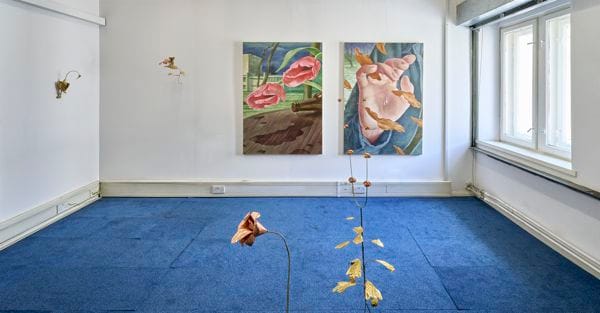
The confirmation comes from Coulisse Gallery in Stockholm, which noted that the market is ripe for international offerings, but wanted to create a hook with the PolishKatarzyna Przezwańska, who already represented Poland at the Architecture Biennale last year and will be at the Museum of Modern Art in Warsaw in September (5.500 euros), and also present the Polish-born EnglishmanTom Trojanowski (11,000 euros), the young Polish painter Bartosz Kowal (5,000-6,500 euros) and the photographs ofAlina Chaiderov, a Russian based in Stockholm (2,800 euros). The fair aspires to be a reference point, above all, for the Central and Eastern European area. 'Vienna also aspired to be one,' explained Joanna, 'but it did not succeed, because it basically belongs to Western Europe. Warsaw, on the other hand, has the right cards to become the market centre of the area'.
The charm of history
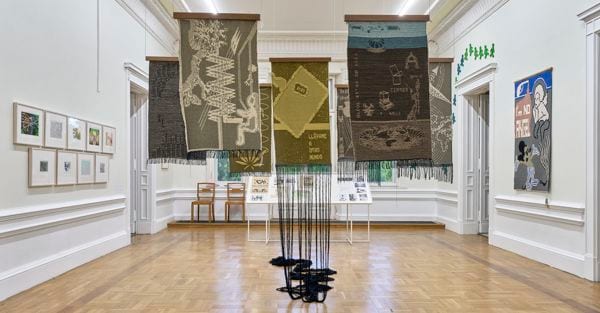
There are 56 participating galleries, which pay a very low fee compared to international fairs, between one thousand and four thousand euros. The venue is the Villa Róż, a fascinating 19th-century palace, formerly home to the British Embassy, whose interior has been modified and reconstructed, and in its labyrinthine corridors and the rooms occupied by the galleries shows all the stratification of Polish history (including curiosities such as the document incinerator, the safes for weapons and cash, and the emergency buttons). The environment also contributes to emphasising the aspect of research and discovery that characterises the exhibition; it may not stay there forever, as it will have to be renovated sooner or later, but it may be there for at least next year.